

Introduction to the EWB Guidelines for Water Resources Assessment and Development PowerPoint PPT Presentation
1 / 21
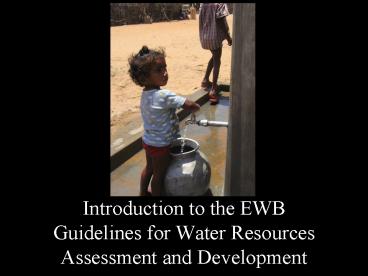
Title: Introduction to the EWB Guidelines for Water Resources Assessment and Development
1
Introduction to the EWB Guidelines for Water
Resources Assessment and Development
2
Read the guidelines
www.ewb-usa.org Go to resources gt guidelines
- Design Tools
- Reference Materials
- Assessment Implementation Tips
3
Why do we have guidelines?
- improved water supplies must meet consumer and
community demand. Community water systems, even
very well-engineered systems, must not be imposed
by an outside team.
--Water Resources Guidelines
4
Why do we have guidelines?
- Blindly applying technology to the communities
we encounter can hurt the people we are trying to
help.
--Me
5
Why do we have guidelines?
- It would be very depressing to see your
beautiful project covered in dust and thrown into
a tree in 6 months.
--Me
6
- The major considerations for water projects can
be broken down into three major components
- Quantity
- Quality
- Access
7
- The major considerations for water projects can
be broken down into four major components
- Quantity
- Quality
- Access
- Usage/Destination
8
Framework for Community Water Supply Development
- Request for improved services
- Conduct a preliminary assessment with
participation by the community - Analyze the data
- Develop several designs if requested by the
community that will meet the needs - Hold discussion with the community to review and
allow them to select the design - Obtain a formal written agreement
9
Demand
- Stimulating water demand
- Demand for a safer water supply may need to be
stimulated before users can value it above a more
risky water supply. - Community perception of safe water demand may be
poorly informed or biased by poor performance of
a past or nearby water systems - Meeting Demand
- Water service level and price
- Gender of water users
- Relationship of water use to economic production
requiring water (dual supplies)
10
Achieving a Sustainable System
- Functions properly over a long period of time
- Delivers the required quantity and quality with
easy access that is reliable and provides health
and economic benefits to users - Community manages the system and is sensitive to
gender issues - Operation, maintenance, replacement, and
administrative costs are covered at the local
level through user fees or other continuous
financial means - System design organically propagates to other
communities
11
Water Assessment- Quantity
- Selecting a source
- Meeting the demand
- Seasonal variations
- Where is the community going?
- Who controls the water?
12
How much water?
- Demand is a key technical design factor
- Minimum allowance of water 7 liters per day
(short term) - 15-20 liters per day for the general population
- Demand can vary by distance to water source
- Defining water demand by the population to be
served - How people using the water value the improved
water service? - Community users making key decisions.
- Provide for services to vulnerable groups or
individuals
13
Consider the source
Disadvantages
Advantages
- Surface Water
- Easy to access
- Always requires treatment
- Never where you need it
- Inconsistent
Groundwater
- Not always available
- Sometimes requires treatment
- Can be very difficult to access
- Can inspire poor resource management
- If available, generally most stable supply
- Often the cleanest option
- Can be located at point of use
Rain Water
- Requires rain
- Requires a clean surface
- Requires storage
- Sometimes requires treatment
- Uses something that would otherwise go unused
- Can provide a clean supply
- Can be located at point of use
- Free water pressure
14
Water Assessment- Quality
- Required for all water projects
- Testing
- Kits
- What parameters to test?
- How many samples?
- Monitoring
- Follow up surveys
- Measure project effectiveness
15
Water Assessment- Access
- Delivery
- Distribution
- Usage
- Completing the loop
- Conflicts of interest
16
Water Distribution
- Pipe Materials
- Valves
- Storage
- Design Parameters Considerations
- Distribution options
- Hydraulic Design
- Pipeline Installation
17
Consider the destination
- Drinking
- Cooking
- Bathing
- Clothes washing
- Livestock
- Crop Watering
18
Water Treatment
- Point of Use vs. Community Scale
- What is appropriate technology?
- Novelty vs. sustainability
- Cost per gallon
- Design Considerations
- Potential Pitfalls
- Avoid the magic box
19
Water Treatment Technologies
- Filtration
- Chlorination
- UV
- Ozone
- Distillation
- Reverse Osmosis
20
Access to safe water is a fundamental human need
and, therefore, a basic human right. Contaminated
water jeopardizes both the physical and social
health of all people. It is an affront to human
dignity. Yet even today, clean water is a luxury
that remains out of the reach of many. Worldwide,
more than a billion people have no access to
improved water sources, while nearly two and a
half billion live without basic sanitation. These
people rank among the poorest in the world -- as
well as the least healthy. In fact, the absence
of a safe water supply contributes to an
estimated 80 per cent of disease and death in the
developing world.
-- UN Secretary-General Kofi Annan
21
Thank you
Recommended

