

Importance of Geophysical Logs and Their Interpretation in Groundwater Assessments PowerPoint PPT Presentation
1 / 35
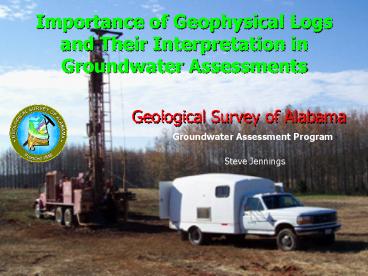
Title: Importance of Geophysical Logs and Their Interpretation in Groundwater Assessments
1
Importance of Geophysical Logs and Their
Interpretation in Groundwater Assessments
- Geological Survey of Alabama
Groundwater Assessment Program
Steve Jennings
2
Importance of Geophysical Logs and Their
Interpretation in Groundwater Assessments
- Principles
- Examples
3
Why log?
- Continuous record of borehole
- Measurements of geological formation
characteristics - Important tool in hydrogeological studies, e.g.
net sand mapping - Information regarding formation fluids
- Detection tool
- Information regarding borehole conditions
- General repeatability
- Support / check other data and methods
- Correlation
- Cost effectiveness
4
Limitations
- Indirect measurements of what you really want to
measure - Non-uniqueness of measured parameter
- Empirical (local knowledge / experience)
- Not a replacement for hard data
- Effects of extraneous factors
- Equipment / operator limitations or errors
- , time, and trouble
5
Effectiveness is increased when coupled with
additional data and other disciplines
- Driller and drilling characteristics
- Engineering, e.g. casing size
- Well cuttings / cores
- With geophysical logs more is usually better
- Other data, e.g. geology (stratigraphy and
structure), geothermal gradients, logs from
nearby wells, water quality data, seismic,
petrophysics
6
Primary Logs - typical Gulf Coastal Plain
open-hole logging suite
- Natural Gamma (gamma ray) (GR) (counts)
- Resistivity (Short and Long Normals 16 and
64) (ohm-m2/m ohm-m) - Single Point Resistance (SPR) (ohm)
- Spontaneous Potential (SP) (mV)
7
Primary Logs Valley and Ridge, Piedmont,
Appalachian Plateau
- Natural Gamma (GR)
- Spontaneous Potential
- Resistivity
- Single Pt. Resistance
- Density (g/cc)
- Neutron (counts)
Radiation Source
8
Other Useful Logs
- Temperature
- Caliper (borehole size)
- Casing Collar Locator (CCL)
- Acoustic (sonic)
- Micro-resistivity
- Fluid conductivity
- Flowmeter
- Downhole camera
9
Borehole Environment
- Temperature
- Open-hole or cased (type, size, thickness)
- Borehole size and rugosity
- Borehole fluid and properties e.g., air,
water/mud, mud additives, water loss of drilling
mud (invasion of mud filtrate into formations),
resistivity of mud (Rm) and mud filtrate (Rmf) - Time since drilling mud circulation stopped
10
Borehole invasion profile for mud rotary drilled
wells
- Depth of invasion dependent on drilling mud
characteristics, mud weight, rate of penetration,
lithology, formation permeability, etc. - Mud properties can greatly affect geophysical log
response - Rarely are these parameters reported in water
well drilling
11
Midland City PWS well 3, Dale County, AL
0
600
300
GR
Screen
SP
Resistivity
SPR
Screen
Example of resistivity curves showing classic
invasion profile for fresh water sand / limestone
each successively deeper electrode spacing
recording higher resistivity value
R8
R16
Clayton Aquifer
R32
R64
Screen
12
Temperature affects resistivity formation
temperature is needed to correct resistivity to
standard temperature (77 F)
SE Alabama - Data from OG exploration wells
(feet)
13
Resistivity versus salinity (NaCl equiv.) and
temperature
100,000
Temperature (F)
10,000
200
150
50
100
1,000
500
Salinity
100
.1
1
10
100
Resistivity
14
Rwe, derived from traditional geophysical log
methods such as Spontaneous Potential log, may
differ significantly from Rw in fresh waters
where salts other than NaCl are significant
components of TDS.
Rw
Rwe
Alger (1966) and Schlumberger (1974)
15
Resistivity of the formation water is inversely
related to Total Dissolved Solids
Empirical Relationships
16
Empirical Relationships
- R F R
- R resistivity of water-saturated geologic
formation - log reading)
- R resistivity of formation water
- F Formation Factor
- F a (G.E. Archie,1942)
- Ø
- (Ø porosity, aempirical constant related to
lithologic and pore factors, m cementation
exponent) - If F 1 , then R R
- Ø ² Ø 2
o
w
o
w
m
w
o
17
Resistivities of Earth Materials(Ohm-m _at_ STP)
- Petroleum 109 to 1016
- Quartz (solid block, dry) 1012 to 1014
- Calcite (solid block, dry) 107 to 1012
- Sand (dry) 10 to 1,000
- Shale 10 to 20
- Ilmenite 10-3 to 1,000
- Pyrite - 10-2 to 10-4
- Magnetite 10-2 to 10-4
- Groundwater 10-2 to 102
18
Porosity vs. Resistivity
- R R Gulf Coastal Plain sands
- ز (Cretaceous-Tertiary)
o
w
(Compare _at_ STP)
19
South Alabama
Example 1
- Cretaceous and/or Tertiary age unconsolidated /
poorly consolidated sands and limestones are the
principal aquifers. - Mud rotary is the primary drilling method.
- Most large and/or deep water wells (PWS and
industry) are logged. - Questions can arise regarding log interpretation,
e.g. water quality in zones of interest.
20
Test Well in Butler County
Eutaw Formation
40 ohm-m
1,800
- TD 2970 in Lower Cretaceous.
- Principal aquifers of interest Eutaw and Gordo
Fms. - Drilling mud properties???
Gordo Formation
2,000
2,200
Test or not ?????
21
1.0
lower part of Gordo Formation (Tuscaloosa Group)
SAND GRAVEL
R
0.5 ohm-m _at_ 90 deg. (?)
o
0.6 ohm-m _at_ 77 deg.
22
EUTAW FORMATION
R
9.5 _at_ 86 deg.
o
10.5 _at_ 77 deg.
Top of Gordo Formation
23
Gordo
Eutaw
24
SN
0
50
Henry County Water Authority Well 5 TD 2,615,
Sec. 20 - T.8N R. 28E
GR
SP
ohm-m
LN
SPR
Eutaw Formation
Invasion profile of LN and SN resistivity curves
appears to show typical salty formation water
signature, i.e., LN lt SN
25
Eutaw Formation
SN
0
50
GR
SP
LN
SPR
Screened intervals
26
Gordo Formation (Tuscaloosa Group)
0
50
SN
LN
Screened intervals
27
Ozark, AL Well
2400
Gordo Fm.
179 ft. screened 26 LN lt SN
50 ohm-m
Eutaw Fm.
SN
2500
LN
GR
2200
2600
2300
2700
2400
28
Henry County PWS well Ozark PWS well Keystone 4,
Barbour Co.
Butler County Well
Gordo
Eutaw
29
There are many influences on electrical
conductivity pathways, e.g., mineralogy, grain
and pore geometry, bedding, secondary cements,
etc.
Thin section view
Clay coatings on sand grains attract and retain
water, resulting in higher electrical
conductivity and hence lower resistivity.
SEM views
( Welton, 1984, SEM Petrology Atlas, AAPG )
Examples from Tuscaloosa sands, Louisiana
30
North Alabama
Example 2
- Intervals in Paleozoic rocks are the principal
aquifers. - Air rotary is the common drilling method.
- Few wells are logged and/or logs that are run do
not provide data on porosity or ID permeable
zones. - Lack of data from logs, especially about porosity
and fluid conduits (fractures, bedding) can
hinder groundwater exploration.
31
Geology of the Hanceville Area, Cullman County,
Alabama
Appalachian Plateau
Structure contours Base of Pottsville FM.
Hanceville
Sequatchie Anticline
32
No. 1 Whaley
- Drilled in early 1900s (cable tool method) to
2,850. - Cased to 585 (?).
- Plugged and abandoned in 1922.
- Said to have flowed large quantity of fresh
water. - Scant information available regarding geology,
potential productive intervals, etc.. - SWL at 7 fresh water.
- Well blocked at 157.
33
A
A
No.1 Whaley
City Well
Vert. Exaggeration 461
34
No. 1 Whaley
GR
Neutron
Casing Collar Locator
Basal Pottsville Sandstone
- Logged 6/30/08
- Gamma Ray-Neutron log indicates 100 ft. of basal
Pottsville sandstone with porosity of about 12 - CCL and camera show base of casing at 581 feet
500
Pennington/Parkwood
600
Bangor Limestone
700
35
Summary and ConclusionsAbout Using Geophysical
Logs in Groundwater Assessments
- Very useful for hydrogeological data and water
quality estimations. - Commonly essential in ID and delineation of
productive intervals in test wells. - Data regarding borehole environment e.g.,
borehole fluids and properties, borehole
characteristics, temperature, etc. should be
collected and recorded to maximize the
effectiveness of use of well logs in evaluations. - Logs are generally very cost effective means of
evaluation.
Recommended

