

The Organization, Role and Operation of the Wildlife Services Program PowerPoint PPT Presentation
1 / 17
Title: The Organization, Role and Operation of the Wildlife Services Program
1
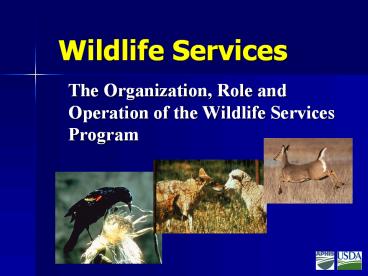
The Organization, Role and Operation of the
Wildlife Services Program
Wildlife Services
2
WS Overview
- This presentation is an overview of the
services and expertise that Wildlife Services
(WS) provides to mitigate human-wildlife
conflicts involving agriculture, airports, urban
areas, disease and more. WS is an extensive
program with many different aspects and
capabilities.
3
Wildlife Services Mission
- . . . is to provide federal leadership in
managing problems caused by wildlife.
4
Wildlife Services Vision
- . . . is to improve the coexistence of people
and wildlife.
5
Authorities
Act of March 2, 1931 . . . may conduct a program
of wildlife services with respect to injurious
animal species and take any action the Secretary
considers necessary
Rural Development, Agriculture, and Related
Appropriations Act to conduct activities and
enter into agreements . . . in the control of
nuisance mammals and birds and those mammal and
bird species that are reservoirs for diseases. . .
6
Wildlife Services
7
Workforce Composition
- WS wildlife managers have expertise in wildlife
biology, ecology, wildlife damage management,
wildlife diseases, chemistry, and other
specialties. - A cadre of professional program managers,
administrative, and office business specialists
complete the workforce composition.
8
WS Partners with Key Groups
- Federal Agencies
- State Wildlife Agencies
- State Agriculture Agencies
- Wildlife/Animal Health Organizations
- Universities and other Wildlife Facilities
- Association of Fish and Wildlife Agencies
9
Wildlife Services
Primary Modes of Operation
- Wildlife Damage Management Operations and
Technical Assistance - Research and Methods Development
The four major areas of operations work
are Agriculture, Natural Resources, Property
Protection and Human Health and Safety
10
WS Provides Technical Assistance
WS provides technical advice and consultation to
citizens and public entities, providing them safe
and effective options and methods for managing
wildlife conflict issues themselves.
11
WS Protects Resources through Direct Assistance
WS also provides on-site expertise to manage
complex wildlife problems that cannot be safely
or effectively resolved by others.
Christy Wyckoff
12
Protecting Agriculture
- Crop protection
- Crop damaging bird dispersal and habitat
manipulation - Deer and feral swine population management
- Livestock protection
- Wildlife disease surveillance
- Predator dissuasion and removal (wolves and
coyotes) - Aquaculture protection (disease and predatory
birds)
13
Protecting Natural Resources
- Protecting threatened and endangered species
- Brown tree snake trapping and removal
- Cowbird removal to protect endangered warbler
- Predation management to protect TE coastal
bird populations - Wildlife populations
- Disease monitoring and control
- Wildlife recovery from oil spills
- Invasive species management
- Manage competition with, and depredation of,
native species (i.e. mute swans competing with
native swans)
Al Nash
14
Protecting Property
- Parks and private property
- Preventing brown tree snake and monk parakeet
related electricity outages - Removal of Canada geese that contaminate parks
and bodies of water - Removing beaver related flooding
- Hazing vulture and seagull roosts
- Removal of feral swine that damage pasture
and watering holes - Aircraft
- Dispersing flocks to reduce bird-strike related
damage in private, commercial and military
aviation
15
Protecting Human Health Safety
- Disease activities
- Oral rabies vaccination program
- Avian influenza surveillance
- Dispersal of concentrated bird roosts in urban
areas - Airport safety
- Wildlife strike reduction program
- Predator management
- Relocation and management around public use areas
Al Nash
16
WS Increasing Role
- Traditionally WS work revolved around predators
and livestock protection - Expansion into disease research and management
- Expansion into emergency response and management
- Expansion into the international arena
17
Thank You
Recommended

