

Potential for Groundwater and Evapotranspiration Monitoring Using GRACE PowerPoint PPT Presentation
1 / 10
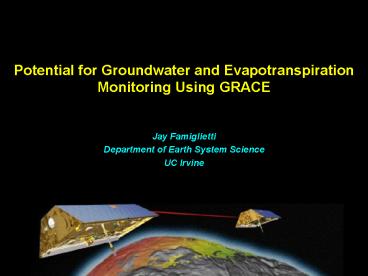
Title: Potential for Groundwater and Evapotranspiration Monitoring Using GRACE
1
Potential for Groundwater and Evapotranspiration
Monitoring Using GRACE
Jay Famiglietti Department of Earth System
Science UC Irvine
2
Terrestrial Water Storage Components
3
The High Plains Aquifer Soil moisture monitoring
stations Soil Climate Analysis Network (SCAN) of
the National Resource Conservation Service
(stars) Atmospheric Radiation Measurement Soil
Water and Temperature System (ARM-SWATS) of the
Department of Energy (crosses)
4
Potential for Estimating Changes in Groundwater
Levels Using GRACE Rodell and Famiglietti, 2002
- Rodell and Famiglietti (2002) explored potential
to detect groundwater aquifer level variations
using GRACE - Compared observations of declining levels of High
Plains Aquifer to predicted errors in
GRACE-derived estimates - Found that GW storage changes can be isolated
from GRACE observations with 8.7 mm uncertainty
(relative to annual average changes in GW storage
in the High Plains Aquifer of 19.8 mm) - Uncertainty dominated by errors in removing the
soil moisture mass signal (above the water
table), which is not well monitored in situ or
remotely - Strong potential for monitoring groundwater
levels in large aquifer systems. Potential will
improve with better surface soil moisture
monitoring (e.g. AMSR-E, SMOS, HYDROS) and
assimilation models (e.g. GLDAS)
5
Estimating Changes in Terrestrial Water Storage
from GRACE
Feasibility Studies Variations in Groundwater
Levels
Orange bars are the mean magnitudes of annual
changes in groundwater storage, based on
measurements compiled by the USGS from more than
6000 wells in the High Plains Aquifer (450,000
km2) of the central United States. Error bars
represent the total uncertainty in GRACE-derived
estimates, including uncertainty due to soil
moisture changes, the atmosphere, and the
instrument itself. Modified from Rodell and
Famiglietti (2002).
6
Feasibility Studies Estimating Basin-Scale
Evapotranspiration
- GRACE estimate of DS can be used to solve
basin-scale water balance as ET P -Q - DS - Famiglietti et al (2004) explored feasibility in
Mississippi basin using land surface model output
and realistic error estimates for all terms - Average monthy ET was 52 mm and average error was
7.4 mm for the period 1985-1993 - Relative error low in summer (7-12) and higher
in winter (20-100) - Uncertainty in precipitation dominated the errror
budget - Indicates strong potential for GRACE contribution
to basin-scale ET estimation
7
Other Potential Applications
- Snowload variations?
- Floodplain inundation?
- Contribution to sea level rise
- Disaggregation of DTWS using other sensors
8
Water Cycle Snow Cover Extent/SWE
Snow Load Variations?
Dynamic shape function using snow areal extent?
Snow
9
Contribution of Continental Water Storage
Changes to Sea Level Rise Using GRACE
Use GRACE for DML
DMO - DML D MA
10
Disaggregation of Terrestrial Water Storage
Components Using Other Sensors
Recommended

