

Monte Carlo Simulations of Soot Particle Formation Including AggregateAggregate Collisions PowerPoint PPT Presentation
1 / 1
Title: Monte Carlo Simulations of Soot Particle Formation Including AggregateAggregate Collisions
1
Monte Carlo Simulations of Soot Particle
Formation Including Aggregate-Aggregate Collisions
M. Balthasar1,2, M. Kraft1 and M.
Frenklach3 1Chemical Engineering, University of
Cambridge, UK, 2CFD and Combustion, VOLVO
Technology, Göteborg, Sweden 3Mechanical
Engineering, UC Berkeley, and Environmental
Energy Technologies Division, Lawrence Berkeley
National Laboratory, USA
A ballistic cluster-cluster aggregation model for
the formation and growth of soot particles in
flames is presented. The model is able to
simulate the full spatial structure of the
complex aggregate particles that are formed in
sooting flames. The influence of surface
reactions, nucleation and coagulation on the
shape of aggregates and primary particles is
investigated.
1. The Model
3.1 Application Test Case
- The model solves the population balance of soot
particles by simulating the Smoluchowski equation
with additional terms for nucleation and surface
reactions. - An efficient stochastic algorithm is used to
solve the population balance 1. - Frenklach and Wang model for gas phase reactions
2. - Kinetic soot model by Frenklach and Wang 3 to
obtain rates of nucleation and surface reactions. - A detailed model describing aggregate-aggregate
collisions 4 is used. - The formation of soot in premixed laminar flames
is studied. - Particles distributions as function of the shape
descriptor d 4 and particle diameter are
obtained, where - The shape of simulated particles is compared to
TEM images of soot. - The properties of the simulated fractal
aggregates are analysed.
a)
b)
c)
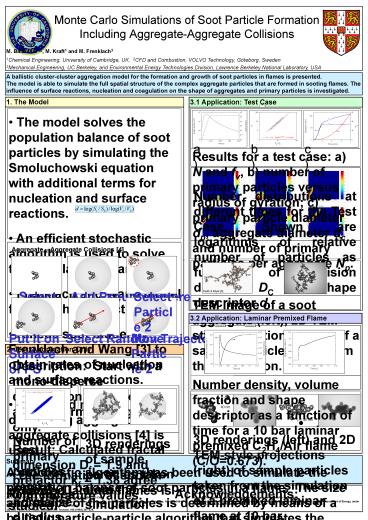
Results for a test case a) N and fv, b) number
of primary particles versus radius of gyration
c) primary particle diameter dp, aggregate
diameter dc and number of primary particles per
aggregate Np.
Number distributions at different times for the
Test Case. Shown are logarithms of relative
number of particles as function of collision
diameter DC and shape descriptor d.
Aggregate Aggregate Collisions 4
Faeth Köylü 5
TEM image of a soot aggregate (left), 2D
TEM-style projections (right) of a sample
particle taken from the simulation.
3.2 Application Laminar Premixed Flame
2. Test Aggregation Only
Description Start with a mono-disperse
distribution of monomers and perform aggregation
only. Result Calculated fractal dimension Df
1.9 and prefactor kf 1.38 agree with literature
values.
Number density, volume fraction and shape
descriptor as a function of time for a 10 bar
laminar premixed C2H4/Air flame (C/O0.673).
---- 40 nm
--- 50 nm
3D renderings (left) and 2D TEM-style projections
(right) of sample particles taken from the
simulation of a premixed laminar flame at 10 bar.
Number of primary particles versus normalized
radius of gyration
3D renderings of sample particles taken from the
simulation
Summary
A stochastic algorithm has been used to simulate
the population balance of soot particles in a
flame. The size and shape of the particles is
determined by means of a ballistic
particle-particle algorithm that simulates the
collisions of the particles in R3. 2D TEM-style
projections of sample particles taken from
simulations of a premixed laminar flame show
similar features as compared to TEM images of
soot.
References
Acknowledgements
- Churchill College, Cambridge, UK
- European Commission under the Marie-Curie Intra
EuropeanFellowship Programme - The Director, Office of Energy Research, Office
of Basic Energy Sciences, Chemical Division of
the U.S. Department of Energy, under contract No.
DE-AC03-76SF00098
1 A. Eibeck and W. Wagner, SIAM Journal of
Scientific Computing, 22(3) 802-821, 2000. 2
J. Appel, H. Bockhorn, M. Frenklach, Combust.
Flame 121 (2000) 122-136. 3 M. Frenklach, H.
Wang, in H. Bockhorn (Ed.). Soot Formation in
Combustion Mechanisms and Models,
Springer-Verlag, p. 165-192, 1994. 4 P.
Mitchell, M. Frenklach, Phys. Rev. E 67 (2003)
061407. 5 G.M. Faeth, Ü.Ö. Köylü, Combust.
Sci. Technol. 108 (1995) 207-229.
Recommended

