

Children and Youth Experiencing Homelessness and the Public Education System: McKinney-Vento 101 PowerPoint PPT Presentation
1 / 45
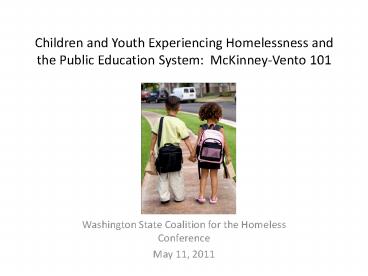
Title: Children and Youth Experiencing Homelessness and the Public Education System: McKinney-Vento 101
1
Children and Youth Experiencing Homelessness and
the Public Education System McKinney-Vento 101
- Washington State Coalition for the Homeless
Conference - May 11, 2011
2
The face of homelessness in Washington
3
How many children and youth experience
homelessness?
- 1.35 million children (nationally)
- 10 of all children living in poverty
- 733,000-1.3 million youths
- Over 40 of all children who are homeless are
under the age of 5 - In Washington 21,826 in 2009-10 (K-12)
4
Causes of Homelessness
- Lack of affordable housing
- Deep poverty
- Health problems
- Domestic violence
- Natural and other disasters
- Abuse/neglect (unaccompanied youth)
5
Washington State Data Trends
- 2003-04 8,141
- 2004-05 12,274
- 2005-06 13,942
- 2006-07 16,853
- 2007-08 18,670
- 2008-09 20,780
- 2009-10 21,826
6
Washington State Data, cont.
- Between 2008-09 and 2009-10
- 139 Districts reported an increase in homeless
students - 103 Districts reported a decrease in homeless
students - 53 Districts reported no change
- In 2009-10, 50 districts reported zero homeless
students a decrease from 2008-09, when 56
districts reported zero homeless students
7
(No Transcript)
8
Research on School Mobility
- Students who switch schools frequently score
lower on standardized tests study found mobile
students scored 20 points lower than non-mobile
students - Mobility also hurts non-mobile students study
found average test scores for non-mobile students
were significantly lower in high schools with
high student mobility rates - It takes children an average of 4-6
- months to recover academically after
- changing schools
9
Research onSchool Mobility (cont.)
- Students suffer psychologically, socially, and
academically from mobility mobile students are
less likely to participate in extracurricular
activities and more likely to act out or get into
trouble - Mobility during high school greatly diminishes
the likelihood of graduation study found
students who changed high schools even once were
less than half as likely as stable students to
graduate, even controlling for other factors
10
Barriers to Education forHomeless Children and
Youth
- Enrollment requirements (school records,
immunizations, proof of residence and
guardianship) - High mobility resulting in lack of school
stability and educational continuity - Lack of access to programs
- Lack of transportation
- Lack of school supplies, clothing, etc.
- Poor health, fatigue, hunger
- Prejudice and misunderstanding
11
Who is homeless?
- The McKinney-Vento Act defines homeless children
and youths as - Individuals who lack a fixed, regular, and
adequate nighttime residence, and includes - Children and youths who are sharing the housing
of other persons due to loss of housing, economic
hardship, or a similar reason
12
Who is homeless, cont.
- are living in motels, hotels, trailer parks, or
camping grounds due to the lack of alternative
adequate accommodations - are living in emergency or transitional shelters
- are abandoned in hospitals or are
- awaiting foster care placement
13
Who is homeless, cont.
- Children and youths who have a primary nighttime
residence that is a public or private place not
designed for or ordinarily used as a regular
sleeping accommodation for human beings - Children and youths who are living in cars,
parks, public spaces, abandoned buildings,
substandard housing, bus or train stations, or
similar settings and
14
Who is homeless, cont.
- Migratory children who qualify as homeless for
the purposes of this subtitle because the
children are living in circumstances described
(above.)
15
Who uses the McKinney-Vento definition of
homeless?
- Elementary and Secondary Education (ED)
- Individuals with Disabilities Education Act (ED)
- Higher Education Act (ED)
- Head Start Act (HHS)
- Child Nutrition Act (USDA)
- Violence Against Women Act (DOJ)
16
The McKinney-Vento Act
- The federal McKinney-Vento Act ensures that
children and youth experiencing homelessness are
able to enroll, attend and succeed in school.
Homeless students must be able to attend and
participate fully in all school activities,
including after-school athletics, co-curricular
activities and other school-sponsored events.
17
School Districts are Required to
- Identify homeless students
- Immediately enroll homeless students, even if
they lack records - Maintain enrollment in the school of
- origin, whenever feasible and in
- the best interest of the child
18
School District Requirements, cont.
- Transfer records immediately when a student moves
- Provide transportation to/from school of origin
- Resolve disputes related to enrollment and
provision of service
19
District requirements, cont.
- Provide comparable services
- Coordinate and collaborate with other
agencies/entities providing services to homeless
children, youth and their families - Coordinate with state and local housing agencies
- Provide training to district staff
- Provide special services, including Special
Education, early childhood, preschool, etc. - Set aside Title I funds to serve homeless
students in schools
20
Key ProvisionsSchool Selection
- Children and youth experiencing homelessness can
stay in their school of origin or enroll in any
public school that students living in the same
attendance area are eligible to attend, according
to their best interest - The terms enroll and enrollment include
attending classes and participating fully in
school activities - School of originschool attended when permanently
housed or in which last enrolled - Best interestkeep homeless students in their
schools of origin, to the extent feasible, unless
this is against the parents or guardians wishes
21
Determining Best Interest
- Continuity of instruction
- Age of the child or youth
- Safety of the child or youth
- Length of stay at the shelter
- Likely area where family will find permanent
housing - Students need for special instructional programs
- Impact of commute on education
- School placement of siblings
- Time remaining in the school year
22
Key ProvisionsEnrollment, cont.
- Children and youth have the right to enroll in
school immediately, even if they do not have
required documents, such as school records,
medical records, proof of residency, or other
documents. - If a student does not have immunizations, or
immunization or medical records, the liaison must
immediately assist in obtaining them, and the
student must be enrolled in the interim.
23
Key ProvisionsEnrollment, cont.
- Enrolling schools must obtain school records from
the previous school, and students must be
enrolled in school while records are obtained. - Schools must maintain records for students who
are homeless so they are available quickly. - States and districts must develop, review, and
revise policies to remove barriers to the
enrolment and retention of children and youths in
homeless situations.
24
Wait a minute My school district told me
- POP QUIZ True or False
- I cant enroll my child without a parent/guardian
signature. - I cant enroll my child without immunizations.
- I cant enroll my child until he/she has been
assessed. - If I want free meals, I need to complete the
free/reduced meal form. - I cant enroll in their district unless I live
within their boundaries. - I cant enroll unless I show proof of my address.
- If the district has a policy or procedure, I need
to - follow it, whether Im homeless or not.
- Since my district does not receive McKinney-Vento
- grant funds, they dont need to comply with the
- McKinney-Vento Act.
- The building principal determines when/if
- a student meets the definition of homeless.
25
What about all those policies?
- Federal law supercedes state and local laws where
there is a conflict. U.S. Constitution, Article
VI
26
Key ProvisionsLocal HomelessEducation Liaisons
- Every LEA must designate a liaison for students
in homeless situations - Responsibilities
- Ensure that children and youth in homeless
situations are identified - Ensure that homeless students enroll in and have
full and equal opportunity to succeed in school - Link with educational services, including
preschool and health services
27
Key ProvisionsLocal HomelessEducation Liaisons
(cont.)
- Inform parents, guardians, or youth of
educational and parent involvement opportunities - Post public notice of educational rights
- Resolve disputes
- Inform parents, guardians, or youth of
transportation services, including to the school
of origin
28
Key ProvisionsDisputes
- Every state must establish dispute resolution
procedures - When a dispute over enrollment arises, the
student must be admitted immediately to the
school where enrollment is sought, while the
dispute is being resolved - Liaisons must ensure unaccompanied youth are
enrolled immediately while the dispute is being
resolved
29
Key ProvisionsDisputes, cont.
- Whenever a dispute arises, the parent or guardian
must be provided with a written explanation of
the schools decision, including the right to
appeal - The school must refer the child, youth, parent,
or guardian to the liaison to carry out the
dispute resolution process as expeditiously as
possible - Documentation should be kept for all local
liaison interventions with parentsnot just
formal disputes (NCLB)
30
Key ProvisionsUnaccompanied Homeless Youth
- Definition youth who meets the definition of
homeless and is not in the physical custody of a
parent or guardian - Liaisons must help unaccompanied homeless youth
choose and enroll in a school, after considering
the youths wishes, and inform the youth of his
or her appeal rights - School personnel must be made aware of the
specific needs of runaway and homeless youth
31
Key ProvisionsTransportation
- Districts must provide students experiencing
homelessness with transportation to and from
their school of origin, at a parents or
guardians request (or at the liaisons request
for unaccompanied youth.)
32
Key ProvisionsTransportation, cont.
- If the students temporary residence and the
school of origin are in the same district, that
district must provide or arrange transportation
if the student is living outside of the school of
origins district, the district where the student
is living and the school of origins district
must determine how to divide the responsibility
and share the cost, or they must share the cost
equally.
33
Key ProvisionsTransportation, cont.
- In addition to providing transportation to the
school of origin, districts must provide students
in homeless situations with transportation
services comparable to those provided to other
students. - School districts must eliminate barriers to the
school enrollment and retention of students
experiencing homelessness (including
transportation barriers.)
34
Preschool-Aged Children
- Liaisons must ensure that families and children
have access to Head Start, Even Start, and other
public preschool programs administered by the
district - State plans must describe procedures that ensure
that homeless children have access to public
preschool programs - U.S. HHS issued a memo in 1992 describing how
Head Start grantees should collaborate and adjust
their programs to serve homeless children this
memo remains in effect - Pending changes to the Head Start Act
35
PreschoolStrategies
- Keep slots open for homeless students
- Provide awareness training for preschool
providers - Collaborate with preschools not operated by the
district or state (including Head Start) - Ask parents about preschool-aged children when
they enroll their school-aged children in school - Coordinate with IDEA Child Find
36
Access to Services
- Students who experience homelessness must have
access to educational services for which they are
eligible, including special education, programs
for English learners, gifted and talented
programs, voc./tech. programs, and school
nutrition programs - Undocumented children and youth have the same
right to attend public school as U.S. citizens
and are covered by the McKinney-Vento Act to the
same extent as other children and youth (Plyler
v. Doe)
37
Access to Services (cont.)
- USDA policy permits liaisons and shelter
directors to obtain free school meals for
students by providing a list of names of students
experiencing homelessness with effective dates - The 2004 reauthorization of IDEA includes
amendments that reinforce timely assessment,
inclusion, and continuity of services for
homeless children and youth who have disabilities
38
Segregation
- States are prohibited from segregating homeless
students in separate schools, separate programs
within schools, or separate settings within
schools - States and districts must adopt policies and
practices to ensure that homeless children and
youth are not segregated or stigmatized on the
basis of their status as homeless - Services provided with McKinney-Vento funds must
not replace the regular academic program and must
be designed to expand upon or improve services
provided as part of the schools regular academic
program
39
Key ProvisionsTitle I and Homelessness
- A child or youth who is homeless and is attending
any school in the district is automatically
eligible for Title IA services - District must reserve (or set aside) funds as are
necessary to provide services comparable to those
provided to children in Title IA schools to serve
homeless children who do not attend participating
schools, including providing educational support
services to children in shelters and other
locations where homeless children may live
40
Strategies for Determining the Title I Set-Aside
Amount
- Review needs and costs involved in serving
homeless students in the current year and project
for the following year - Multiply the number of homeless students by the
Title IA per pupil allocation - For districts with subgrants, reserve an amount
greater than or equal to the McKinney-Vento
subgrant funding request - Reserve a percentage based on the districts
poverty level or total Title IA allocation
41
Title IServices forHomeless Students
- Services for homeless students in both Title I
and non-Title I schools comparable to those
provided to non-homeless students in Title I
schools - Services that are not ordinarily provided to
other Title I students and that are not available
from other sources
42
McKinney-Vento Grants
- Currently, Washington receives 862,249
- Provides competitive grants to 23 sites
- Of 295 districts, 245 reported homeless students
enrolled in 2009-10 - 123 districts receive one-time ARRA (American
Recovery and Reinvestment Act) fundsthese are
formula dollars for districts that reported 20 or
more homeless students 2007-08
43
Funding is Limited Collaboration is Essential
- Continuums of care
- Shelters
- Housing
- Faith community
- Schools
- Child welfare and other social services
- Food and clothing banks
- Others
44
Resources
- Office of Superintendent of Public Instruction
www.k12.wa.us/homelessed/default.aspx - National Center for Homeless Education
www.serve.org/nche/ - National Association for the Education of
Homeless Children and Youth www.naehcy.org - National Law Center on Homelessness and Poverty
www.nlchp.org
45
For more information
- Melinda Dyer, Program Supervisor
- Education of Homeless Children and Youth
- Office of Superintendent of Public Instruction
- 360.725.6050
- melinda.dyer_at_k12.wa.us
Recommended

