

Human Systems/Communities and The Breadwinner by Deborah Ellis PowerPoint PPT Presentation
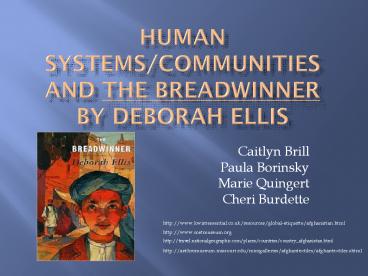
Title: Human Systems/Communities and The Breadwinner by Deborah Ellis
1
Human Systems/Communitiesand The Breadwinner by
Deborah Ellis
- Caitlyn Brill
- Paula Borinsky
- Marie Quingert
- Cheri Burdette
http//www.kwintessential.co.uk/resources/global-e
tiquette/afghanistan.html
http//www.metmuseum.org
http//travel.nationalgeographic.com/places/countr
ies/country_afghanistan.html
http//anthromuseum.missouri.edu/minigalleries/afg
hantextiles/afghantextiles.shtml
2
Content Standards
- Intermediate
- Reading Students will use a variety of
strategies to understand literary text and
reflect connections to text. - Writing Students will use the writing process
to create a persuasive essay. - Social Studies Students will demonstrate an
understanding of communities and human systems. - Students will understand the interactions
between citizens and their government. - Math Students will understand different money
systems. - Art Students will demonstrate the ability to
use principles and elements of design.
3
Brain Target 1
- Students and teachers read the book, The
Breadwinner, making connections to events in the
story to their own everyday lives. - Students make a personal connection to the main
character, Parvana, through visualization
activities, such as simulations which excludes
girls from the classroom and learning. - Remove all rules from the classroom but require a
group assignment to be completed in order to
leave. - View Afghan artifacts from the National Museum in
Afghanistan (www.metmuseum.org or
www.nationalgeographic.org). - Students will design their own rubrics to
evaluate their communities and community
projects. - Listen to Afghan music (www.smithsonianfolkways.or
g). - Students will play charades to assist with
learning vocabulary from the story. - Connect students to the importance of rules/laws.
Discuss how they felt in a chaotic situation. - Allow students to evaluate their own cognitive
and social learning on a KWL chart. - Celebration of student work.
4
Brain Target 2
- Afghani music playing in the background as
children enter the room. - Displays of Afghan artwork and childrens created
work. - Display of maps of regions involved in book.
- Display graphic organizer (timeline) of recent
historic events in Afghani government. - Desks arranged in cooperative learning groups
that simulate living quarters. - Reading area set up for class reading activities
that simulates living quarters of Parvanas home.
- Materials organized to be easily accessible.
5
Brain Target 3
6
BT 3 Continued
- Learning Goals
- Social Studies
- Students will demonstrate the processes of
building a community and be able to create an
ideal community. - Students will be able to argue the importance of
a structured government for the success/failure
of a community. - Students will investigate the concept of trade in
order to understand economics.
7
BT 3 Continued
- Introductory Big Picture Activity/Assessment of
Prior Knowledge - Activities
- Students will review the concept map and discuss
what they know about each topic in a
think-pair-share. - Students will brainstorm types of communities and
create a working definition to use throughout
unit. - Students will use map skills to identify location
of the Middle Eastern region. - Students will play a telephone game in order
to simulate communication challenges.
8
Brain Target 4
- Learning Goals
- Students will acquire background knowledge on how
geography can impact the development of a
community and be able to relate that information
to what they know about the geography in
Afghanistan and the United States. - Students will learn how communication plays a
large role in a community by analyzing
hieroglyphics, Roman numerals, and other early
forms of communication and be able to create a
communication system for language, numeracy, and
money. - Students will develop a government system by
weighing the pros and cons of different systems
and be able to design a set of laws for their own
community.
http//www.kwintessential.co.uk/resources/global-e
tiquette/afghanistan.html
9
Brain Target 4
- Activities
- Students will research modern
- forms of government.
- Students will compare the use of
hieroglyphics/Roman numerals in communication in
ancient societies. - Students will create an outline of government
charter, laws, and judicial systems. - Students will transcribe a letter in
hieroglyphics.
10
Brain Target 5
- Learning Goals
- Students will be able to identify the parts
needed to establish a community and will be able
to design all elements of an effective community. - Students will test their community for its
ability to respond to stress and conflict.
11
Brain Target 5
- Activities
- In small groups students will use previously
created outline to create their own communities
aligned to a rubric. - The teacher will distribute scenario cards to
test conflict resolution. - Students will design an artifact such as a
community seal, flag, and/or song to represent
community identity. - Students will create a persuasive article to
influence others to join their community using
previously written communication systems.
12
Brain Target 6
- KWL chart
- Opinion papers
- Reflection paper on how well
- community succeeded
- Develop traits of each role
- Record ongoing history of community using
language system key - Create a map of geography territory
- using rubric
Recommended

