

Alternative Silvicultural Techniques for European Sub-alpine and Montane Protection Forests: PowerPoint PPT Presentation
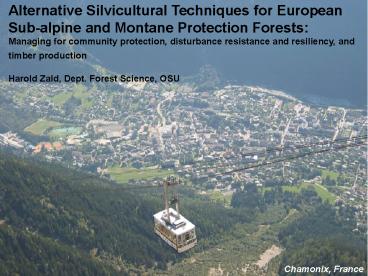
Title: Alternative Silvicultural Techniques for European Sub-alpine and Montane Protection Forests:
1
Alternative Silvicultural Techniques for European
Sub-alpine and Montane Protection
Forests Managing for community protection,
disturbance resistance and resiliency, and timber
production Harold Zald, Dept. Forest Science, OSU
Chamonix, France
2
- Protection forest overview
- Protecting from what?
- Protective functions
- Resistance and resiliency
- Protective attributes
- Alternative silviculture
3
- Protecting from What?
- Protection from rockfall, avalanches,
- and debris flows
- Engineered mitigation is expensive!!!
- The role of forests in reducing rockfall
- increasingly appreciated
4
Protective functions, resistance, and resiliency
Direct-protection functions directly protect
people, buildings, and infrastructure against
the impacts of natural hazards such as
rockfall and avalanches Site-protection
functions protect the site a forest occupies
against processes such as soil erosion and
debris flows
Stability of protection forests over time
requires managing for both resistance and
resilience to rockfall and avalanche
Resistance The ability of a protection forest to
slow or dissipate the energy and matter
generated in a rockfall or avalanche. Resilience
The ability to recover direct-protection
resistance characteristics following a natural
hazard (or other) disturbance event.
5
Protection forest attributes Stem Density
Increased stem densities increase resistance to
rockfall and avalanches
Dorren et al. 2004. Geomorphology
Simulated rockfall patterns (rockfall
accumulation in black) a) current forest, b) 50
stem reduction, c)100 stem reduction.
6
Protection forest attributes
- Increased stem diameters
- increase resistance to
- rockfall and avalanches
- However importance
- of diameter varies
- Long live crowns
7
Protection forest attributes Forest
Floor/Understory
- Regeneration
- (for resistance and resiliency)
- Large down wood
- Shrubs
- Ground structure (rocks)
8
Alternative Silvicultural Applications
Density/Size Management Developmental
Stage Regeneration Understory/Forest Floor
Management Silvicultural Application
Layout Landscape Considerations
9
Density, Diameters, and Developmental Stages
- Greater resistance at the cost of lower
resilience - Implication manage for earlier developmental
stages - Especially important for older Norway spruce
plantations - Best balance between resistance and resilience
- may occur at what is roughly analogous to the
- understory reinitiation stage - at the stand
level
10
- Regeneration
- Clumped planting
- Coppice method
- when possible
- Regeneration slits
Ott 1989 Schonenburger 2001. For.
Eco. Man.
11
Harvest Layout and Landscape Considerations
- Conserve forest floor
- structure
- Position harvest units
- with respect to hazards,
- areas to protect, and
- surround forests, non-
- forest vegetation, and
- any engineered
- mitigation structures
Dorren et al. 2004. For. Eco. Man.
12
Changing Objectives, Changing Perceptions
- When you look at these two forests, which is
better for - Timber production?
- Protection function resistance?
- Protection forest resilience?
Recommended

