

Three Types of International Transactions PowerPoint PPT Presentation
1 / 74
Title: Three Types of International Transactions
1
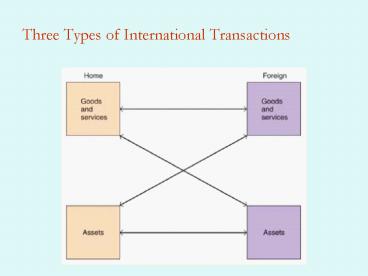
Three Types of International Transactions
2
Three Types of International Transactions
- Goods for Goods is straight trade
- Goods for assets is intertemporal trade
- The theory of intertemporal trade describes the
gains from trade of goods and services for
assets, of goods and services today for claims to
goods and services in the future (todays
assets). - Assets for assets is portfolio diversification
- The theory of portfolio diversification describes
the gains from trade of assets for assets, of
assets with one type of risk with assets of
another type of risk.
3
Portfolio Diversification
- Gains from portfolio diversification are large
- This explains why asset trade is so large
- Gains from international sharing of risks
- This makes economies more interdependent than
even trade relations - Important mechanism for transmitting shocks cross
countries - Important in the current financial crisis
- We consider a simple model with one good but two
states - This is characterization of uncertainty. For
example, it could rain or be sunny. Agents have
expectations about these states. By trading they
can hedge some risks.
4
Portfolio Diversification
- Consider a two-country, two-period endowment
economy (one good, yi) with two states of nature - Let
- For example, the probability that harvest is good
- So with only two states, we have
- Thus in each country the endowment is stochastic
- Assume risks are not perfectly correlated across
countries - Assume identical agents in each country are risk
averse - Then, if contracts can be enforced, there are
gains from trade
5
Expected Utility
- Agents maximize expected utility
- Preferences are state-dependent
- What is the budget constraint?
- If no trade then there is no choice to make
- ci yi for each state i
- Suppose a country can buy (sell) an asset (bi)
that pays off in case state i occurs - Let pi be the price of this asset (where does
this come from?) - Expected consumption is now
6
State Dependent Preferences
- Agents prefer certain consumption, C, to a
lottery of A and B
7
Gains from trade
- Would agents be willing to pay for these claims?
- Yes, if they are risk averse
- Risk averse agents are willing to sacrifice some
income for certain income - Suppose that in country A,
- And in country B,
- And we suppose that people know the
- Then for some p there will be gains from trade
- Country A will deliver b1 of the good if state 1
occurs - Country B will deliver b2 of the good if state 2
occurs
8
Implications
- International risk sharing makes both countries
better off - This is just insurance
- Result depends on risk aversion
- Notice that we have derived a motive for capital
flows, even though - There is only one good
- There is only one time period
- How is contract enforced?
9
Gains from Trade
10
Gains with Trade
11
Extent of Portfolio Diversification
- In 1999, US owned assets in foreign countries
represented about 30 of US capital, while
foreign assets in the US was about 36 of US
capital. - These percentages are about 5 times as large as
percentages from 1970, indicating that
international capital markets have allowed
investors to increase diversification. - Likewise, foreign assets and liabilities as a
percent of GDP has grown for the US and other
countries.
12
Extent of International Portfolio Diversification
13
Home Bias
- Investors hold too large a share of portfolio in
domestic assets - In principle investors should hold domestic
assets in proportion to size of the economy - In practice, much less international
diversification - Costly in terms of return and risk analyze using
efficiency frontier - Why is there home bias?
- Transaction costs seem too small
- Perhaps information asymmetries
- Imperfect capital market integration?
- Home bias seems to be decreasing over time
- But it is has not gone away!
14
Equity Portfolio Weights
15
Efficiency Frontier
- Suppose we have two assets, A and B
- Asset A has lower risk and lower expected return
- Asset B has higher risk and higher expected
return - Suppose that returns are not perfectly correlated
- gt a diversified portfolio will generate higher
expected return and lower risk - As we add asset B to the portfolio, ER rises and
risk falls - Eventually diversification offset by higher risk
(point C) - So we obtain the efficiency frontier
16
Efficiency Frontier
Efficient Portfolios lay along the segment CB
Minimum Variance Portfolio
17
Digression
- Easy step from Efficiency frontier to the Capital
Asset Pricing Model (CAPM) - Workhorse idea of finance
- Use Tobin Separation Theorem
- Add risk-free asset (T-bills) to investors
choices - Investor divides wealth between T-bills and a
portfolio of risk assets on the efficiency
frontier - To learn about the CAPM click here.
18
Tobin Separation Theorem
19
Tobin Separation Theorem
- Consider an agent more risk averse than in
previous slide - Indifference curve will be tangent to the CAL to
the southwest of point C. But it will still be on
CAL - So agent will hold more cash and less of P, but
all risky assets will still be portfolio P - Indeed, all agents hold the same portfolio of
risky assets. They hold different shares of risky
and risk-free assets, but not different
portfolios of risky assets!
20
Efficiency Frontier with Many Assets
21
Risk and Return
- How does diversification reduce risk? The key is
covariance - Suppose we have two assets, y and z, and suppose
that their weights are a and b - The variance of the returns are given by
- Notice that if there is no benefit
- So, if it follows that
- Thus, when assets are not perfectly correlated
diversification reduces risk
22
Home Biasmean return and std dev (1970-1996) for
SP 500 and Morgan Stanley EAFE fund
39 foreign
23
International Portfolio Diversification
24
Certain and Uncertain Income
25
Can there be too much risk sharing?
- Risk sharing enables consumption smoothing
- Marginal benefits are positive
- Possibilities are endless given derivatives
- Swaps, options and other ways to insure
- Many bets are made with leverage
- Banks and financial institutions are often too
big to fail or federally insured - Moral hazard
- Implies social cost of insurance could be greater
than private cost
26
Current Account Intertemporal Framework
- Huge US current account deficit
- Current account balance is the record of a
countrys current transactions with the rest of
the world - Why do we care?
- Because debts must be paid back gt lower future
consumption - Perhaps via lower exchange value of the dollar
- A current account deficit means a decline in net
foreign assets - That is why the US net international position has
deteriorated
27
Current Account as Share of GDP
28
US Current Account Deficit by Region
29
Current Account Balancebillions of dollars,
seasonally adjusted at annual rates
30
Components of Current Account Deficit, 1946-2004
31
US Net International Investment Position(share
of GDP)
32
US Net International Investment Position
33
Dollar Price of one Euro
34
Trade Balance (net exports), since 3/31/92
35
Current Account in an Intertemporal Framework
- Consider a small economy with identical
consumers. - Consumption is chosen to maximize
- Income in each of the two periods is given, so
budget constraint is - Optimal consumption when
- Or
- Marginal rate of substitution relative price
36
Optimum Consumption
37
Autarky
- Notice that if then consumption
would be equal across periods. - Call this interest rate, ra, the autarky interest
rate - Notice that if r ra then so c1
c2 - if r lt ra then so c1 gt c2 (and
vice versa) - So if r lt ra (interest rates very low)
consumption is decreasing over time (and vice
versa) - The notion of an autarky rate will be useful
later
38
Current Account
- From NIA we have Y C NX
- If Ci ? Yi we have borrowing and lending, NX? 0
- Let At be net foreign assets in time t, (A0
initial assets) - The budget constraint is thus
- Second period consumption is
- Second period CA surplus First period CA
deficit plus interest on the debt, plus initial
assets - We can define the current account as net exports
plus net interest payments CA NX rA
39
More current account
- Since there are only two periods the CA in period
two equals NX in period two, or - So we can write
- PV of future surpluses the initial level of
debt - No free lunch
40
Longer Time Horizon
- What if there are more than two periods?
- No problem. Start with definition of CA
- So I can write
- which must be true for any period, so
- or
41
Longer time horizon (cont.)
- Now just substitute for At1
- And if I repeat the process
- And again,
- We just keep pushing the last term, terminal
assets further and further into the future
42
Longer time horizon (cont.)
- We can write it compactly as
- As T gets very large the last term goes to zero
- Why? No Ponzi schemes, and no wasted wealth.
- So,
- PV of future NX equals (negative) initial level
of assets
43
Implications
- If we start life NA gt 0, we can consume more than
we earn over our lifetimes (in pv) - i.e., PV of NX lt 0
- If we start with net debt, we are going to have
to produce more than we earn over our lifetimes
(in pv) - i.e., PV of NX gt 0
- So negative US NFA today means that we will have
to run future current account surpluses - This is a very weak constraint!
44
Adding Investment
- Now suppose a country can invest
- Production function F(K), with return
- But diminishing returns
- How to raise K? By investing today
- Suppose endowment is at A in figure
- Present value of production maximized at P
- Marginal rate of technical substitution 1r
- First period investment
- If economy closed then consumption choices must
be along BA in figure - What if small open economy facing r?
- Production and consumption decisions are
separated
45
Production Possibilities
46
Separation
47
Implications
- With open capital markets, production at P and
consumption at C - Notice that C is outside the closed economy
consumption possibilities set - Consumption in period one is greater than
production - Current account deficit in period one
- In period two we pay back, as
- What if there were initial debt?
48
Optimum with initial debt
49
Investment and the Current Account Balance
- Now two ways to hold wealth I and K
- Capital stock evolves according to
- So the change in domestic wealth is
- Thus, domestic wealth increases (sometimes called
accumulation) only if earnings exceed spending on
consumption (government included). - Using the capital stock equation and the
definition of the current account we can
rearrange to obtain
50
Current Account with Investment
- Using the definition of savings
-
(1) - Then Net Exports is given by
-
(2) - notice this is NX not CA on the LHS of (1)
because we do not have net interest income on the
RHS of (1). - Thus, national saving in excess of domestic
capital formation flows into net foreign asset
accumulation. - gt the current account is fundamentally an
intertemporal phenomenon. - Example Norway discovers oil
51
Current Account, NNI and NNS
52
Norway and the Current Account
53
Two-Country Model
- Small country model takes r as given
- To determine r we use the two-country model
- Key point is that world savings 0, or
- So
- This implies that the equilibrium world interest
rate must be fall between the autarky interest
rates of the home and foreign country
54
Equilibrium world interest rate a decrease in
foreign savings
55
Missing world savings
- World current account balances must sum to 0
- But they dont
- Why?
- Proof of life elsewhere in the universe?
- Statistical discrepancies
- But why is it a missing surplus?
- Timing
- Does not explain missing surplus
- Misreporting of interest income
- Explains the relation to world interest rates
- Also non-reporting of maritime freight earnings
56
Measured World Current Account Balances
57
Current Accounts by region
58
Two-Country Model Utilized
- Global Imbalances can be analyzed using this
model - Global Current Account Balances
- Two Hypotheses
- US Party
- Fiscal expansion or investment boom
- Global Glut
- ROW savings increases or I decreases
- Many take this as primary cause of the asset
bubble - How to distinguish?
59
CSI State College
State College Economics
60
Hypothesis Testing
61
Hypotheses Compared
- Key Difference real interest rates
- In US party case, r increases
- In global glut case, r falls
- Real interest rates are low
- But where is the rise in world savings?
- Why a global glut?
- Excess reserves accumulation
- Insurance against crises
- Costly insurance
- Looked at today, maybe a good investment after all
62
Real Interest Rates
- In the model this is just r
- In the data we only observe i
- But Fisher equation gives
- So we need to know expected inflation to measure
the real interest rate - We can use realized rates, but how often does
? - Fortunately, we can use TIPS data
63
Global Imbalances
64
US Fiscal Expansion
Investment rises relative to Savings in the US.
Alternatively, S could fall relative to I in US
due to budget deficits
65
Global Savings Glut
Investment falls relative to savings in ROW.
Alternatively, we could have a rise in S
66
Realized Interest Rates
67
Realized US T-bill rates
68
30-Year Treasury Inflation-Indexed Bond, Due
4/15/2028 Percent
69
Historical Real Interest Rates
70
World Real Interest Rates
71
World Real Interest Rates
72
Excess Reserves, Developing Countries(level of
reserves in excess of 1 years short-term debt)
73
Excess Reserves Beyond 2-years Debt
74
Opportunity Cost of Excess Reserves
- Total roughly 1.5 Trillion
- Suppose diversified yield 6
- gt 90 billion, roughly 1.8 of combined GDPs of
the 10 leading holders of excess reserves - Big number
- As large as gains from trade liberalization
- Developing countries presumably have better uses
for their wealth than holding US Treasuries
75
Excess Reserves 10 leading Countries
76
War and the Current Account
- Good test of theory
- Temporary increase in spending
- In non-belligerent countries, opportunity to earn
higher returns - So current accounts of belligerents and
non-belligerents should move opposite - E.g., Sweden and Japan
- But sovereign debt is complicated
- Fear of repudiation
- Why is there sovereign lending?
77
Adam Smith on Sovereign Debt
- "When national debts have once been accumulated
to a certain degree, there is scarce, I believe,
a single instance of their having been fairly and
completely paid. The liberation of public
revenue, if it has ever been brought about at
all, has always been brought about by a
bankruptcy sometimes by an avowed one, but
always by a real one, though frequently by a
pretended payment in a depreciated
currency...When it becomes necessary for a state
to declare itself bankrupt, in the same manner as
when it becomes necessary for an individual to do
so, a fair, open, and avowed bankruptcy is always
the measure which is both least dishonourable to
the debtor, and least fruitful to the creditor."
Wealth of Nations, Book V, Chapter III, 882.
78
Current Accounts of Sweden and Japan
79
US Current Account Balance, Savings and Investment
80
Valuation
- Intuitively, net wealth is sum of past CA
- But this ignores valuation
- Valuation effects can occur because the returns
on assets we own abroad may differ from those
foreigners own here, and also from capital gains
and losses due to movements in the dollar. - Normally one would think that these factors would
balance out -- why should a country enjoy such an
advantage?
81
Valuation
- US is different
- The dollar is the world's reserve currency.
- The US borrows in its own currency, something
other countries cannot do. - Exorbitant privilege
- US is safe haven
- Valuation effects are quite large
82
U.S. Net Foreign Assets, relative to GDP19521
to 20041
83
Net Valuation Component (relative to GDP)
84
How Valuation Effects Impact US External Wealth
85
Valuation
- Notice that when the CA gt 0, the valuation effect
was negative. Now it is positive - Where does it come from?
- US is safe haven
- World money center, US borrows short and lends
long - But where does the advantage come from?
- Dark matter
- Will positive valuation effects survive?
Recommended

