

The Molecular Basis of Inheritance 29 October, 2003 Text Chapter 16 PowerPoint PPT Presentation
1 / 18
Title: The Molecular Basis of Inheritance 29 October, 2003 Text Chapter 16
1
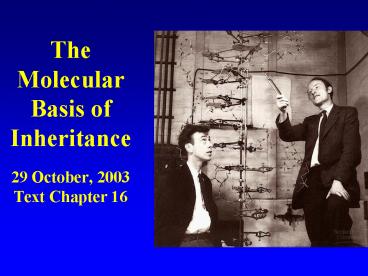
The Molecular Basis of Inheritance29 October,
2003Text Chapter 16
2
What is the genetic material?
It could be DNA or protein. Transformation of
bacterial cells must involve transfer of genetic
material.
Since bacterial DNA, but not bacterial protein is
capable of transforming R to S, DNA must be the
genetic material.
3
DNA and not protein in injected into cells by
phage.
4
Hershey and Chase, 1952
5
DNA Structure
Each DNA molecule is a linear polymer of nucleic
acid monomers.
The DNA backbone consists of ribose and phosphate
groups. This part of the molecule is the same
for every monomer.
The variable part of DNA consists of four
different nitrogenous bases attached to the C1 of
the ribose ring.
6
Base Pairing
Two DNA molecules with complementary sequences
can form a double helix. This structure is only
possible when the sequence of bases on the two
strands allow base pairing over an extended
region.
7
The two strands (molecules) in a DNA duplex are
antiparallel.
8
Base Pairing
9
The complementary nature of a DNA duplex allows
each strand to serve as the template for the
synthesis of its partner.
10
Semiconservative Replication
In living systems, DNA replication is
semiconservative. Each daughter duplex contains
one old and one newly synthesized strand.
11
Semiconservative Replication
12
Replication Origins, Forks, and Bubbles
DNA replication begins at each of several origin
sequences. Replication proceeds until the entire
double-stranded molecule has been replicated.
13
DNA monomers are triphosphates that are
hydrolyzed in the process of polymerization.
14
This means that DNA molecules can only grow in
the 5 to 3 direction.
15
DNA Synthesis
At each replication fork, there are two strands
of DNA to be synthesized.
From the point of view of the leading strand, the
fork moved in the 5 to 3 direction.
From the point of view of the lagging strand,
fork movement is in the 3 to 5 direction.
16
Priming
Since DNA synthesis requires a free 3 OH group,
DNA synthesis begins with the synthesis of an RNA
primer. This primer is replaced by DNA later.
17
DNA Synthesis
18
(No Transcript)
Recommended

