

EPILEPSY IS THE MAJOR MANIFESTATION IN THE RING 14 SYNDROME PowerPoint PPT Presentation
1 / 1
Title: EPILEPSY IS THE MAJOR MANIFESTATION IN THE RING 14 SYNDROME
1
EPILEPSY IS THE MAJOR MANIFESTATION IN THE RING
14 SYNDROME Simona Giovannini, MD1, Daniela
Orteschi, PhD2, Giuseppe Gobbi, MD1 , Elvio Della
Giustina, MD3, Angela Scarano, MD3, Marcella
Zollino, MD2, Giovanni Neri, MD2 1Neuropsichiatria
Infantile, Ospedale Maggiore, Bologna
2Istituto di Genetica Medica, Università
Cattolica del S. Cuore, Roma 3Neuropsichiatria
Infantile, Arcispedale S. Maria Nuova, Reggio
Emilia, Italy
Introduction
A preliminary report on the ring 14 (r(14))
syndrome, has established this condition as
commonly characterized by postnatal growth
retardation, hypotonia, acquired microcephaly,
cognitive disability/speech delay, mild facial
dysmorphisms, pigmentary retinal abnormalities
and seizures (1). Epilepsy is the most common and
severe manifestation occurring in this syndrome
and it does not seem to be related to a
consistent underlying structural brain
abnormality (1, 2). Likewise, putative genes
involved in epileptogenesis do not seem to map to
the terminal 14q region, usually deleted in the
formation of the ring. In fact, a linear terminal
14q deletion syndrome does not include epilepsy
among its component manifestations (1). Seizures
occur in practically all cases and are commonly
reported as early onset, more often as
generalized tonic-clonic and drug-resistant (3).
However, an accurate electro-clinical phenotype
is poorly known and a detailed description of the
clinical, EEG findings and their natural history
are still lacking.Therefore, we studied clinical
characteristics of epilepsy in a ring 14 group of
patients and its correlations with clinical data
and the underlying genetic defect.The majority of
informations were extrapolated from the
password-protected Electronical Database of Ring
14 (www.ring14.com).
Materials and methods
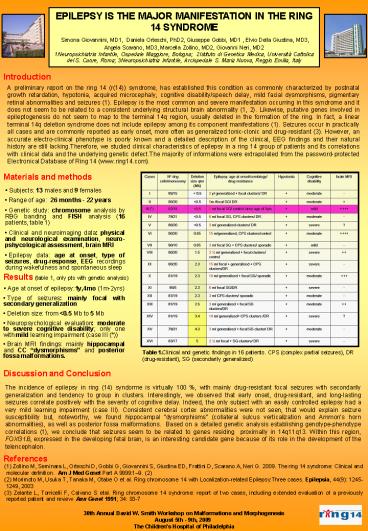
- Subjects 13 males and 9 females
- Range of age 26 months - 22 years
- Genetic study chromosome analysis by RBG
banding and FISH analysis (16 patients, table 1) - Clinical and neuroimaging data physical and
neurological examination, neuro-pshycological
assessment, brain MRI - Epilepsy data age at onset, type of seizures,
drug-response, EEG recordings during wakefulness
and spontaneous sleep
Results (table 1, only pts with genetic analysis)
- Age at onset of epilepsy1y,4mo (1m-2yrs)
- Type of seizures mainly focal with secondary
generalization - Deletion size from lt0.5 Mb to 5 Mb
- Neuropsychological evaluation moderate to
severe cognitive disability only one with mild
learning impairment (case III ()) - Brain MRI findings mainly hippocampal and CC
dysmorphisms and posterior fossa malformations.
Table 1.Clinical and genetic findings in 16
patients. CPS (complex partial seizures), DR
(drug-resistant), SG (secondarily generalized)
Discussion and Conclusion
The incidence of epilepsy in ring (14) syndorme
is virtually 100 , with mainly drug-resistant
focal seizures with secondarily generalization
and tendency to group in clusters. Interestingly,
we observed that early onset, drug-resistant, and
long-lasting seizures correlate positively with
the severity of cognitive delay. Indeed, the only
subject with an easily controlled epilepsy had a
very mild learning impairment (case III).
Consistent cerebral cortex abnormalities were not
seen, that would explain seizure susceptibility
but, noteworthy, we found hippocampal
dysmorphisms (collateral sulcus verticalization
and Ammons horn abnormalities), as well as
posterior fossa malformations. Based on a
detailed genetic analysis establishing
genotype-phenotype correlations (1), we conclude
that seizures seem to be related to genes
residing proximally in 14q11q13. Within this
region, FOXG1B, expressed in the developing fetal
brain, is an interesting candidate gene because
of its role in the development of the
telencephalon.
References
(1) Zollino M, Seminara L, Orteschi D,
Gobbi G, Giovannini S, Giustina ED, Frattini D,
Scarano A, Neri G. 2009. The ring 14 syndrome
Clinical and molecular definition. Am J Med
Genet Part A 999919. (2) (2)
Morimoto M, Usuka T, Tanaka M, Otabe O et al.
Ring chromosome 14 with Localization-related
EpilepsyThree cases. Epilepsia, 44(9)
1245-1249, 2003 (3) Zelante L,
Torricelli F, Calvano S etal. Ring chromosome 14
syndrome report of two cases, including extended
evaluation of a previously reported patient and
review. Ann Genet 1991 34 93-7
30th Annual David W. Smith Workshop on
Malformations and Morphogenesis August 5th - 9th,
2009 The Children's Hospital of Philadelphia
Recommended

