

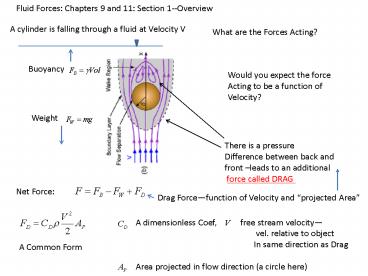
A cylinder is falling through a fluid at Velocity V PowerPoint PPT Presentation
1 / 39
Title: A cylinder is falling through a fluid at Velocity V
1
Fluid Forces Chapters 9 and 11 Section
1--Overview
A cylinder is falling through a fluid at Velocity
V
What are the Forces Acting?
Would you expect the force Acting to be a
function of Velocity?
V
2
So Drag is a result of fluid moving over a
bodyAre there other forces that can arise in
this way
Flow over a thin plateDrag not important
Small projected area
V
Resulting in a Surface Resistance Force in
direction of free stream velocity
Net Force
What Area here?
3
Also Lift Consider rotating Cylinder in Free
stream Flow V
V
The Magnus Effect
Pressure Difference will lead to a Force The
Lift Force NORMAL to free stream DirectionEngine
ers calculate this as
4
Sothere are three forces that can occur due to
flow over a body
In flow direction -------
normal to flow
Drag
Surface Resistance
Lift
Trick is finding C
Also in tables
For given Bodies Look up in tables Correlated to
Account for Drag and shear resistance see next
slide and later notes
Can be calculated for plate See section 2
5
Relation between Stress Distribution and Flow
Forces (See Fig 11.2)
Free-Stream Velocity V will give rise to
pressure acting normal to body and shear acting
along body
Lift force normal to flow
Drag force in line with flow
form drag friction drag
form drag friction drag
One value for body and flow condition
6
Section 2 Boundary LayersCalculating Surface
Resistance
7
Drag on a surface 2 types
- Pressure stress
- Shear stress / skin friction drag
Chapter 9
8
Boundary layer velocity profile
- Far from the surface, the fluid velocity is
unaffected. - In a thin region near the surface, the velocity
is reduced - Which is the most correct velocity profile?
this is a good approximation near the front of
the plate
9
Boundary layer growth
- The free stream velocity is u0, but next to the
plate, the flow is reduced by drag - Farther along the plate, the affect of the drag
is felt by more of the stream, and because of
this the boundary layer grows - Fluid friction on the surface is associated with
velocity reduction throughout the boundary layer
10
Local stress total force, skin friction
- Not immediately straightforward (unlike
approximations we made with thin films) - du/dy decreases with x y
- We need to find then
- And there is more trouble
Breadth
11
Boundary layer transition to turbulence
At a certain distance along a plate, viscous
forces become to small relative to inertial
forces to damp fluctuations
12
figure_09_04
Picture of boundary layer from text
figure_09_04
13
Boundary layer transition
- How can we solve problems for such a complex
system? - We can think about key parameters and possible
dimensionless numbers - Important parameters
- Viscosity µ, density ?
- Distance, x
- Velocity uO
- Reynolds number combines these into one number
d(x)
14
B L thickness in laminar region
Self-similar shape
15
Boundary layer questions
- How can we solve problems for such a complex
system? - We can think about key parameters and possible
dimensionless numbers - What about stress?
- We talk about (local) stress and (total) force on
a boundary in terms of local cf and average CF
stress coefficients
d(x)
16
Average shear-stress coefficientOn Plate of
Length L
Ignore this part just for a moment
figure_09_12
Note New Reynolds No
17
Example 9.6 from text
- A plate is 3 m long x 1 m wide
- Air at 20C and atmospheric pressure flows past
this plate with a velocity of 30 m/s - A boundary layer over a smooth, flat plate is
laminar at first and then becomes turbulent. The
turbulent forms of drag, etc., are reasonable
above Re 5 x 10⁵. - What is the average resistance coefficient Cf for
the plate? - Also, what will be the total shearing resistance
force of one side of the plate? - What will be the resistance due to the turbulent
part and the laminar part of the boundary layer?
18
Find , shearing resistance on one side of
plate, and resistance due to laminar flow
19
Find , shearing resistance on one side of
plate, and resistance due to laminar flow
1st calculate plat Reynolds number
Mixed laminar-Turbulent
20
Find , shearing resistance on one side of
plate, and resistance due to laminar flow
21
Find , shearing resistance on one side of
plate, and resistance due to laminar flow
Now Calculate Transition point
22
Find , shearing resistance on one side of
plate, and resistance due to laminar flow
Now Calculate Transition point
So laminar layer Coefficient is
23
Find , shearing resistance on one side of
plate, and resistance due to laminar flow
Now Calculate Transition point
So laminar layer Coefficient is
And laminar force is
24
Average shear-stress coefficient
figure_09_12
25
Laminar, Turbulence, Induced Turbulence
Laminar Turbulent Induced
d(x)
cf
FS
Cf
26
Back to drag on submerged objects
27
Drag on a surface 2 types
- Pressure stress / form drag
- Shear stress / skin friction drag
- A boundary layer forms due to skin friction
- For shapes more complex than a plane, these
result in total drag forces which are usually
hard to solve analytically
28
Shortcuts for total drag
- For less precise design and/or well-known /
well-studied (simple) objects, we rely on charts
for an average coefficient of drag
Frontal Area
shear
29
Drag coefficients for 2d or infinitely long
objects for 3d bodies
figure_11_04
figure_11_07
30
(No Transcript)
31
P 11.18, 9th edition
- Compute the overturning moment exerted by a 35
m/s wind on a smokestack that has a diameter of
2.5 m and a height of 75 m. Assume that the air
temperature is 20 C and that the atmospheric
pressure is 99 kPa absolute.
32
2.5 m
V 35m/s
Object is an infinite cylinder
75m
33
d2.5 m
V 35m/s
Object is an infinite cylinder
75m
34
d2.5 m
V 35m/s
Object is an infinite cylinder
75m
Then turning moment
35
Lift
36
Total lift
- Similar to our calculations of total drag, we
rely on charts for an average coefficient of lift
- A is a reference area, usually planform area
37
Example 11.6 Lift on a Rotating Sphere
- A ping-pong ball is moving at 10 m/s in air and
is spinning CW at 6000 rpm as shown. The ball
diameter 3 cm. Calculate the lift and drag
forces and indicate the direction of each.
Assume standard atmospheric pressure and a
temperature of 20? C. - How does the answer change if the ball is
spinning CCW?
6000
0.03
Rotation parameter
38
Find Lift and Drag Forces on Ping-Pong
6000
0.03
Rotation rate
Rotation parameter
Rotation parameter
39
Sothere are three forces that can occur due to
flow over a body
In flow direction -------
normal to flow
Drag
Surface Resistance
Lift
Trick is finding C
Also in tables ch 11
For given Bodies Look up in tables ch
11 Correlated to Account for Drag and shear
resistance see next slide and later notes
Can be calculated for plate See chapter 9
Recommended

