

Russia and the Newly Independent States: An Introduction to Geo-Political History PowerPoint PPT Presentation
1 / 46
Title: Russia and the Newly Independent States: An Introduction to Geo-Political History
1
Russia and the Newly Independent States An
Introduction to Geo-Political History
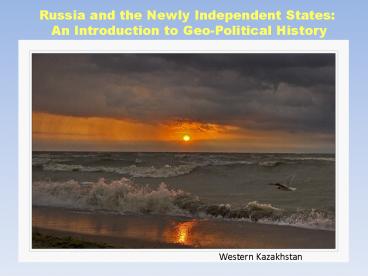
Western Kazakhstan
2
Eastern Georgia
3
Saint Petersburg, Russia Photo UVM Student
Julia Katsnelson
4
Transcaucasus Mountains
5
Georgia
6
Baku, Azerbaijian photo Alexander Pasternak
7
Transcaucasus
8
Chechen Refugee Camp
9
Chechnya, Russia
10
Winter Palace, St Petersburg, Russia
11
Moscow, Russia
12
The Kremlin, Moscow, Russia
13
Altay Region
14
Altay Region, Russia
15
Lake Baykal, Russia
16
Novosibirsk, Western Siberia, Russia
17
Uzbekistan
18
Samarkand, Ukbekistan
19
Turkmenistan
20
Turkmenistan
21
Almaty, Kazahkstan
22
Almaty Region, Kazahkstan
23
Tajikistan
24
Tajikistan
25
Western Tajikistan
26
Kyrgyzstan
27
Kyrgyzstan
28
- Some facts about Russian Federation
- Arable land 7.17
- Population growth rate -0.47 (2010 est.)
- Life expectancy at birth 2004 2010
- total population 66.39 years 66.16male
59.91 years 59.5female 73.27 years 73.1 - Independence 24 August 1991 (from Soviet Union)
- Constitution adopted 12 December 1993
- Literacy 99.4 (2002)
- GDP growth rate 7.3 (2003 est.) 8.1 (2007
est) 3.8 (2010 est) - GDP per capita (PPP) 16, 100 (2008) 15,300
(2009) - Economy has been growing by around 7 each year
since 1998. - Poverty 25 (January 2003 est.) (13.1 2009
est)
29
RUSSIAN GEO-POLITICAL HISTORY Russian
Imperialism Russian Empire began in Muscovy
region, around present-day Moscow
30
The Soviet Empire
In exchange for peoples compliance with the
system, citizens would receive housing, education
and health care at no or minimal cost.
However, the system had its roots in Russian
legacy of collectivisim and authoritarianism, in
which citizens were not guaranteed representation
or rights.
31
- Gosplan- the central economic planning commission
- Bourgeois specialists
- Lenins ideal of the one Soviet People
- Stalin years (1928-1953)
Josef Stalin
32
Soviet State Expansion 1940s and 1950s
33
World War II The Iron Curtain Continued
Industrialization Achievements in engineering,
space race, and military
Sputnik stamp
34
- Rapid Breakup of the Soviet Empire
- Occurred between 1989 and 1992
- Due to (?? These are theories.)
- regional inequalities
- consumer demands
- manipulation of power by ruling elites
- Empire broke into 15 separate countries.
Economies and systems left in disarray, regions
had to readjust quickly.
35
The Former Soviet Union and Todays Independent
States
36
- Russian Federation, Post 1992
- The Russian Federation was weakened politically
and economically by the break-up. - By the end of the 1990s Russian Federation was in
crisis huge debt, 100 inflation, half of the
economic output of 1989. - Russian Diaspora 1
- Because workers were needed throughout the USSR
to keep to economic and industrial goals,
Russians relocated throughout the territories of
the USSR, forming a diaspora of the Russian
people in non-Russian territories. - Diaspora the spatial dispersion of a previously
homogenous group.
37
- In 1989, 25 million Russians found themselves to
be ethnic minorities in new countries. - Russian Diaspora 2 An even greater number moved
to other parts of the world, and while the number
is not very high, these tend to be the most
educated and talented individuals, resulting in a
brain drain. - Still, there are 92 ethnic groups remaining in
Russian Federation and there are numerous
irredentist and secessionist movements.
38
Russian Federation Today
- Strong economy, mainly due to oil and gas and
domestic production of goods, wobbled during the
2008-2010 downturn - Growing middle class
- President Premier Vladimir Vladimirovich PUTIN
(since May 2012, and another term before) - head of government Dmitriy Anatolyevich MEDVEDEV
(since 8 May 2012 - semi-authoritarian state with carefully managed
elections
39
Getting to Know the Newly Independent States
Armenian bread, Armenia Photo Monica Wiegart,
TrekEarth
40
(No Transcript)
41
Some facts about Kazakhstan
- Climate and geography continental climate,
grasslands, steppe, mountainous region, 9th
largest (area) country in the world - Economy Oil, natural gas, grain and machinery.
Oil pipeline to China. (Economy is larger than
all other Central Asian countries combined.)
53rd highest GDP in world - Political Structure Parlimentary republic but
power concentrated in executive branch.
Nazarbayev has been president since 1991.
42
- Demographics
- pop growth rate .4,
- 57 urban,
- life expectancy 68 years (male 69, female 74)
- literacy rate 99.5
- Ethnic groups Kazakh (Qazaq) 63.3 (2009) was
53.4 (1999), Russian 23.7 (2009) 30 (1999),
Ukrainian 3.7, Uzbek 2.5, German 2.4, Tatar
1.7, Uygur 1.4, other 4.9 (1999 census) - Religion (Sunni) Muslim 47, Russian Orthodox
44, Protestant 2, other 7 - Language Kazakh (Qazaq, state language) 64.4,
Russian (official, used in everyday business,
designated the "language of interethnic
communication") 95 (2001 est.)
43
Some facts about Turkmenistan
- Climate and Geography subtropical desert,
rolling dune desert, mtns in south - Political Structures parliamentary government,
but executive branch holds power. Niyazov who
was President for Life (1991-2006) passed away in
2006. His Vice Premier, Berdimuhamedow, was
elected president in 2007. - Economy agriculture and energy exports cotton,
grain livestock - natural gas, oil, petroleum products, textiles,
food processing
44
- Demographics
- pop growth rate 1.4,
- 49 urban,
- life expectancy 68 years (male 65, female 71)
- literacy rate 98.8
- Ethnic groups Turkmen 85, Uzbek 5, Russian 4,
other 6 (2003) - Religions Muslim 89, Eastern Orthodox 9,
unknown 2 - Languages Turkmen 72, Russian 12, Uzbek 9,
other 7
45
Some facts about Armenia
- Climate and Geography highland continental,
- hot summers, cold winters
- Economy Since the implosion of the USSR in
December 1991, Armenia has switched to
small-scale agriculture away from the large
agroindustrial complexes of the Soviet era - Conflict with Azerbaijan
46
Etchmiadizn, may be oldest church in the world
- Demographics
- pop growth rate .107,
- 64 urban,
- Net migration -3.35/1000 (2012)
- life expectancy 72 years (male 69, female 77)
- literacy rate 99.4
- Ethnic groups Armenian 97.9,
- Yezidi (Kurd) 1.3, Russian 0.5,
- other 0.3 (2001 census)
- Languages Armenian 97.7,
- Yezidi 1, Russian 0.9,
- other 0.4 (2001 census)
- Religion Armenian Apostolic 94.7,
- other Christian 4, Yezidi (monotheist with
elements of nature worship) 1.3
Recommended

