

Exploring Corporate Strategy 7th Edition PowerPoint PPT Presentation
1 / 22
Title: Exploring Corporate Strategy 7th Edition
1
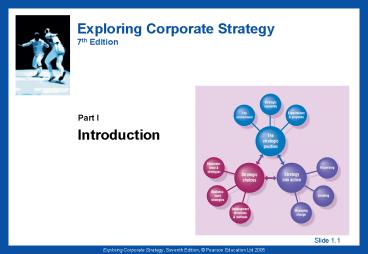
Exploring Corporate Strategy7th Edition
Part I Introduction
2
Exploring Corporate Strategy7th Edition
Chapter 1 Introducing Strategy
3
Introducing Strategy Outline
- What is strategy and strategic management?
- Strategic priorities at corporate, business and
operational level - Vocabulary of strategy
- Exploring Corporate Strategy strategic management
model
4
Definition of Strategy
- Strategy is the direction and scope of an
organisation over the long term, which achieves
advantage in a changing environment through its
configuration of resources and competences with
the aim of fulfilling stakeholder expectations.
5
Strategic decisions
Exhibit 1.1
6
Strategic Decisions are About
- The long-term direction of the organisation
- The scope of an organisations activities
- Gaining advantage over competitors
- Addressing changes in the business environment
- Building on resources and competences
(capability) - Values and expectations of stakeholders which
affect operational decisions
7
Strategic Decisions are Likely to
- Be complex in nature
- Be made in situations of uncertainty
- Affect operational decisions
- Require an integrated approach (both inside and
outside an organisation) - Involve considerable change
8
LEVELS OF STRATEGY
- Corporate level
- Determine overall scope of the organisation
- Add value to the different business units
- Meet expectations of stakeholders
- Business level (SBU)
- How to compete successfully in particular markets
- Operational
- How different parts of organisation deliver
strategy
9
The vocabulary of strategy
Exhibit 1.2
10
The Vocabulary of Strategy
- Mission overriding purpose
- Vision/strategic intent desired future state
- Goal general statement of aim or purpose
- Objective quantification or more precise
statement of goal - Strategic capability resources, activities and
processes - Business model how product, service and
information flow - Control monitoring of action steps
11
Strategy and Operations
Strategic Management Operational Management
Organisation-wide, holistic Routinised
Conceptualisation of issues Techniques and actions
Creating new directions Managing existing resources
Developing new resources Operating within existing strategy
Ambiguous/uncertain Operationally specific
Long term Day to day issues
12
Elements of Strategic Management
- Understanding the strategic position of an
organisation - Making strategic choices for the future
- Turning strategy into action
13
A model of the elements of strategic management
Exhibit 1.3
14
Strategic Position (1)
- The Organisations Environment
- Political Economic Social Technological Legal
Environmental - Sources of Competition
- Opportunities and Threats
- Strategic Capability of the Organisation
- Resources and Competences
- Strengths and Weaknesses
15
Strategic Position (2)
- Expectations and Purposes
- Corporate Governance, Stakeholders, Ethics and
Culture - Sources of Power and Influence
- Communication of Purpose Mission and Objectives
16
Strategic Choices
- Bases of competitive advantage at business level
- Scope of activities at corporate level
- Portfolio
- Market spread, e.g. international
- Value added by corporate parent (parenting)
- Directions and methods of development
- Directions Product/Market
- Methods Internal/organic, MA, strategic
alliances
17
Strategy into Action
- Structuring the organisation
- Marshalling resources (people, information,
finance, technology) - Managing change
18
Processes of Strategy Development
- Intended strategies
- Deliberate management intent
- Emergent strategies
- Develop out of social and political processes in
and around organisations
Most strategies are a combination ofintended and
emergent processes
19
Strategy as a Subject of Study
20
The Strategy Lenses (1)
- Strategy as design
- Logical analytical process
- Planned implementation
- Top manager driven
- Strategy as experience
- Adaptation of past strategies based on experience
- Influenced by taken for granted assumptions
(culture) - Bargaining and negotiation
21
The Strategy Lenses (2)
- Strategy as ideas
- Importance of variety and diversity for
innovation - Emergent strategy from within and around the
organisation - Top managers create the conditions for this to
take place
22
Three strategy lenses
Exhibit I.v
Recommended

