

Tract-Based Spatial Statistics of Diffusion Tensor Imaging in Adult Dyslexia PowerPoint PPT Presentation
1 / 1
Title: Tract-Based Spatial Statistics of Diffusion Tensor Imaging in Adult Dyslexia
1
Tract-Based Spatial Statistics of Diffusion
Tensor Imaging in Adult Dyslexia
Todd Richards1, Jeff Stevenson1, James Crouch2,
L. Clark Johnson3, Kenneth Maravilla1, Patricia
Stock4, Virginia Berninger41Dept. of Radiology,
University of Washington2School of Medicine,
Saint Louis University3Psychosocial Community
Health, School of Nursing, University of
Washington4Educational Psychology, University of
Washington
4
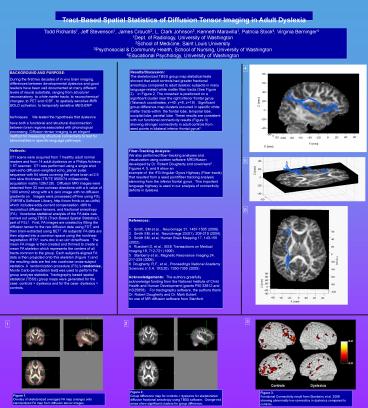
Results/Discussion The skeletonized TBSS group
map statistical tests showed that adult controls
had greater fractional anisotropy compared to
adult dyslexic subjects in many language-related
white matter fiber tracts (See Figure 2). In
Figure 2, The crosshair is positioned on a
significant cluster near the right inferior
frontal gyrus (Talairach coordinates, x45, y8,
z19) . Significant group difference map clusters
occurred in specific white matter tracts within
the frontal lobe, temporal lobe, occipital lobe,
parietal lobe. These results are consistent with
our functional connectivity results (Figure 3)
showing stronger connectivity in adult controls
from seed points in bilateral inferior frontal
gyrus5 .
BACKGROUND AND PURPOSE During the first two
decades of in vivo brain imaging, differences
between developmental dyslexics and good readers
have been well documented at many different
levels of neural substrate, ranging from
structural neuroanatomy to white matter tracts,
to neurochemical changes, to PET and rCBF , to
spatially sensitive fMRI BOLD activation, to
temporally sensitive MEG/ERP techniques. We
tested the hypothesis that dyslexics have both a
functional and structural disconnection between
brain regions associated with phonological
processing. Diffusion tensor imaging is an
elegant method for measuring structural
connectivity to test for abnormalities in
specific language pathways.
Methods DTI scans were acquired from 7 healthy
adult normal readers and from 14 adult dyslexics
on a Philips Achieva 1.5T scanner. DTI was
performed using a single shot spin-echo
diffusion-weighted echo_planar pulse sequence
with 64 slices covering the whole brain at 2.5 mm
slice thickness (TR/TE 9500/74 milliseconds
acquisition matrix 128x128). Diffusion MRI
images were obtained from 32 non-colinear
directions with a b value of 1000 s/mm2 along
with a b zero image with no diffusion gradients
on. Images were processed off-line using FSL
(FMRIB's Software Library, http//www.fmrib.ox.ac.
uk/fsl) which includes eddy-current compensation,
dtifit to reconstruct diffusion tensors, and
fractional anisotropy (FA). Voxelwise
statistical analysis of the FA data was carried
out using TBSS (Tract-Based Spatial Statistics1),
part of FSL2. First, FA images are created by
fitting the diffusion tensor to the raw diffusion
data using FDT, and then brain-extracted using
BET3. All subjects' FA data are then aligned into
a common space using the nonlinear registration
IRTK4, www.doc.ic.ac.uk/dr/software. The mean
FA image is then created and thinned to create a
mean FA skeleton which represents the centers of
all tracts common to the group. Each subject's
aligned FA data is then projected onto this
skeleton (Figure 1) and the resulting data are
fed into voxelwise cross-subject statistics. A
randomization procedure (FSL's randomise, Monte
Carlo permutation test) was used to perform the
group analysis statistics. Tractography based
spatial statistical (TBSS) group maps were
generated for the case controls gt dyslexics and
for the case- dyslexics gt controls.
Fiber-Tracking Analysis We also performed
fiber-tracking analyses and visualization using
custom software MRDiffusion developed by Dr.
Robert Dougherty and coworkers6 . Figures 4, 5,
and 6 show an example of the IFG-Angular Gyrus
Highway (Fiber tracts) that resulted from a seed
point/fiber tracking analysis stemming from the
inferior frontal gyrus. This important language
highway is used in our analysis of connectivity
deficits in dyslexia.
5
6
References 1. Smith, SM et al.,. Neuroimage
31, 1487-1505 (2006).2. Smith SM, et al,
NeuroImage 23(S1), 208-219 (2004).3. Smith SM,
et al, Human Brain Mapping 17, 143-155 (2002).
4. Rueckert D, et al., IEEE Transactions on
Medical Imaging 18, 712-721 (1999) .5.
Stanberry et al., Magnetic Resonance Imaging 24,
217-229 (2006). 6. Dougherty, R,F., et al.,
Proceedings National Academy Sciences U S A,
102(20), 7350-7355 (2005) Acknowledgements The
authors gratefully acknowledge funding from the
National Institute of Child Health and Human
Development (grants P50 33812 and HD25858). For
tractography software, the authors thank Dr.
Robert Dougherty and Dr. Mark Eckert for use of
MR diffusion software from Stanford.
3
2
1
Figure 2. Group difference map for controls gt
dyslexics for skeletonized diffusion fractional
anisotropy using TBSS software. Orange-red areas
show significant clusters for group difference.
Figure 3. Functional Connectivity result from
Stanberry et al. 2006 showing abnormally low
connectivy in dyslexics compared to controls.
Figure 1. Overlay of skeletonized averaged FA
map (orange) onto standardized FA map from
diffusion tensor images.
Recommended

