

Two types of T cells PowerPoint PPT Presentation
1 / 31
Title: Two types of T cells
1
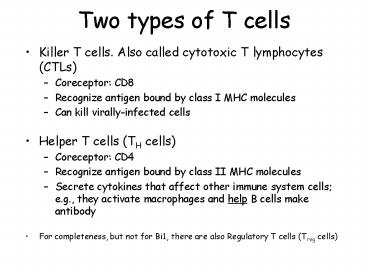
Two types of T cells
- Killer T cells. Also called cytotoxic T
lymphocytes (CTLs) - Coreceptor CD8
- Recognize antigen bound by class I MHC molecules
- Can kill virally-infected cells
- Helper T cells (TH cells)
- Coreceptor CD4
- Recognize antigen bound by class II MHC molecules
- Secrete cytokines that affect other immune system
cells e.g., they activate macrophages and help B
cells make antibody - For completeness, but not for Bi1, there are also
Regulatory T cells (Treg cells)
2
To understand T cells, we have to understand the
MHC proteins that present antigens to TCRsMajor
Histocompatibility Complex (MHC)
- First discovered by tumor immunologists working
with inbred mice. - Grow tumors by passaging them in mice. Tumors
will only grow in the genetic strain they came
from.
3
Rejection of tumors results from differences in
normal cellular antigens
- The antigens causing tumor rejection are
polymorphic. Polymorphic genes different
between individuals. Each variant of a gene
called an allele. - Genes responsible for acceptance or rejection of
tumors defined as histocompatibility genes --
encode cellular structures that are polymorphic
within species but immunogenic enough to evoke a
rejection reaction.
4
- Genetic region that determines graft rejection is
called major histocompatibility complex (MHC). - The MHC encodes proteins (MHC class I molecules)
that determine the acceptance or rejection of a
graft. - Differences between foreign and self are due to
genetic polymorphisms among different
histocompatibility alleles. - Human MHC molecules are called Human Leukocyte
Antigens (HLA). - Human MHC class I molecules are encoded in three
loci HLA-A, HLA-B and HLA-C - Different alleles of HLA are numbered e.g.,
HLA-A1, HLA-B27, HLA-C3 - Within the human population, there are hundreds
of possible HLA-A alleles, hundreds of HLA-B
alleles, and hundreds of HLA-C alleles
5
Clicker question
- MHC polymorphism is the result of
- Differential (alternative) RNA splicing
- Gene recombination at the DNA level (as in
antibodies) - Mutation throughout the lifetime of an individual
- Inherited genetic differences
6
Clicker question
- There are hundreds of different of HLA-A
alleles, hundreds of HLA-B alleles, and hundreds
of HLA-C alleles. What is the maximum number of
different class I MHC proteins that any one
individual can express? - 1) One
- 2) Three
- 3) Six
- 4) Twelve
- Hundreds
- Millions
7
Loci encoding human class I MHC proteins are
HLA-A, HLA-B, HLA-C
Your class I MHC proteins HLA-A2, -A8, -B5,
-B27, -C3, -C3
My class I MHC proteins HLA-A2, -A28, -B6, -B48,
-C2, -C8
At least 100 alleles in human population at each
locus. MHC genes are most polymorphic genes in
genome of every species analyzed.
8
Clicker question
- You need an organ transplant so you want to find
a donor who is most closely matched to your HLA
haplotype. In the absence of knowing your HLA
haplotype or anyone elses, from which of the
following people is it safest for you to obtain a
donated organ?
- Your mother
- Your father
- Your fraternal twin
- One of your other siblings
- Your roommate
- Your Bi1 TA
Your set of HLA proteins e.g., HLA-A2, -A8,
-B4, -B7, -C1, C8 plus your class II MHC
molecules -- more about these later.
9
- Your mother
- HLA-A2, HLA-Aw68
- HLA-B5, HLA-B27
- HLA-Cw1, HLA-C4
Your father HLA-A28, HLA-A44 HLA-B53,
HLA-B55 HLA-Cw7, HLA-C18
You HLA-A2, HLA-A28 HLA-B27, HLA-B53 HLA-C4,
HLA-C18
Note 1 the scenario in which you are a perfect
match with one of your siblings and completely
mismatched with another is theoretically
possible, but unlikely.
Note 2 Class I MHC molecules are expressed on
all nucleated cells. Each cell expresses all
class I molecules, not a subset.
Sibling 1 HLA-Aw68, HLA-A44 HLA-B5,
HLA-B55 HLA-Cw1, HLA-Cw7
Sibling 2 HLA-A2, HLA-A28 HLA-B27,
HLA-B53 HLA-C4, HLA-C18
10
Clicker question
- Why does a woman tolerate a fetus?
- 1) The fetus has the same MHC molecules as its
mother. - 2) Half of the fetus MHC proteins are the same
as the mothers -- this is enough to prevent
graft rejection. - 3) The outermost layer of the placenta does not
express MHC molecules. - 4) She only tolerates it for 9 months, then she
rejects it. - Tolerating a fetus is good practice for
tolerating a teenager later. - No one knows.
11
Clicker question
- Why did the immune system evolve to reject
transplanted organs? - 1) To prevent animals from exchanging grafts in
the wild. - 2) To frustrate transplantation surgeons.
- 3) To force Bi1 students to learn about
histocompatibility and MHC molecules. - 4) Because graft rejection is a by-product of an
essential immune function.
12
Zinkernagel Doherty, 1974
Infect mouse with virus A. Isolate cytotoxic T
lymphocytes (CTLs or killer T cells) from
spleen of mouse X. Look for killing of
virally-infected target cells derived from self
(X) or non-self (Y) mouse.
See Bi1 website for link to Zinkernagel and
Dohertys 1996 Nobel prize for this experiment.
13
Clicker question
- Which of the following scenarios explains
Zinkernagel and Dohertys data?1) T cells have
two types of receptor one for antigen and the
other for MHC. Both receptors must be occupied to
get killing. - 2) T cells have one type of receptor, which
recognizes a complex between the MHC molecule and
the antigen. - 3) Both scenarios explain the data.
- 4) Neither scenario explains the data.
14
TCR recognizes a viral antigen and an MHC
molecule, perhaps in a complex. One receptor, two
receptors?
Antibodies recognize free and cell-bound antigens
independent of MHC proteins
15
Now understood thatTCRs recognize antigen in
the form of a peptide bound toan MHC protein.
Viral proteins aredegraded into peptides
inside cells and presented on class I MHC
proteinsfor recognition byT cell receptors
(TCRs) on cytotoxic T lymphocytes (CTLs or
killer T cells).
The receptors on B cells (antibodies) are made in
both membrane and secreted forms.
Peptide A short fragment of a protein. In
general, a peptide is considered to be a protein
if it is 50 amino acid residues. The peptides
presented by class I MHC molecules are 7-10
residues.
The receptors on T cells (TCRs) exist only as
membrane-bound proteins.
16
- Note that T cell mediated responses are
restricted to CELLS, whereas antibodies can see
soluble antigens (e.g., viruses). T cells cant
kill viruses, can only kill virally-infected
cells. - Viruses can mutate rapidly so can easily destroy
antibody epitope, then virus cant be
neutralized. Mutated virus goes on to infect
cells, but infected cells can be killed by T
cells. Unlikely that virus can make all peptide
sequences different to prevent binding to all MHC
molecules.
17
Class I MHC proteins
18
Crystal structure of HLA-A2
- Peptide binding site identified as groove between
a1 and a2 domain helices allele-specific
differences cluster in groove. - Groove was occupied by mixture of peptides
although cells from which protein was purified
were not expected to be presenting antigen. - Implies that MHC proteins always presenting
peptides -- why dont T cells recognize MHC/self
peptides and kill uninfected cells?
19
Remember Viral proteins are degraded inside
cells and presented onclass I MHC proteins for
recognition by TCRs on cytotoxic T lymphocytes
(CTLs or killer T cells).
- MHC molecules are (almost) always occupied with
peptides (usually self peptides, occasionally
non-self peptides), so T cell has be able to
distinguish. - Auto-immune diseases result from T cells that
mistake a harmless self peptide for a dangerous
non-self peptide. - Graft rejection results from a cross-reaction in
which non-self MHC plus peptide Y (random self
peptide) looks like self MHC plus peptide X
(pathogen-derived peptide).
The receptors on T cells (TCRs) exist only as
membrane-bound proteins.
20
Variable residues located within peptide-binding s
ite create different environments for binding
different types of peptides
21
Allele-specific peptide binding motifs
Allele 1
Allele 2
Different class I MHC molecules bind to different
types of peptides, but peptides that bind to
every allele are (almost) always 7-10 residues
long and usually have a hydrophobic C-terminus.
Class I MHC-binding peptides can be predicted by
computational analysis of protein sequences. See
link on reading/links for todays lecture on Bi1
website.
Janeway et al., The Immune System in Health and
Disease Garland Publishing
22
DR and Dw molecules are class II MHC proteins.
Goldsby, Kindt, Osborne, Kuby. Immunology, 5th
edition.
23
Rusty, the narcoleptic dog
lthttp//www.devilducky.com/media/8232/
24
Review The cellular immune response evolved to
deal with viruses that mutate and hide out in
cells
- Many viruses, including HIV, rapidly mutate so
that antibodies produced against one strain dont
react with new strains. - Another problem once a virus enters a cell,
antibodies cant access it, so it can make
thousands of copies of itself. - The cellular immune response (T cell mediated)
can usually deal with both viral mutations and
intracellular viruses.
25
Comparison of antibody versus T cell epitopes on
a model antigen shows how the antibody-mediated
(humoral) and cellular immune responses are
complementary
Discontinuous epitopes (adjacent in 3D space, but
not in sequence) on the surface of a protein are
recognized by antibodies.
Linear epitopes recognized by TCRs.Note red
epitope is in interior ofprotein and only
accessible afterunfolding and proteolytic
degradation.
Easier for a viral protein to mutate to escape
antibodies than to escape from T cells
Janeway et al. (2001) Immunobiology The immune
system in health and disease. Garland Publishing,
5th edition
26
Clicker question
- At what level is the polymorphism of MHC
molecules a benefit? - A) An individual ? has a variety of MHC proteins
to present various antigens. - B) A population ? not wiped out by a single viral
infection. - C) Both.
27
Clicker question
- Heterozygosity of MHC is advantageous because it
doubles the chances that a given antigen will be
presented. - How is MHC heterozygosity maintained in a
population?
- Completely homozygous individuals are non-viable.
- MHC molecules mutate throughout an individuals
lifetime. - Different cells express different MHC alleles, so
homozygous individuals become heterozygous. - Individuals prefer mates that express different
MHC alleles than theirs.
28
MHC and behavior
- Heterozygosity of MHC is advantageous because it
doubles the chances that a given antigen will be
presented. - How is MHC heterozygosity maintained in a
population?
Answer MHC affects mating choice
- Mice preferentially mate with mice that are MHC
disparate. - Female mice will spontaneously abort a fetus
that is MHC-similar if they smell urine from a
male that is MHC disparate (the Bruce effect). - T shirt study suggests similar mechanism
influences mate choice in humans (link to this
paper on Bi1 website). - MHC-based dating service (see link on Bi1
website).
29
(No Transcript)
30
Clicker question
- Smell is very important to me in choosing a
boyfriend/girlfriend. - 1) True
- 2) False
31
MHC heterozygosity delays the progression to AIDS
in HIV-infected individuals
Heterozygous for MHC I and II Homozygous for one
MHC locus Homozygous for two or three loci
Recommended

