

Great Speeches (re)framing the rhetorical tradition in English PowerPoint PPT Presentation
1 / 29
Title: Great Speeches (re)framing the rhetorical tradition in English
1
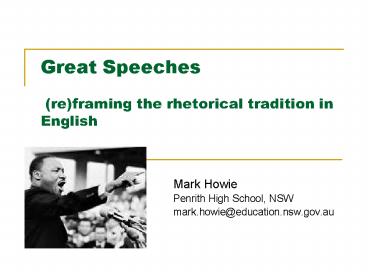
Great Speeches (re)framing the rhetorical
tradition in English
- Mark Howie
- Penrith High School, NSW
- mark.howie_at_education.nsw.gov.au
2
Workshop aims
- challenge common criticisms of English curriculum
pedagogy - argue that English is a subject in the process of
becoming that change is not antithetical to
tradition - suggest a framework for a coherent approach to
teaching Speeches - make case for Speeches as an education in legacy
of Enlightenment reclaiming the Western
tradition.
Socrates a kind of gadfly to a big generous
horse
3
English -a site of (incoherent) moral panic?
- NSW HSC teacher talking about English on the
Sunday program (July, 2006) - Students would have to look at a feminist
reading of Gwen Harwood. And they would also have
to look at a Christian reading and a romantic
reading to give a variety. instead of teaching
the students to be critical, they are having to
grapple with these theories in such a short space
of time that they have to rote learn a little bit
in order to pass and I think what tragically gets
lost is their own their own interpretations of
the poem. - Questions
- is theory a barrier to a personal response?
- can we even have an untheorised (or unmediated)
interpretation / response? - do we not read (in English) within a community,
with a sense of history and tradition, in
particular ways and for particular purposes (even
if these have changed over time)?
4
English -a site of (youthful arrogance) moral
panic?
- HSC STUDENT, featured on the Sunday program
- It is sort of like you are spewing out what the
Board of Studies wants you to say. It is not this
is what I thought, this is an original unique
thought it is this is what these people have
said through time and this is what I am going to
say now.this is not a way to learn. We are not
learning anything really, we are not thinking for
ourselves which is what we are going to need to
do when we leave school.I feel let down. - Questions
- where and how did this student get the idea that
understanding what others have thought and said
is not important, not worth knowing and does not
even amount to learning? - is the idea that meaning and understanding are
arrived at dialectically and dialogically such a
radical idea? - has there ever been a time in which senior
English students have not engaged with the
interpretations of others?
5
Great Speeches Recent Publications
6
Great speeches speechwriters memoirs
7
Great speeches ABC/RN
8
Speeches the NSW context
- HSC elective choice in Advanced English
- set for Module B Critical Study
- BOS collection (available on web) begins with
Socrates and ends with Mary McAleese - includes speeches by Cicero, Lincoln, Luther
King, Havel, Keating, Pearson, Suu Kyi, Atwood
(amongst others)
9
The NSW Syllabus Module B
- Students explore the ideas expressed in the text
through analysing its construction, content and
language. They examine how particular features of
the text contribute to textual integrity. They
research others perspectives of the text and
test these against their own understanding and
interpretations of the text. Students discuss and
evaluate the ways in which the set work has been
read, received and valued in historical and other
contexts. They extrapolate from this study of a
particular text to explore questions of textual
integrity and significance.
10
The sacred the profane English change
Model Key ideas Module B
Cultural Heritage moral education aesthetic sensibility offered by (great) literature a superior imaginationpropagation of cultural traditions, values timeless human truthsfocus on genius use of language the ways the text has been read, received and valued questions of textual significance
New Criticism single text is focus eschews authorial intent reader response works to expose unity of text- how elements support unifying themevalues complexity unifying of ambiguities, ironies, tensions analysing (construction, content, language)how particular features contribute to textual integrity
Growth / reader response readers processes developing response the focusreaders actively make meaning(reading communities process) Students explore / analyse /discuss evaluate / research others perspectives
11
The sacred the profane English change
Model Key ideas Implications
Post-structuralism Contextual shaping of meaning The social cultural function of textsDeath of the author / the author function(denial of authorial intention)Meaning refuses closure is contradictory indeterminate ways text has been read, received and valued in (different) contextsquestions of textual integrity and significance how particular features of the text contribute (or do not contribute) to textual integrity
Cultural studies critical literacy The representational ideological nature of texts Alternative ( resistant) readings questions of significance valuetesting own understanding against others
12
Tensions in English rhetoric a more inclusive
subject field?
- Terry Eagleton
- Rhetoric saw speaking and writing not merely
as textual objects, to be aesthetically
contemplated or endlessly deconstructed, but as
forms of activity inseperable from the wider
social relations between writers and readers,
orators and audiences.rhetoricans studied
language devices in other peoples language in
order to use them more productively in their own.
It wasa creative as well as a critical
activity. Literary Theory, 1983, 206-207
13
Tensions in English rhetoric a more inclusive
subject field?
- Richard Andrews
- a rhetorical perspective allows us to see that
our subject is profoundly democratic (rhetorics
classical function) in that it foregrounds
argument and enables language to accept and
explore difference.placing language as the more
central issue than literature, at the same time
it enhances and clarifies the function of
literature and narrative in our societies
.against reductive back to basics discourses
it draws on centuries of concern with language in
society and politics. - (The Future of English, E in A, 106, Dec. 1993)
14
Programming starting points
- Focus of unitHow meaning is made through
responding to a particular text in different
contexts to develop understandings of textual
integrity. - Synthesis in approach and a balanceThe
importance of responding to the speeches the
interpretations of others in a critical
evaluatory way. - Developing a personal response centered in the
text (but moves beyond it), developmental,
multi-layered tested against that of others
(ie dialectical dialogic in nature).
15
Phase 1
Phase 2
Phase 3
Phase 4
A Transformative Model of Programming (Howie,
2003)
16
Sequencing learning
- A possible way of sequencing teaching and
learning - Phase 1 engaging students with the text and its
ideas - Phase 2 exploring how these ideas are expressed
in the text through analysis of its construction,
content and language, and examining how
particular features of the text contribute to
textual integrity - Phase 3 researching others perspectives of the
text and testing these against their own
understanding and interpretations, in the process
considering and evaluating the ways in which the
set work has been read, received and valued in
historical and other contexts - Phase 4 affirming a deep personal critical
understanding of the text through exploring
questions of textual integrity and significance.
17
Framing Module B
- Following MacLachlan and Reid (Framing and
Interpretation,1994), the term frame is used in
the model outlined here as emphasis on framing
draws attention to agency and acknowledges the
complex nature of the interpretive process
(p.9). (cf Module emphasis on personal) - The term draws attention to the ways in which
participants in any act of interpretation
interact with each other to produce meaning. - It suggests a reciprocal activity something
readers do to texts and something texts do to
readers - raising issues of interpretative
freedom and control. - It is an alternative to deterministic idea of
CONTEXT as given existing independently of an
act of interpretation
18
Framing Module B
- Circumtextual framing the mediating context of
production. Raises questions such as who has
produced this text? why have they produced it?
who have they produced it for? what meaning(s) do
they expect or want to be made from the text? The
placement of a text in a particular communicative
space, in this case Module B (Advanced) English
in NSW as prescribed by the requirements of the
BOS, will shape the meaning we will, and indeed
are able to make. - Intratextual framing the structural,
subdivisional and other internal framing devices
(eg chronological or non-chronological
arrangement of speeches in BOS collection)
19
Framing Module B
- Extratextual framing the influence of outside
information, unspecified by the text but felt to
be presupposed by it the drawing on our
accumulated knowledge of the world (experiential
and textually mediated). - Intertextual framing the relating of one text or
text-type to another. (Obviously, how a
particular speech might refer directly to
another- Lincoln / Martin Luther King) or echo
another (McAleese / Socrates). In the framework I
am also proposing this will include students
relating different stages of their own response
to each other.)
20
Framing Module B phased textual orientation
Phase Textual Orientation Context(s)
1. Subjective Promoting personal engagement. Engaging students with the text and its ideas, and initial consideration of aspects of the circumstances of reception beyond the personal context of the responder. Circumtextual Extratextual Personal Social Cultural
2. Structural Developing an informed personal response.Exploring analysing how ideas are expressed in the text how particular features of the text contribute to textual integrity. Intratextual PersonalSocial Cultural Historical
21
Framing Module B phased textual orientation
Phase Textual Orientation Context(s)
3. Cultural Investigating and evaluating criticism and other ways of understanding the text. Extratextual Personal Cultural Historical
4. Critical Refining the personal response.Affirming a deep critical and evaluative understanding of the text through exploring questions of textual integrity and significance. Intertextual Personal Social Cultural Historical
22
Speeches framing a program
Phase 1 Subjective Framing Context Key Questions
Circumtextual Personal Social What might students personally gain from studying the speeches? What broader social purposes are served by having students study these speeches?
23
Speeches framing a program
Phase 2 Structural Framing Context Key Questions
Intratextual Historical Cultural What rationale might be provided for this particular collection of speeches orators? What can be said about who and what has been included? How might the arrangement of orators and speeches be explained? Focus on close linguistic analysis of individual speeches
24
Speeches framing a program
Phase 3 CulturalFraming Context Key Questions
Extratextual Personal Historical Cultural The immediate historical context in which a particular speech was delivered and its reception? How do individual speeches relate to the tradition of rhetoric? What other understandings of the speeches will students engage with in developing their own understanding? What historical and cultural understandings will students develop in studying the speeches? Why are these important?
25
Speeches framing a program
Phase 4 Critical Framing Context Key Questions
Intertextual Historical Cultural In what way(s) do these speeches relate to each other in terms of their ideas? What meanings are generated by reading the individual speeches as a collection? What similarities and differences are there between the speeches in terms of construction, content, language? How do particular speeches conform to or break with particular understandings of rhetoric (eg Aristotelian)? How are the speeches to be compared and evaluated in terms of textual integrity and value?
26
Speeches the legacy of the Enlightenment the
values traditions of western liberal democracy
- EXTRACT FROM ESSAY INTRO establishing notion of
reception valuation in different contexts - These speeches are representative of the
universal ideals of the Enlightenment, promoting
freedom, reason and truth through the employment
of rhetoric. The tradition of rhetoric remains an
essential feature of the critical analysis of
texts in contemporary society, further signifying
the relevance and worth of the speeches to an
audience being educated in the art of effective
communication and critical thinking. Furthermore,
the texts raise several fundamental themes,
uniting common goals including the search for
reason and meaning in life, humanitys
responsibility to create a virtuous society, and
the need for unprejudiced co-existence and
understanding.
27
Speeches the legacy of the Enlightenment the
values traditions of western liberal democracy
- EXTRACT FROM ARGUMENT synthesising perspectives
in a personal response - .Reading Socrates speech through Aristotelian
standards of rhetoric, it is evident no attempt
is made to establish a good character for, nor
does he endeavour to favour the emotional state
of, his immediate audience, the jury. The
frequent use of high modality reinforces this
argument, apparent in the line, you may acquit
or not, but I shall not alter my conduct, no, not
if I have to die a score of deaths, and
similarly in the use of the active voice against
the jury, thou doest wrong. Lacking remorse and
reticence, which one would expect from a man on
trial for his life, such statements insinuate
Socrates intended audience was history, rather
than his contemporary addressees.
28
Speeches the legacy of the Enlightenment the
values traditions of western liberal democracy
- EXTRACT FROM ARGUMENT synthesising perspectives
in a personal response - .McAleese adds further weight to the
universality of her position, and engages an
audience beyond the immediate audience to which
she was speaking, by making use of history and
international law to gain credence and present
her views as learned and reasoned. This
rhetorical technique of an appeal to external
authority is demonstrated in her references to
Article 19 of the Declaration of Human Rights,
the Magna Carta and historical events such as
the immigrant issueaffecting so many countries,
including my own. Thus McAleese submits an
articulate, rational case which consequently
becomes worthy of study as an example of rhetoric
and for its promotion of virtuous values and
societal mores such as freedom of speech and
empathy across cultures.
29
Speeches the legacy of the Enlightenment the
values traditions of western liberal democracy
- EXTRACT FROM CONCLUSIONIn evaluating the
speeches of Socrates, McAleese and Cicero, it
becomes apparent all, despite their differing
historical and social contexts, transcend time
and remain of great value to contemporary
audiences. The effective use of rhetorical
devices furthers their enduring relevance and
significance to humanity, enhancing the
authoritative and virtuous nature of each
orator.all are undeniably worthy of recognition
in the 21st century as furthering the ideals,
aspirations and enduring ideologies of Western
European culture.
Recommended

