

Chp 3: Hormonal Influences on Female Sex Behavior PowerPoint PPT Presentation
Title: Chp 3: Hormonal Influences on Female Sex Behavior
1
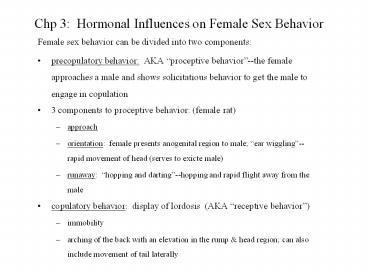
Chp 3 Hormonal Influences on Female Sex Behavior
- Female sex behavior can be divided into two
components - precopulatory behavior AKA proceptive
behavior--the female approaches a male and shows
solicitatious behavior to get the male to engage
in copulation - 3 components to proceptive behavior (female rat)
- approach
- orientation female presents anogenital region
to male ear wiggling--rapid movement of head
(serves to exicte male) - runaway hopping and darting--hopping and
rapid flight away from the male - copulatory behavior display of lordosis (AKA
receptive behavior) - immobility
- arching of the back with an elevation in the rump
head region can also include movement of tail
laterally - .
2
Quantification of Proceptive and Receptive
Behaviors
- It may be important to determine the degree of
proceptivity or receptivity of a given female,
especially when looking at interactions between
individuals. - Ex. quantification of lordosis behavior
- strength of lordotic posture
- frequency of lordosis
- duration of lordosis
- lordosis quotient is calculated as a measure of a
females receptivity - lordotic postures by female/10 mounts by
male X 100 LQ - if a female shows 5 lordotic postures to 10
mounts by male, then LQ50 this would be
considered a moderately receptive female.
3
Hormonal Influences on Female Sex Behavior
- Estrogen and progesterone play an important role
in female sex behavior. - Considering the female rat as a model
- estrogen
- enhance attractivity of the female to the male
(increasing production of pheromones and
vocalizations) - induce a GnRH surge that will lead to an LH surge
and subsequently ovulation - estrogen and progesterone
- increase females willingness to approach a male
and to show solicitious behavior - these hormones will couple sex behavior with
ovulation - progesterone has biphasic effects on female sex
behavior - initially, increases in progesterone will
stimulate female sex behavior - prolonged exposure to progesterone will inhibit
female sex behavior
4
Hormonal Influences on Female Sex Behavior
- In many mammalian species, females show
precopulatory and copulatory behaviors at
specific times during their reproductive cycle. - Definitions
- estrus refers to the day in which ovulation
occurs - behavioral estrus refers to the period of time
during which female shows precopulatory and
copulatory behaviors (AKA--behavioral heat) - estrus cycle series of ovarian events that
determines when an animal comes into estrus - In females that ovulate spontaneously, the
duration of an ovarian cycle can vary - 4 days mice, rats and hamsters
- 16 days guinea pigs
- 28 days humans
5
Ovarian Cycle
- There are 3 main phases of ovarian cycle
- follicular phase series of hormonal events
GnRH--gtLH FSH--gtestrogen - FSH stimulates primary follicles to enlarge and
differentiate into inner granulosa cell layer and
an outer thecal cell layer oocyte (egg) may also
complete development - LH and FSH act together to produce estrogen LH
stimulates thecal cells to produce androgens, and
androgens are converted to estrogens in granulosa
cells via aromatase FSH increases aromatase
activity in granulosa cells - lasts 2-3 days in rodents and 10-14 days in
humans - periovulatory phase
- as follicle matures, rate of estrogen secretion
increases - in female rats, increase in estrogen will
stimulate a GnRH surge followed by an LH
surge--gtLH surge will cause the ovarian follicle
to rupture--gtrelease the egg a rise in LH also
induces a preovulatory surge of progesterone
release from ovaries - lasts about 12 hours in most rodents in humans
it occurs over a period of 1-2 days
6
Ovulation and GnRH Surge in Rats
- Ovulation
- as follicles develop in ovary
- increasing levels of estrogen are released
- in female rats, increases in estrogen lead to a
GnRH surge (positive feedback) - GnRH surge leads to LH surge
- LH surge leads to ovulation
- male rats are unable to show a GnRH surge in
response to increases in estrogen
GnRH Neuron
HYPO
GnRH
ANT PIT
FSH LH
Estrogen
OVARY
GnRH gonadotropin-releasing hormone FSH
follicle stimulating hormone LH luteinizing
hormone
7
Ovarian Cycle
- luteal phase
- once the follicle has ruptured and expelled its
egg into Fallopian tube (oviduct), the remaining
follicle may be transformed into the corpus
luteum - corpus luteum secretes progesterone which is
important for 1) implantation of the egg into
the uterine wall, and 2) maintenance of pregnancy - in some species, corpus luteum is spontaneously
functional, in other species, vaginal-cervical
stimulation during copulation is required for
formation of corpus luteum - length varies depending on species in humans,
lasts 10-12 days - menstrual phase (species dependent)
- see uterine bleeding in species that have long
ovarian cycles (primates) - during luteal phase, estrogen and progesterone
prepare uterus for implantation - if the egg is not fertilized, then no embryo will
implant into uterine wall, the corpus luteum will
regress (die) - drop in estrogen and progesterone levels will
lead to sloughing off of the uterine wall
(endometrium)--uterine bleeding
8
(No Transcript)
9
Female Rat Estrous Cycle
- day 1--metestrus
- early ovarian hormone secretion is relatively
low - late start of follicular activity
- day 2--diestrus
- follicles continue to develop, see significant
increases in estrogen levels - day 3--proestrus
- early see further increases in estrogen
- late estrogen levels peak mid-late proestrus
the rise in estrogen stimulates GnRH and LH
surges the rise in LH will also stimulate
preovulatory rise in progesterone - day 4--estrus
- early ovulation (resulting from increases in
estrogen and LH), and behavioral
estrus--proceptive and receptive behaviors
(resulting from increases in estrogen and
progesterone) - late declining levels of estrogen and
progesterone - depends on whether female engages in copulation
follicular phase
periovulatory phase
luteal phase
10
Formation of the Corpus Luteum
- Spontaneously Functional
- following ovulation, the corpus luteum forms and
secretes progesterone (and estrogen) for several
days - Ex humans
- Not Spontaneously Functional
- corpus luteum will not form unless female engages
in copulation - Ex rats
- critical stimulus--intromissions
- (insertion of penis into vagina by male) will
stimulate a neuroendocrine reflex in the female
leading to release of PRL which then acts to form
the corpus luteum
PRL Neuroendocrine Reflex
PRF Neuron
HYPO
PRF
ANT PIT
PRL
spinal cord
follicle
egg
OVARY
vaginocervical stimulation
progesterone
corpus luteum forms
PRF prolactin releasing factor PRL prolactin
11
Hormones and Female Sex Behavior
- How do gonadal steroids affect the nervous system
to stimulate sex behavior? - Female rat as a model
- both estrogen and progesterone are needed to
stimulate female sex behavior--if you
ovariectomize (OVX) a female rat, she will not
show proceptive nor receptive behaviors - if you OVX a female rat administer estrogen for
1 to 2 days single injection of
progesterone--gtsex behavior will occur 4 hours
after the progesterone injection (activational
effects of gonadal sterodis) - rise in estrogen primes the brain to respond to
progesterone - rise in progesterone times the onset of
behavioral estrus - ventromedial nucleus of the hypothalamus (VMH)
plays an important role in hormonal modulation of
lordosis - estrogen and progesterone act, in part, at the
VMH to stimulate the display of lordosis in
response to mounting by a male
12
Ventromedial Nucleus of the Hypothalamus
- VMH is critical for hormone-mediated lordosis
behavior - bilateral lesions of VMH can reduce or eliminate
lordosis - estrogen and progesterone act at the VMH to
activate female sex behavior - if OVX an adult female rat, lordosis behavior
will not be shown - if you give estrogen for 2 days followed by a
single injection of progesterone, lordosis
behavior will be shown 4 hours later - if you implant estrogen capsules within the VMH
and administer progesterone systemically,
lordosis behavior will be shown (estrogen acts
specifically within VMH to stimulate lordosis
this is also true for progesterone) - mechanism (genomic)
- increases in estrogen lead to increases in ER
within lateral VMH - estrogen binds to ER induce expression of PR
(genomic mechanism) - rising progesterone levels then bind to PR induce
the expression of other proteins that serve to
activate lordosis (genomic mechanism) - know that protein systhesis is critical to
facilitation of lordosis--1) administration of a
protein synthesis inhibitor inhibits lordosis,
and 2) time-frame for effects to be seen takes
3-4 hours - neurons within VMH project to PAG changes in
synthesis of proteins in VMH neurons leads to an
increased state of excitability of neurons within
the PAG that control motoneurons within brainstem
and spinal cord
13
Ventromedial Nucleus of the Hypothalamus
- What proteins are synthesized within the VMH that
can lead to an increased state of excitability of
neurons within the PAG? - Recent evidence suggests
- evidence that estrogen and/or progesterone can
increase the number of oxytocin receptors within
VMH--gtadministration of oxytocin can stimulate
female sex behavior (specific to VMH?) - oxytocin may facilitate lordosis by altering
other responses such as decreasing aggressive
behavior or increasing pair-bonding - evidence that estrogen can increase the number of
acetylcholine receptors within VMH--gtadministratio
n of acetylcholine within VMH can stimulate
female sex behavior (this effect is also seen
other brain areas) - evidence that estrogen can also increase a 70,000
MW protein--an isoform of phospholipase C that is
transported to the midbrain periaqueductal gray - How do these changes lead to increased
excitability of PAG neurons? - not presently known
14
Periaqueductal Gray
- PAG--via input from VMH--is critical for
hormone-mediated lordosis behavior - lesions of the PAG can block display of lordossis
- PAG integrates hormonal and sensory inputs
- the PAG must receive excitatory input from VMH
(critical)--gtincreased excitability of PAG
neurons - when a male mounts a female, somatosensory
information will be relayed to the PAG to
activate lordosis - the PAG will excite neurons within the reticular
formation of the brainstem (medulla) - reticular formation integrates sensory and motor
responses (within the spinal cord) for the
display of lordosis--immobility, arching of head
and rump and movement of tail laterally - PAG also contains ERs, so estrogen may also act
at the PAG to facilitate the display of lordosis
15
Medial Preoptic Area
- Neurons within MPOA can have inhibitory and
facilitatory effects on lordosis. - Inhibitory
- estrogen-responsive neurons in MPOA project to
the VMH and PAG - neurons within the MPOA have inhibitory effects
on lordosis - lesion neurons within dorsolateral
MPOA--gtfacilitation of lordosis - stimulate neurons within dorsolateral
MPOA--gtinhibition of lordosis - estrogen can act to decrease electrophysiological
activity of MPOA neurons - current theory estrogen acts at VMH to increase
excitatory drive on lordosis, while decreasing
inhibitory tone by decreasing activity of
neurons within MPOA - Stimulatory
- GnRH neurons are also present throughout MPOA
(located more medially) - GnRH secretion into median eminence
(neurohormone) will lead to follicular
development, estrogen secretion, preovulatory
rise in progesterone, LH surge and ovulation - GnRH can also be secreted within brain
(neurotransmitter) GnRH receptors are present
within VMH and PAG, and administration of GnRH
into VMH and/or PAG can facilitate lordosis
16
Progesterone
- Progesterone has biphasic effects on sex behavior
in the female rat - progesterone interacts with PRs to stimulate the
display of lordosis (as well as the display of
proceptive behaviors) - prolonged exposure to progesterone can inhibit
sex behavior - Mechanism of inhibitory effects
- progesterone can lead to a decrease in the number
of PRs and ERs (considered a refractory state) - It is essential that the elevations in estrogen
and progesterone drop to low levels so that
elevations in these two hormones can effect
changes in protein synthesis within the brain to
effect changes in behavior.
17
Dopamine
- Dopamine is a neurotransmitter synthesized within
two main cell groups - substantia nigra
- dopaminergic neurons project to the basal ganglia
to control general locomotion and execution of
stereotyped movements - ventral tegmental area
- dopaminergic neurons project to nucleus accumbens
to control motivated behavior - Background information
- estrogen can facilitate release of dopamine and
hence dopamine-mediated processes - further, it is known that dopamine is released
within the basal ganglia and nucleus accumbens of
female rats during sex behavior - Thus, estrogen-enhanced release of dopamine
within the basal ganglia and nucleus accumbens
most likely acts to promote proceptive behaviors.
Note dopaminergic activity is not believed to
be important for the display of lordosis.
18
Species Differences in Periovulatory Period
- In rats
- as follicles mature and grow in size, estrogen
levels increase - increase in estrogen leads to a GnRH surge, an LH
surge, and the LH surge leads to ovulation
(deterministic model) - the rise in LH also stimulates secretion of
progesterone from the ovary - preovulatory rise in progesterone acts to couple
behavioral estrus with ovulation (estrus) - if mating occurs, the corpus luteum will form and
secrete progesterone (luteal phase) - In primates
- as follicles mature and grow in size, estrogen
levels increase - increase in estrogen leads to increased
sensitivity of the pituitary to GnRH, the
pituitary secretes more LH to a given amount of
GnRH (LH surge), and the LH surge leads to
ovulation (permissive model) - there is no preovulatory rise in progesterone
- the corpus luteum will form spontaneously and
secrete progesterone during the luteal phase
19
Species-Specific Patterns--Sex Behavior
Ovulation
- spontaneous ovulation
- a series of hormonal events lead to the
occurrence of ovulation - Ex rats (hormonal events also time the
occurrence of behavioral estrus) - Ex humans
- induced ovulation
- behavioral estrus occurs in spontaneous cycles,
but ovulation does not occur without copulation - Ex rabbits, cats and ferrets
- induced estrus and ovulation
- both behavioral estrus and ovulation are induced
by specific stimuli external to the female - Ex prairie vole
20
Induced Ovulation
- the ovaries produce waves of follicles, and
follicles secrete estrogen - increasing levels of estrogen stimulate
behavioral estrus - progesterone is not needed to stimulate sex
behavior - vaginocervical stimulation (via intromissions
from male) will activate a neuroendocrine reflex
resulting in GnRH release - GnRH release will lead to LH surge and ovulation
- subsequent production of progesterone will
maintain pregnancy if necessary
GnRH Neuroendocrine Reflex
GnRH Neuron
HYPO
GnRH
ANT PIT
stimulate sex behavior
LH FSH
LH
spinal cord
follicle
estrogen
OVARY
vaginocervical stimulation
ovulation
GnRH gonadotrophin releasing hormone FSH
follicle stimulating hormone LH luteinizing
hormone
21
Induced Estrus Ovulation
- a female is reproductively inactive until exposed
to a male - a male pheromone stimulates GnRH release
(neuroendocrine reflex) - GnRH release stimulates FSH and LH release,
follicular development and secretion of estrogen - increasing levels of estrogen stimulate
behavioral estrus - vaginocervical stimulation (via intromissions
from male) stimulates further GnRH release - GnRH release will lead to LH surge and ovulation
- after ovulation, progesterone will maintain
pregnancy if necessary
GnRH Neuroendocrine Reflex--twice
pheromone
GnRH Neuron
HYPO
GnRH
ANT PIT
stimulate sex behavior
LH FSH
LH
spinal cord
follicle
estrogen
OVARY
vaginocervical stimulation
ovulation
GnRH gonadotrophin releasing hormone FSH
follicle stimulating hormone LH luteinizing
hormone
22
(No Transcript)
Recommended

