

Parkway School District St. Louis, MO. PowerPoint PPT Presentation
1 / 60
Title: Parkway School District St. Louis, MO.
1
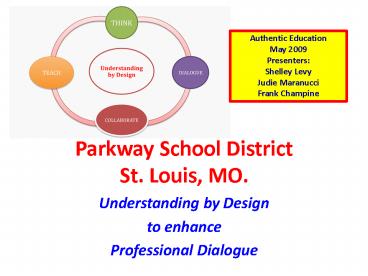
Parkway School DistrictSt. Louis, MO.
Authentic Education May 2009 Presenters Shelley
Levy Judie Maranucci Frank Champine
- Understanding by Design
- to enhance
- Professional Dialogue
2
Please put phone on vibrate
3
The Reality of Schooling at the Elementary Level
Language Arts
Here comes UbD
Class Trips
Social Studies
Math
Science
Parent Conferences
State Testing
4
KWL-UbD
If the tree is UbD which kid are you? What would
you like to know about Understanding by
Design? What is your biggest concern about this
curriculum model?
5
Overall Objective of the Workshop
6
Organization of Workshop
- Process uncovering the 3 Stages of
Understanding by Design - Product Development of a common unit and
transfer to a actual unit. - Progress Our teams observations of YOUR TEAMS
WORK
7
How many buses does the army need to transport
1,128 soldiers if each bus holds 36 soldiers?
Answer from 30 31 Remainder 12!
8
12 soldiers
??
9
A Caveat
- Dont Confuse the Teaching with the Learning.
Misunderstanding Alert
10
(No Transcript)
11
(No Transcript)
12
(No Transcript)
13
Foundations of Learning
14
Foundations of Learning
Transfer
Acquisition
New Knowledge Skills
Making Meaning
15
Three forms of learning
- You acquire facts you figure out what they mean
you transfer your prior learning to new
challenges. - You acquire a skill you figure out a good
strategy you apply all your skills to a new
task, in context.
16
Our workshop involves all 3
- You will acquire information about UbD
- You will draw conclusions from examples,
generalize from experiences, and make sense of
data - You will transfer general understandings to
specific cases and situations in which you work.
17
Coverage vs. Uncoverage
- Coverage - what teachers do with content -
Research states that rapid coverage without
connections to concepts or generalization is not
retained nor transferred. - Uncoverage - Something students do through
constructivist experiences. They own the learning
and make meaning for themselves. This is retained
and transferred.
18
It is the students attempts to learn that causes
the learning not the teachers covering the
content or skills!
UNCOVERAGE IS LEARNING
19
What went wrong?
- View this short video from the Harvard/M.I.T.
study on the teaching of Math and Science. - Listen to the talking heads from various
universities. - Jot down 3 things that resonate with you that are
said in the learning analysis. - DIALOGUE with your table mates and then share
with the entire group.
20
Continue. . .
- Dialogue Share your thoughts and explore the
possible application to your own teaching
experience. What might be going wrong in your
classroom based on the awareness gained in this
video? - Collaborate List at least three things you
might do to begin to make changes in your
curriculum, assessments, and instruction that
might increase the learning potential of your
students - Teach What teaching strategies might you add to
this teachers tool box that might increase the
understanding of this particular student and his
classmates?
21
Westward Movement and Pioneer Life
- Third Grade Unit on the Westward Movement
- Interdisciplinary
- Assessments
- Chapter Reading and questions
- Sarah Plain and Tall vocab.
- Memory Box Show and Tell
- Completion of 7 learning stations
- Reflection paper on the unit.
- Life on the Prairie Pioneer Day Activities
- Churn Butter
- Play 19th century games
- Send letter using sealing wax
- Play Dress the Pioneer-computer Simulation
- Make a corn husk doll
- Quilting
- Tin Punching
- Full day with Parent Visitation
22
Analysis of the Unit
- THINK What are the strengths and weaknesses of
this unit. Use Page 6 in W.B. - DIALOGUE with table develop insights
- Apply UbD thinking to the unit see p. 7.
Dialogue with table about what is revealed. - COLLABORATE with table What might you do to
improve this unit? - DIALOGUE REVIEW PP. 89 What happened when
UbD is applied to CIA?
23
Conclusion What is UbD?
- View video clip Using UbD
- DIALOGUE
- What do you see as the strengths and weaknesses
of the Backward Design model? - Based on the examples provided in the video, what
are implications of implementing this design
model in your teaching?
24
KNOWING vs UNDERSTANDING
- Divide the group into two large groups?
- Group 1 Knowing
- Group 2 Understanding
- Brainstorm as many synonyms for the word of your
group as you possibly can. Please follow the
rules for Brainstorming. - You have 4 minutes to complete your Brainstorm
- Dialogue What are the implications for your
curriculum, assessments and instruction if you
want your students to understand what they are
taught? - What does teaching for understanding look like?
- Video clip of Kindergarten Teacher Using UbD
teaching strategies ASCD Using UbD. - Dialogue How are her teaching strategies
reflective of helping students better understand
what is taught?
25
What is Backward Design?
Page. 5
Create your DESIRED RESULTS
Establish EVIDENCE of Understanding
Then, and only then
Develop INSTRUCTIONAL STRATEGIES
26
BACK WARD DESIGNMETHAPHOR
STAGE 1 DESIRED RESULT
Architect Designs The HOUSE
Takes into consideration
Customers desires Building Codes Possible
Problems
27
Metaphor continued
Stage 2
Does the design meet code? Does it meet the
standard? Will it be quality work? Are there
backup systems in place just in case?
Building Inspector Tests and assesses the design
28
Metaphor continued
Stage 3
Carpenters, plumbers, electricians, etc. Follow
the design and apply their crafts.
29
Moral of the Story
If the Curriculum is not well designed, Assessed
well and Taught for Understanding the likelihood
that kids will get it and transfer it is slim.
THIS
INSTEAD OF THIS
When the construction crew does not teach for
understanding the outcome is.
30
DEEPER LOOK AT BACKWARD DESIGN
- Turn to PP. 12 18 in W. B.
- Take some time to read, discuss and discern an
hypothesis on the logic and flow of using
Backward Design. - Dialogue How does designing curriculum in this
manner increase the likelihood of improving
student learning? - We will sit with you from time to time to share
your collaborate on this questions. (10
minutes).
31
Using the Template
- What are BIG IDEAS? Where do they come from and
How are they created? - Turn to pp 71-75
- Take time to look over the pages and pay specific
attention to p. 74 to see how BIG IDEAS shape a
unit like the Western Movement.
32
Where are Big Ideas found?
- Concepts
- Themes
- Issues or Debates
- Problems or Challenges
- Theories
- Processes
- Paradoxes
- Assumptions or Perspectives
33
Meaning Making The Lunch Date
- Watch the video The Lunch Date
- What are the BIG IDEAS found in this video?
- Let us use this video as if it were the hook for
a unit of study. How would this unit be designed?
34
BIG IDEAS
- Take a few minutes and Dialogue about what you
all actually saw. - Return to page 71, review the meanings behind Big
Ideas and their categories - COLLABORATION - Go to page75 and develop as many
Big Ideas about the Lunch Date as your table can.
35
EXPAND YOUR THINKING
- Suppose you were using this video to kick off
(anticipatory set) a unit in Math or Science.
What Big Ideas in those disciplines might be
FOUND IN THIS VIDEO that might be perfect BIG
IDEAS in a unit of study in either of the
disciplines?
36
What does it look like?
Big Ideas Concepts
UNCOVERAGE
Facts
Facts
Facts
FACTS
Facts
Facts
Retained for the test
Facts
Facts
Facts
Facts
Retention and Transfer
COVERAGE
37
TRANSFER TO YOUR TEACHING
- LETS MOVE FROM THE LUNCH DATE TO A UNIT YOU WILL
TEACH NEXT YEAR. - Think of the unit, any unit, write down the TOPIC
- Write down as many BIG IDEAS for that unit as you
can think of. Collaborate with your table mates.
38
UbD in the Primary Grades
39
No big ideas for little kids??? Not so
- Never talk to strangers..but I am LOST!
- Do it myself vs. ask for help
- meaningful squiggles vs. nonsense squiggles on
the page - What if?
40
Whenever there is
- A burning question
- A difficult decision
- A generalization
- An intelligent adjustment
- ...There is a big idea
41
Key misunderstanding at work first, learn ALL
the basic stuff
- Not so!
- If this were true
- Children would never learn to speak their native
language without teaching the basics first - No 1st graders would be able to play in soccer
games or use their computers and cell phones
effectively - No child would tell good stories until they had
mastered English syntax, grammar, rhetoric
42
Sequence Whole/part/whole
- Learning complex tasks requires a constant and
meaningful back and forth between - - part/whole,
- skill/performance
- learn some/apply what you know
43
In other words
- You have to learn to THINK while you also learn
the basics - What does this somewhat unclear situation demand
of me? - Learning to judge the situation - what should I
do HERE? - How should I choose?
44
Gradual Release of Responsibility in literacy
- I do, you watch
- I do, you help
- You do, I help
- You do, I watch
- This is a general schema for the development of
transfer ability at any age, in any subject
45
GENERALIZATIONS Broad statements that serve as
principles expressing the relationship of two or
more concepts.
46
The Lunch Date
- Consider what you want the students to UNDERSTAND
about this film and its Big Ideas.
What will be the UNDERSTANDINGS you want to
ENDURE and TRANSFER to other subjects and into
the students lives?
47
Understandings require unpacking the standards
- Read your standards carefully
- Look for the NOUNS the concepts and Big Ideas
- Look for the VERBS the required student
assessments
48
Lets attack the development of understandings
- Look in your book at the 3 Circle Inventory
(p.78)- What is important? - Lets look at what an understanding is and how it
is constructed.(PP.108-110) - What are the common characteristics of an
understanding?
49
The Lunch Date- Understandings
- Turn to page 107 in your book.
- Use this concept attainment strategy to help you
UNCOVER the meaning of and construction of
ENDURING UNDERSTANDINGS. - Write two understandings for the Lunch Date
50
Enduring Understandings
- Design Standards for Understandings p.115
- Framing Understandings p.116
- Goals or topics can shape Understandings
p.111-113 - Critical Skills as Understandings PP 75-76
- 2 Types of Understandings P.114
- Now that you have understandings for The Lunch
Date, TRANSFER your understanding to your
teaching unit.
51
The essential questions have no answers. You are
my question, and I am yours and then there is
dialogue. Questions unite people, answers divide
them. So why have answers when you can live
without them?
52
(No Transcript)
53
ESSENTIAL QUESTIONS? What are they? How are they
developed? What are their connections to the
standards and the generalizations?
54
THE LUNCH DATE - ESSENTIAL QUESTIONS
- Turn to page 89-90 in your book.
- Examine several of these essential questions
uncover a pattern. - Again, we confront a concept attainment on
ESSENTIAL QUESTIONS. Page 88. - What are the essential questions that would drive
our LUNCH DATE UNIT? - Create 3 Essential Questions for our Unit.
55
Essential Questions
- Design Standards for Essential Questions p. 91
- Essential Questions for Critical Skills pp 104-5
- Tips for using Essential Questions p.106
- Now that you have Essential Questions for your
Lunch Date unit, TRANSFER the skill to writing
questions for your teaching unit.
56
Instead of thinking of content as stuff to be
covered, consider knowledge and skills as the
means of addressing questions central to
understanding key issues in your subject.
57
The Lunch Date - Knowledge and Skills needed
- You have the Enduring Understandings
- You have the guiding questions of the unit.
- What content knowledge and skills must you teach
NOW for the students to deeply understand the
unit?
58
ALIGNMENT ALERT!
STANDARD
ENDURING UNDERSTANDING/ GENERALIZATION
ESSENTIAL QUESTIONS
PAGE 86
59
(No Transcript)
60
MisunderstandingAlert
- Most teacher believe the Standards must be
COVERED by them, rather than their students being
able to DO the Standard.
61
HOW DEEP IS YOUR CURRICULUM?
FACTS/ content
SKILLS
SURFACE LEARNING- NO TRANSFER
CONCEPTS GENERALIZATIONS ENDURING UNDERSTANDINGS
TRANSFER
- ARE YOU COVERING A GREAT DEAL, BUT YOU DONT HAVE
TIME FOR DEEPER UNDERSTANDING?
REMEMBER, TEACHERS COVER, KIDS NO NOT
Recommended

