

Modeling the Summertime Heat Budget of Southeast New England Shelf Waters PowerPoint PPT Presentation
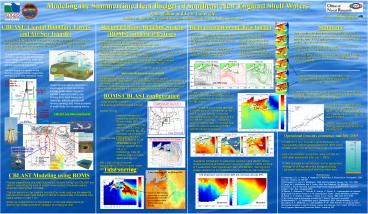
1 / 1
Title: Modeling the Summertime Heat Budget of Southeast New England Shelf Waters
1
Modeling the Summertime Heat Budget of Southeast
New England Shelf Waters
John Wilkin and Lyon Lanerolle Institute of
Marine and Coastal Sciences, Rutgers University,
New Brunswick, N.J.
wilkin_at_marine.rutgers.edu http//marine.rutgers.e
du/wilkin/wip/cblasthttp//ocean-modeling.org
CBLAST Coastal Boundary Layers and Air-Sea
Transfer
Regional Ocean Modeling System (ROMS) numerical
features
Mean circulation and heat budget
Summary
Tides significantly affect the mean circulation
and heat budget. Lateral heat transport is large
in much of the region, including near MVCO, and
will need to be considered in the analysis of
ASIT heat budgets. Wind-driven upwelling
circulation contributes to the heat budget
southwest of Marthas Vineyard. A 1-D heat
balance occurs near the B-A-C ASIMET mooring
sites, and these data will be used for evaluation
of model turbulent closures.
Circulation around the Nantucket Shoals is
augmented by strong tidal rectified cyclonic flow
that carries water northward into Vineyard Sound
through Muskegat Channel (between Nantucket and
the Vineyard).
The open boundary climatology imposes a south and
westward flow from the Gulf of Maine, through
Great South Channel and around Nantucket Shoals.
The ONR CBLAST-Low program focuses on air-sea
interaction and coupled atmosphere/ocean boundary
layer dynamics at low wind speeds where processes
are strongly modulated by thermal forcing. (There
is a companion CBLAST-Hurricane program.)
- Split-explicit, free-surface, hydrostatic,
primitive equation model 1,2 - Generalized, terrain-following vertical
coordinates - Orthogonal curvilinear, horizontal coordinates,
Arakawa C-grid - 3rd- and 4th-order advection and time-stepping
weighted temporal averaging reduced pressure
gradient and mode-splitting error - Simultaneous conservation and constancy
preservation for tracer equations in combination
with evolving coordinate system due to
free-surface 2 - High-order accurate continuous, monotonic
reconstruction of vertical gradients - Adjoint and tangent-linear implemented 4-D
variational assimilation under test - MPI and OpenMP shared and distributed memory
parallel F-90 code - All input/output via NetCDF
- NPZD biology EcoSim bio-optics Community
sediment transport model, Lagrangian floats - Vertical turbulence closure options
- Mellor-Yamada level 2.5
- K-profile parameterization (KPP) surface and
bottom boundary layers 3 - Generalized Length Scale scheme 4,5 Eddy
viscosity and diffusivity are the product of a
non-dimensional stability function, TKE, and
length scale. Stability functions are the result
of various 2nd-moment closures. TKE and length
scales are calculated by dynamic (as in k-? or
M-Y) or algebraic formulations. GLS encompasses
k-?, k-? and M-Y in a single code.
Southwest of Marthas Vineyard, and within
Vineyard Sound, winds drive eastward depth
averaged flow.
Turbulence and mean flow observations are being
used to quantify the turbulent kinetic energy,
momentum, mass, and heat budgets in the oceanic
mixed-layer and atmospheric boundary layer. The
field program is centers on the Marthas Vineyard
Coastal Observatory (MVCO) and Air-Sea
Interaction Tower.
Tidal phase eddies transport cold tidally-mixed
Nantucket Shoals water into Vineyard Sound, and
warmed VS water toward MVCO.
Observational assets deployed in July/August of
2002 and 2003 include in situ observations of
vertical fluxes and mixing rate profiles from
fixed towers and moorings, satellite and aircraft
remote sensing, and measurements of small-scale
and breaking waves.
Time series of the heat budget (below) in a box
near MVCO shows half the air-sea flux goes to
warming the water column, and half is removed by
lateral divergence.
Air-sea flux (Qnet) is greatest east of Vineyard
Sound where SST is cold, but is largely balanced
by divergence due to tidal mixing. Ocean
temperature increase (storage) is largest south
of The Islands, primarily due to surface heating.
Horizontal divergence is small in the region of
the B-C ASIMET moorings - indicating a region of
approximate 1-D vertical heat balance suited to
evaluating ROMS vertical turbulence closures.
ROMS CBLAST configuration
1 km horizontal resolution20 s-levels (stretched
toward surface)
The time mean advection cools the box at, on
average, 200 W/m2. The net eddy divergence
(uT) warms the MVCO region at about 150 W/m2.
Episodic positive divergence (cooling) events
briefly arrest the warming trend.
Coherent structures (Fanbeam) Heat mom. flux
U(z), Waves (ACDP)
Surface forcing Heat and momentum fluxes from
bulk formulae 6 with model SST, observed
downward long-wave at MVCO, and Tair, pair, rel.
humidity, U10, V10, and short-wave radiation from
3 km resolution nested COAMPS 6--36 hr forecast
CBLAST-Low Observing System
Open boundary conditions Inflow climatology 7
outflow radiation 8 on T,S, u, vClimatology,
tides 9, radiation (?gh) on ? and depth average
u,v 160 x 380 x 20 grid requires approximately 2
CPU mins per model day on 16-processor HP/Compaq
Qualitative comparison to subsurface validation
data (below) shows realistic vertical
stratification and mixed layer depths. In 2003,
an array of 5 subsurface moorings between ASIT
and ASIMET mooring-A will enable validation of
the modeled evolution of the diurnal mixed layer.
Tidal stirring
CBLAST Modeling using ROMS
References 1 Haidvogel, D.B., H. Arango, K.
Hedstrom, A. Beckmann, P. Rizzoli and A.
Shchepetkin, 2000 Dyn. Atm. Oceans, 32,
239-281. 2 Shchepetkin, A., and J.C.
McWilliams, 1998 Monthly Weather Review, 126,
1541-1580. 3 Large, W., J. McWilliams, and S.
Doney, 1994 Rev. Geophys., 32, 363-403. 4
Umlauf, L. and H. Burchard. A generic
length-scale equation for geophysical turbulence
models, J. Mar. Res., accepted 2003. 5 Warner,
J., Sherwood, C., Butman, B., Arango, H.,
Signell, R., Implementation of a generic length
scale turbulence closure in a 3D oceanographic
model." Ocean Modelling, submitted. 6 Fairall,
C., E. Bradley, D. Rogers, J. Edson, and G.
Young, 1996 JGR, 3747-3764. 7 Bi-monthly
regional climatology provided by C. Naimie,
Dartmouth University 8 Marchesiello, P., J.C.
McWilliams, and A. Shchepetkin, 2001 Ocean
Modelling, 3, 1-20. 9 Luettich, R. A.,
Westerink, J. J., and Scheffner, N. W., 1992
ADCIRC An advanced three-dimensional circulation
model for shelves, coasts, and estuaries, Tech.
Report DRP-92-6, U.S. Army Engineer Waterways
Experiment Station, Vicksburg, MS.
Precise observations of air-sea fluxes and
turbulent mixing from CBLAST are ideal for
evaluating the suite of ocean model vertical
turbulence closure schemes implemented in
ROMS. This comparison will be possible provided
the model captures the essential features of the
ocean heat budget on diurnal to several day
time-scales, and spatial scales of order 1
km. Modeling complements the interpretation of
the field observations by quantifying unobserved
lateral transport and mixing of heat.
Recommended

