

Part II.2 A-Posteriori Methods and Evolutionary Multiobjective Optimization PowerPoint PPT Presentation
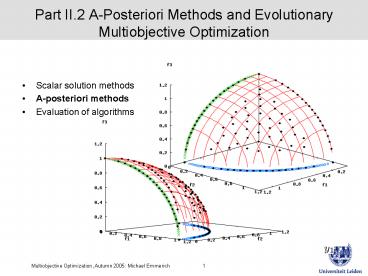
1 / 46
Title: Part II.2 A-Posteriori Methods and Evolutionary Multiobjective Optimization
1
Part II.2 A-Posteriori Methods and Evolutionary
Multiobjective Optimization
- Scalar solution methods
- A-posteriori methods
- Evaluation of algorithms
2
A posteriori-methods
- A priori-method
- First define preferences, including decisions in
case of conflicts (e.g. by specifying a utility
function) - Let the algorithm search for a single best
solution - User selects the obtained solution
- gt Single objective optimization can be used
- A posteriori-method
- Specify general, possibly conflicting, goals
- Let algorithm find Pareto front
- User selects best solution among solution on
Pareto front - gt Algorithms for obtaining Pareto fronts needed!
3
A-Posteriori methods (Pareto Optimization)
- A finite set of non-dominated solutions
Approximation set - Strive for good coverage and convergence to the
pareto front !
4
Overview Approaches
- Continuation methods
- Starting from a Karush Kuhn Tucker point
gradually extend Pareto front by including
neighboring Karush Kuhn Tucker points - Problem Connected Pareto front is required and
differentiability - Epsilon-Constraint method
- Obtain all points on the Pareto front by solving
constraint optimization problems.All but one
objective is set to a constraint value - The constraint values are changed gradually until
the whole Pareto front is sampled
density/position of points can be easily
controlled - Problem Effort growth exponentially.
- Population-based Metaheuristics (evolutionary,
particle swarm, ) - Use selection/variation scheme to gradually move
a population of search points to the Pareto front - Very flexible method, easy to apply in different
search spaces - Problem Cannot guarantee optimality of result
5
Overview Approaches
- Indicator-based method
- Approximation set A to pareto front of qA
points (each one of dimension n) is viewed as nm
dimensional vector - A quality measure is defined for a set of points
e.g. the dominated hyper-volume and functions as
surrogate objective function - Problem Reference point is required Dimension
of problem may be to large if q is to large
An example of indicator for the quality of an
approximation set is the S-metric, Measuring the
area between the points in A and the reference
point to be maximized.
6
Evolutionary Multiobjective Optimization (EMO)
7
Overview of the EMO field
8
State of the literature in EMOA
9
Biologically inspired terminology
- Biological term
- Individual
- Fitness
- Population
- Generation
- Mutation Operator
- Recombination
- Parents, Offspring
- Mathematical term
- Element of search space S
- Objective function value (penalty)
- Multi-set of elements of S
- Iteration of main loop
- Operator generating a new solution by adding a
small perturbation to a given solution - Operator generating a new solution by combining
information of at least two given solutions - Given a set of variations generated from an
original set, the original set is called parents,
and the set of variations offspring
The concepts are used slightly differently,
depending on authors. This will be the way we use
them.
10
General schema of evolutionary search
Application of variation operators
parents
offspring
Population of individuals
Evaluation of fitness
11
Example Steady state evolutionary algorithm
12
Variation Operators
13
Initialization
14
Stochastic variation operators
15
Representation Independence
Variation Operators Representation Operators
Population Model and Selection Operator
The concept of PISA (ETH Zuerich)
Algorithms such as NSGA, SPEA2, PAES are widely
independent of represenations (search spaces and
variation operators)!
16
Mutation
17
Recombination Crossover Operators
18
Advanced operators
19
Selection operator in EMOA
20
First generation EMOA
21
NSGA-II Algorithm
22
Non-dominated sorting genetic algorithm (NSGA-II)
23
(ml)- Evolutionary algorithm
24
A-Posteriori methods (Pareto Optimization)
- A finite set of solutions
- Strive for good coverage and convergence to the
pareto front !
25
A Non-dominated sorting
26
A Non-dominated sorting
27
B Crowding distance sorting
28
B Crowding distance sorting
Objective space (NSGA-II)
Variable space (NSGA)
29
B Crowding distance sorting
30
NSGA-II Complete procedure
Download NSGA-II
http//www.iitk.ac.in/kangal/soft.htm
31
NSGA-II ZDT1
32
NSGA-II ZDT2
33
Results ZDTL4
34
Non-dominated sorting genetic algorithm
35
SMS-EMOA
36
Remarks
- Introduced by Beume, Emmerich, Naujoks, 2005
- Outperforms standard approaches on common
Benchmarks for continuous multiobjective
optimization ZDT and DTLZ - Especially well suited for small approximation
set - Paradigm shift Indicator-based Pareto
optimization - Can be hybridized with S-Gradient method (Deutz,
Beume, Emmerich 2007)
37
SMS-EMOA Basic Algorithm
38
Replacement
The following invariant holds
39
SMS-EMOA
40
Hypervolume in 2-D
41
Computation of hypervolume in 3-D
- O(m q3) algorithm was proposed by Emmerich
42
SMS-EMOA (20.000 Auswertungen)
43
Pareto front in higher dimensons
Points demark finite Set approximation of Pareto
fronts
44
Pareto front in higher dimensons
45
SMS-EMOA Conclusions
- SMS EMOA tries to maximize the dominated
hypervolume - Increment in hypervolume are used as a selection
criterion in an Evolutionary Algorithm - The evolutionary algorithm gradually improves the
dominated hypervolume of the population by
variation-selection scheme - The SMS EMOA is the best performing MCO
techniques on standard benchmarks from literature
(cf. EJOR 2006 Preprint, EMO Conference 2005) - A bottleneck is the high computational cost of
computing hypervolume increments, if no, of
objectives is high
46
Summary
- Large number of EMOA algorithms available today
- Most popular variants are NSGA-II, SPEA-II
- In EMOA field also other population-based
algorithms (particle swarm optimization,
simulated annealing) are discussed - New generation of EMOA is developed (IBEA,
SMS-EMOA) that directly addresses optimization of
performance measure - Statistical performance measuring on test
problems crucial technique to engineer and select
EMOA technique - Bi-annual conference EMOO 2001, 2003, 2005
(Lecture notes in Computer Science) - Bi-annual conference MCDM Operations Research
Oriented
Recommended

