

Science Fair Project (Place title of your project here) THE DRAGONS PowerPoint PPT Presentation
1 / 17
Title: Science Fair Project (Place title of your project here) THE DRAGONS
1
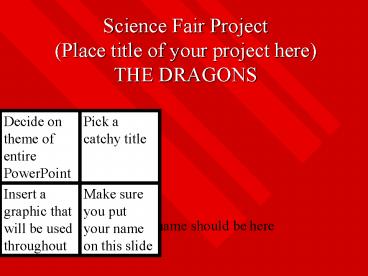
Science Fair Project(Place title of your project
here)THE DRAGONS
Decide on theme of entire PowerPoint Pick a catchy title
Insert a graphic that will be used throughout Make sure you put your name on this slide
- Your name should be here
2
Problem
- State the Purpose of the Project here
- Write a statement that describes what you want to
do. Use your observations and questions to write
the statement.
3
Identify Variables
- Based on your gathered information, make an
educated guess about what types of things affect
the system you are working with.
4
Hypothesis Statement
- Form a Hypothesis
- A hypothesis is a question which has been
reworded into a form that can be tested by an
experiment. - There is usually one hypothesis for each
question you have. - You must do at least one experiment to test
each hypothesis. This is a very important step.
5
Design Experiments to Test Your Hypothesis
- For an experiment to give answers you can
trust, it must have a "control." A control is a
neutral "reference point" for comparison that
allows you to see what changing a variable does
by comparing it to not changing anything. - Experiments are often done many times to
guarantee that what you observe is reproducible,
or to obtain an average result.
6
Some Guidelines for Experimental Procedures
- Select only one thing to change in each
experiment. Things that can be changed are called
variables. - Change something that will help you answer
your questions. The procedure must tell how you
will change this one thing. - The procedure must explain how you will
measure the amount of change. Each experiment
should have a "control" for comparison that you
can see what the change actually did.
7
Materials and Equipment
- Make a list of the things you need to do the
experiment, and describe their preparation.
8
Experiments and Data
- As you do experiments, record all numerical
measurements made. - If you are not making any measurements, you
probably are not doing an experimental science
project.
9
Your Observations and Calculations
- Observations can be written descriptions of
what you noticed during an experiment, or
problems encountered. - Keep careful notes of everything you do and
everything that happens. - Do any calculations needed from your raw data
to obtain the numbers you need to draw your
conclusions.
10
Lessons Learned
- Draw Conclusions
- Using the trends in your experimental data and
your experimental observations, try to answer
your original questions. - Other Things You Can Mention in the Conclusion
- If your hypothesis is not correct, what could be
the answer to your question? - Summarize any difficulties or problems you had
doing the experiment. - Do you need to change the procedure and repeat
your experiment? - What would you do different next time?
- List other things you learned
11
BibliographyA bibliography is an alphabetical
list of all the sources used in your research.
Sources are alphabetized by author or by title
if no author is given.
- Books One Author Hoving, Thomas. Tutankhamun.
New York Simon and Schuster, 1978. - More than One Author Cooper, Robert K. and
Leslie L. Cooper. Low-Fat Living. Emmaus, PA
Rodale Press, 1996. - No Author Given The Amazing Universe.
Washington, DC National Geographic Society,
1991. - PERIODICALS Begley, Sharon. "A Healthy Dose of
Laughter." Newsweek 4 Oct. 1987 65. - "A Walk Across America Part II." National
Geographic August, 1979 52. - PERIODICALS ONLINE "Human Cloning?". Maclean's
28 December 1998 110. Online Available
http//nettrekker.com March 21, 2000. - NEWSPAPER Collins, Glenn. "Single Father
Survey." New York Times 21 November 1986 20. - "Low Cholesterol Level Key." Providence
Journal-Bulletin 24 November 1987 A6.
12
Samples continued
- ENCYCLOPEDIA ARTICLES Print and CD-ROM "Animal
Rights." World Book Encyclopedia. 1990 edition. - Stemple, James. "Solar Energy." Book of Popular
Science. 1990. - "Wyoming." Grolier Multimedia Encyclopedia.
CD-ROM, 1996 edition. - PAMPHLET (Usually the same as book with no
author given) Smoking and Your Lungs.
Providence, Rhode Island American Lung
Association, 1991. - ONLINE SERVICES and the INTERNET Gordon,
Daniel. "Acid Rain." Compton's Living
Encyclopedia. Online America Online. Mar. 6,
1997. - "Plant Extracts." Online Available
http//www.sciences.com/scidata/edu.html
February 23, 1997. - Other examples Research Central
13
Required Sources
- One Media Center Book
- One Media Center Reference Source
- One Online Encyclopedia
- One Periodical online from Galileo Searchasaurus
Plus - One SIRS Article from Galileo
- One website obtained from Galileo or Nettrekker
- One website from Google with a filled out
evaluation.
14
Save your work
- Look for interesting pictures for your slides and
save them to the folder on the Macs LaCie d
drive or the PCs Patron drive. - Take notes from this work for your slides by
typing in Word or copying and pasting from a web
site. BeWARE of plagiarism (put notes in your
own words no copying word for word!)
15
Are you ready to conquer your fears?
16
Can you find these in the Media Center?
- Card catalog? HMS
- Magazines?
- Non-Fiction Books?
- Reference Encylcopedias?
- Reference Science Sets?
- Your Subject?
- Galileo-dont forget your password?
- NetTrekker-dont forget your login?
- Google-best place for images on the web?
- Where to save your work?
17
Question What would be worse than being covered
with 50 tarantulas?
Look for interesting pictures for your slides as
you go along!
Recommended

