

Week 9 Lecture: Music and Art in Hitchcock PowerPoint PPT Presentation
1 / 89
Title: Week 9 Lecture: Music and Art in Hitchcock
1
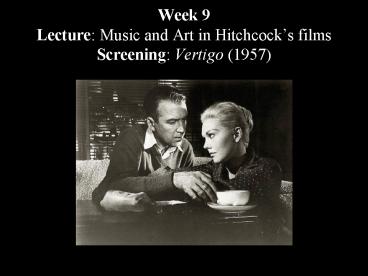
Week 9Lecture Music and Art in Hitchcocks
films Screening Vertigo (1957)
2
Readings
- Readings Cohen, T. Volume 2 Cohen Volume 2 Part
III Jump Cuts Time machine pp 107 - 137 Matrixide
pp 138-168 - Recommended Readings Sloan, J., Hitchcock The
Definitive Bibliography (pp. 289-295) - White, S. "Vertigo and Problems of Knowledge in
Feminist Film Theory" (Allen pp279-307) - Hitchcock "On Music in Films" (1934) (Reader)
3
(No Transcript)
4
(No Transcript)
5
(No Transcript)
6
Origins Genre
- A psychological thriller Film noir/Drama
- The film is an adaptation of the French novel
Sueurs froids dentre les morts (Cold Sweat
From Among the Dead) by Pierre Boileau and Thomas
Narcejac ScreenplayAlec Coppel and Samuel A.
Taylor
7
Actors
- James Stewart - Scottie" Ferguson
- Kim Novak - Madeleine Elster Judy Barton
- Barbara Bel Geddes - Marjorie "Midge" Wood
- Tom Helmore - Gavin Elster
8
(No Transcript)
9
Jimmie Stewart (1908-1997)
- James Maitland Stewart popularly known as Jimmy
Stewart. Parents of Scottish origin, Alexander
M. Stewart and Elizabeth Ruth Jackson, in Indiana
Penn. He was the eldest of three children (two
younger sisters, Virginia and Mary) and father a
prosperous hardware store owner. Also military
career in USAF rose to rank of Brigadier General
10
Jimmy Stewart
- Jimmy Stewart was named by the AFI the third
greatest male star of all time . He is one of the
most represented stars with five films on the
list of the top 100 films and is one of the most
represented stars with ten films on the list of
400 nominees. Alfred Hitchcocks Vertigo 9
Frank Capra's Its a Wonderful life 20 Capras
Mr. Smith Goes to Washington 26 George Cukor The
Philadelphia Story 44 and Hitchcocks Rear
Window 48
11
AFI Top ten Actors
- Humphrey Bogart Katharine Hepburn
- Cary Grant Bette Davis
- James Stewart Audrey Hepburn
- Marlon Brando Ingrid Bergman
- Fred Astaire Greta Garbo
- Henry Fonda Marilyn Monroe
- Clark Gable Elizabeth Taylor
- James Cagney Judy Garland
- Spencer Tracy Marlene Dietrich
- Charles Chaplin Joan Crawford
12
(No Transcript)
13
Kim Novak (1933-
- Kim Novak (Feb 13 1933) was born Marilyn Pauline
Novak in Chicago Illinois a Roman Catholic of
Czech extraction (cw. Annie Ondra in Hs
Blackmail). Her father was a railroad clerk and
former teacher her mother also was a former
teacher, and Novak has a sister.
14
(No Transcript)
15
(No Transcript)
16
(No Transcript)
17
(No Transcript)
18
Some Locations
- Madeleine jumps into the sea at Fort Point
underneath the Golden Gate Bridge. - Coit Tower appears in many background shots
Hitchcock once said that he included it as a
phallic symbol
19
(No Transcript)
20
Locations
- The Mission San Juan Bautista where Madeleine
falls from the tower, is a real place, but the
tower had to be matted in with a painting using
studio effects. - The gallery where Carlotta's painting appears is
the California Palace of the Legion of Honor in
San Francisco. The Carlotta Valdes portrait was
lost after being removed from the gallery, but
many of the other paintings in the background of
the portrait scenes are still on view - showing its age is a replica of one that can
still be found at Muir Woods.
21
- Muir Woods National Monument is in fact
represented by Big Basin Redwoods State Park
however, the cutaway of the redwood tree - At Mission Dolores for many years tourists could
see the actual Carlotta Valdes headstone featured
in the film (created by the props department).
Eventually, the headstone was removed as the
mission considered it disrespectful to the dead
to house a tourist attraction grave for a
fictional person.
22
- The McKittrick Hotel was a privately-owned
Victorian mansion from the 1880s at Gough and
Eddy Streets. It was torn down in 1959 and is now
an athletic practice field for Sacred Heart
Cathedral Preparatory School. - The sanatorium is 351 Buena Vista East, formerly
St. Joseph's Hospital, now Park Hill
condominiums. It looks much the same from the
outside the best view is from the Corona Heights
neighborhood park. - The Empire Hotel is a real place but is now
called the York Hotel at 940 Sutter Street.
Judy's room was created but the flashing green
neon of the "Hotel Empire" sign outside is based
on the actual hotel's sign (it was replaced when
the Hotel was re-named). - Ernie's Restaurant (847 Montgomery St.) was a
real place in Chinatown, not far from Scottie's
apartment. It is no longer operating.
23
(No Transcript)
24
(No Transcript)
25
(No Transcript)
26
(No Transcript)
27
28
(No Transcript)
29
Vertigo
- Robin Woods Hitchcock's Films (1968), which
calls the film Hitchcock's masterpiece to date
and one of the four or five most profound and
beautiful films the cinema has yet given us. - Release in 1996 of a restored print to great
acclaim
30
Vertigo Rankings
- 2005, Vertigo came in second (to Goodfellas) in
British magazine Total Films book of the top 100
films of all time and 2nd in Sight and Sound
list.Vertigo is 9 on the AFI list. The film has
been deemed culturally significant by the
United States Library of Congress and selected
for preservation in the National Film Registry
31
(No Transcript)
32
- Vertigo has been described as an intense
psychological study of a desperate, insecure
man's twisted psyche (necrophilia) and loss of
equilibrium. It follows the troubled man's
obsessive search to end his vertigo (and deaths
that result from his 'falling in love'
affliction) and becomes a masterful study of
romantic longing, identity, voyeurism, treachery
and death, female victimization and degrading
manipulation, the feminine ideal, and fatal
sexual obsession for a cool-blonde heroine.
Hitchcock was noted for films with voyeuristic
themes, and this one could be construed as part
of a trilogy of films with that
preoccupationRear Window (1954)Vertigo (1958) - Psycho (1960)
33
(No Transcript)
34
Cinematic techniques
- Hitchcock used two simultaneous devices to
achieve the effect and create an approximation of
the disoriented psychological state of the Jimmy
Stewart character - the camera both tracks away
from the subject while also zooming towards it.
The simultaneous, opposing movements - a forward
zoom and a reverse tracking shot - also represent
the attraction and repulsion that the main
protagonists experience in their relationships.
The camera effect is used in this scene, and in
the first mission stairwell sequence.
35
Week 10
- Lecture Surveillance through two Rear Windows
- Screenings Rear Window (1954) Alfred Hitchcock
Ross Bleckner Rear Window (clips) (1999) - Readings Cohen Vol 2 Part IV The Black Sun 8
Prosthesis of the Visible pp169-190
36
Recommended readings
- Readings Cohen Vol 2 Part IV The Black Sun 8
Prosthesis of the Visible pp169-190 - Modleski, T. "The Master's Dollhouse" Rear
Window - Stam, R and Pearson, R., "Hitchcock's Rear
Window Reflexivity and the Critique of
Voyeurism" (Reader) - Belton, J. The Space of Rear Window" (reader)
37
(No Transcript)
38
(No Transcript)
39
http//www.youtube.com/watch?vzC5UhVwcIyg
- Rear Window Origins
- Cornell Woolrichs short story It Had to be
MurderJohn Michael Hayes (screenplay)
40
Cast
- James Stewart...L. B. Jefferies Grace Kelly...
Lisa Carol Fremont - Wendell Corey... Detective Lt. Thomas J. Doyle
Thelma Ritter...Stella , Insurance company nurse - Raymond Burr... Lars Thorwald
- Judith Evelyn..Miss Lonelyheart
- Ross Bagdasarian... Songwriter
- Georgine Darcy... Miss Torso
- Sara Berner... Wife living above Thorwald
41
Cast continued
- Frank Cady... Husband living above Thorwald
- Jesslyn Fax...Sculpting neighbor with hearing aid
- Rand Harper...Newlywed man
- Irene Winston..Mrs. Anna Thorwald
- Havis Davenport...Newlywed woman
- Marla English.. Girl at songwriter's party
42
(No Transcript)
43
Heat wave
- During a heat wave, normally itinerant news
photographer L.B. Jefferies (James Stewart) finds
himself confined by a broken leg to a wheelchair
in his Greenwich Village apartment. Each day,
and often into the night, he has little to do but
gaze out his rear window at the activities of his
neighbours in the surrounding apartments.
44
- Jeffs main visitors are his fiancée Lisa
Fremont (Grace Kelly), a high-fashion model and
Stella (Thelma Ritter), an insurance company
nurse who provides him with therapeutic massages.
45
(No Transcript)
46
(No Transcript)
47
Heat Wave Plot device
- More than a plot device explaining why everyone
has their windows open, the heat wave intensifies
a crisis for which it also serves as a metaphor
for vulnerability. - windows open, the heat intensifies a crisis for
which it also serves as a metaphor
48
(No Transcript)
49
(No Transcript)
50
(No Transcript)
51
(No Transcript)
52
(No Transcript)
53
Jeff I wonder if it's ethical to watch a man
with binoculars and a long focus lens. Do you, do
you suppose it's ethical even if you prove that
he didn't commit a crime?Lisa I'm not much on
rear window ethics.Jeff Of course, they can do
the same thing to me, watch me like a bug under a
glass if they want to.
54
- Lisa Jeff, you know, if someone came in here,
they wouldn't believe what they'd see.Jeff
What?Lisa You and me with long faces, plunged
into despair because we find out a man didn't
kill his wife. We're two of the most frightening
ghouls I've ever known. You'd think we could be a
little bit happy that the poor woman is alive and
well.
55
(No Transcript)
56
Character Parallelism
- Hitchcock scholars (Mulvey, Modleski, Woods et.
al.), have discussed the way the relationship
between Jeff and Lisa parallels the lives of the
neighbours they are spying upon. Many of these
points are considered in Tania Modleskis The
Women Who Knew Too Much.
57
(No Transcript)
58
POV
- Almost the entire film is shot from inside
Jeff's bedroom, and most of the point of view
(POV) shots are his. However, at key points in
the movie this rule is broken usually as a dual
or triple POV shot, but also with single POV
shots of detective Doyle, Stella, and Lisa.
59
(No Transcript)
60
(No Transcript)
61
(No Transcript)
62
(No Transcript)
63
(No Transcript)
64
Hs Cameo
- Alfred Hitchcock appears in one of his most
inventive cameo appearances as the man winding
the clock in the songwriter's apartment as he is
playing the composition that he is working on
during the course of the film.
65
(No Transcript)
66
(No Transcript)
67
(No Transcript)
68
(No Transcript)
69
(No Transcript)
70
(No Transcript)
71
(No Transcript)
72
(No Transcript)
73
(No Transcript)
74
(No Transcript)
75
(No Transcript)
76
(No Transcript)
77
Art references
- Seven lively arts
- Painting, sculpture, dance, music, theatre,
opera, literature, photography and, of course,
film. - Pets The dog who knew too much.
78
Themes
- Surveillance, ocular ethics, doubling, uncanny.
- Everyone needs to lovesomeone.
- The fine art of murder
- Symbolic relationship between spectator and
screen. - The wrong man becomes the right man
- Suspicion suspense
- The violability of the fourth wall
79
literary influences Source Kenn Mogg,
- E.T.A. Hoffmanns classic tale of the uncanny
The Sandman (Hitchcock owned several editions
of Hoffmann), H.G. Wellss 1894 short story
Through a Window (Hitchcock owned a set of
Wellss complete works), and Aldous Huxleys
famous 1922 short story loosely based on the
then-current Armstrong murder case, The Gioconda
Smile.
80
Hoffmans Sandman
- The relevance of Hoffmanns tale may be seen
from even a partial synopsis. The student
Nathanael becomes fixated on a house opposite his
own occupied by Professor Spallanzani and his
beautiful daughter called Olympia. Watching
the house through binoculars, the student quite
loses interest in his regular girlfriend, Klara.
One day, he goes to the house and at last
encounters Olympia - who turns out to be just a
life-size doll.
81
Freuds The Uncanny
- Also the basis of the ballet 'Coppélia' (1870).
The tale is also the main subject of Freuds
famous essay The Uncanny unheimlich , in which
he alludes to Spallanzani as a potentially
castrating father-figure.
82
In Jeff's rear window world, each story is
resolved. Miss Torso is reunited with her
military boyfriend. Miss Lonelyhearts hooks up
with the songwriter, whose music prevents her
from committing suicide. The Thorwalds apartment
is being repainted. The childless couple gets a
new dog. The sculptress finishes her work,
Hunger. The newly-weds are beginning to have
marital strife. Life goes on..
83
Trivia
- Principal photography was completed by January
1954, having taken approximately eight weeks.
The overall budget scarcely exceeded 1,000,000.
Following its world premiere at New Yorks Rivoli
Theater on 4 August 1954, the film and its
performances were hailed by critics and public
alike. 'Time' thought it possibly the second
most entertaining picture (after The 39 Steps)
ever made by ... Hitchcock. By May 1956, it had
grossed 10,000,000.
84
Homage to Rear Window
- In 1998, Christopher Reeve (Superman) as the
paraplegic architect Jason Kemp appeared in a
remake of Rear Window that retained the original
title, but had the main character completely
paralyzed instead of just having a recently
broken leg (due to Reeve's real life condition).
The Lars Thorwald character is replaced by an
English sculptor thus racking up the art/murder
connection.
85
(No Transcript)
86
Other homages to Rear Window
- Brian De Palma paid homage to Rear Window with
his movie Body Double (which also added touches
of Hitchcock's Vertigo). The 2001 film Head Over
Heels starring Freddie Prinze Jr., in which a
young woman falls for a man she believes she saw
commit a murder, closely follows the plot of Rear
Window, as well as the 2007 film Disturbia -
although in this film, there is no accident, and
the suspect has no wife. Marcos Bernstein's The
Other Side of The Street (2004 also makes a
reference to Rear Window.
87
Woody Allen's Manhattan Murder Mystery, in which
Allen and his wife suspect an elderly neighbor of
murdering his wife and are forced to investigate
for themselves when no one else takes their
concerns seriously, could also be said to owe a
debt to Rear Window.
88
- Many animated series, including Tiny Toon
Adventures, Rocket Power and The Simpsons, Bart
of Darkness" is heavily influenced by the movie,
with Bart breaking his leg and coming to the
belief that he witnesses Ned Flanders killing his
wife. - Rocko's Modern Life Home Movies, and The Venture
Bros. Pay homage to Rear Window in different
ways. Robert Zemeckis' What Lies Beneath is
another film that pays tribute to this film and
other Hitchcock features.
89
And most recently
Recommended

