

The Continuing Role of SRF for AARD: Issues, Challenges and Benefits PowerPoint PPT Presentation
1 / 22
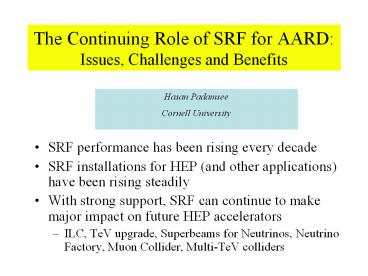
Title: The Continuing Role of SRF for AARD: Issues, Challenges and Benefits
1
The Continuing Role of SRF for AARD Issues,
Challenges and Benefits
Hasan Padamsee Cornell University
- SRF performance has been rising every decade
- SRF installations for HEP (and other
applications) have been rising steadily - With strong support, SRF can continue to make
major impact on future HEP accelerators - ILC, TeV upgrade, Superbeams for Neutrinos,
Neutrino Factory, Muon Collider, Multi-TeV
colliders
2
Steady Increase of Installed SRF Voltage in
Accelerators With Time
3
Total Installation gt 1000 m Total Voltage gt 6 GV
KEK-B
SNS
SNS/Jlab
CEBAF
CESR
HERA
LEP-II
CESR
TRISTAN
Stanford
Cornell
4
Steady Increase of SRF Gradients1980 20065
MV/m -gt 40 MV/m
Along the way
5
1995 Gradients 26 - 27 MV/m reached in Three
5-cell structures
Cornell DESY Fermilab Collaboration
6
Increase of SRF Gradients9-cells, 1995
2006-gt 40 MV/m
7
SRF for ILC (0.5 TeV)
SRF technology in US needs serious catching up
! Need to engage ALL available resources in US
35 - 40 MV/m DESY-KEK 6 best cavities, Vertical
Tests
8
Goals of Near Term RD for ILC
See talks by Holmes, Kephart, Kneisel
- Demonstrate reproducibility of performance
- Perfect EP, HPR, clean room techniques in US
- Long term performance characterization of full
scale structures in cryomodules - Assemble and operate one complete RF unit with
all ILC building blocks - US labs engaged
- Fermilab, Jlab, Cornell, Argonne
- (SMTF collaboration)
9
Beyond 35 MV/m for TeV ILC
- Important work started
- BUT much more needed!
- Better shapes
- Better niobium
- Better understanding of SRF physics of niobium
See Talk by Kneisel
See Talk by Gurevich
10
New Shapes Breakthrough50 MV/m in Single Cells
!Lower Surface Magnetic Field Lower Losses
Need Multi-cells Next
11
Better NiobiumStarted at Jlab
- Reduction of grain boundary density improves
performance - Lower cost through ingot stage
material
12
SRF for Muon Colliders at Multi-TeV energies
- Biggest challenge is muon cooling
- being addressed elsewhere
- Muon collider is a cascade of SRF Recirculating
Linear Accelerators (many turns each) - Starting with linac at low frequency (e.g 200
MHz) at 10 15 MV/m, followed by low frequency
RLAs - TeV scale energies after with several 30 MV/m
gradient RLAs - Total about 5 km of ILC-like linac
13
Need High Quality Nb Coatings For Low Frequency
Applications
- For 200 MHz, cost of Nb is a major factor gt
Develop Nb/Cu - CERN/Cornell collaboration reached 10 MV/m
- Improved coatings needed for 15 MV/m
- Ionize Nb atoms using various methods
- Bias magnetron sputtering (Cornell/ACCEL)
- Electron cyclotron resonance in a Nb plasma
(Cornell/Jlab) - Vacuum Arc (Cornell/INFN-Rome)
14
SRF for the Neutrino Sector
- Neutrino factory (Muons accelerated to 20 GeV via
5-turn RLA, need about 4 GeV) - Could serve as demonstrator for the muon
collider - Neutrino factory may or may not be needed
depending on super-beams, as for example - 8 GeV Proton Driver
- Main part of Proton Driver is SRF, ILC-like linac
- Could also be test linac for ILC (if needed)
Neutrino Beams
See Talk by Foster
15
SRF for Colliders Beyond 1 TeVBoth gradients gt
50 MV/m Q 1011 can contribute
- Higher gradients
- Need New materials, e.g. Nb3Sn
- Simple theory
- RF critical magnetic field Superheating
critical field - Nb 2200 Oe (57 MV/m) Best achieved 2000 Oe
- Nb3Sn 4000 Oe (105 MV/m) Best achieved 1100
OeWhy? - Fundamental research needed on the RF critical
field of highly Type II superconductors - Theoretical studies
- Experimental work to determine Hcrit
- Coupled with fabrication of best materials
- Present funding level for this effort is nearly
zero !
16
Pulsed Measurements of RF Critical Field Nb
Nb3Sn
4000 Oe 105 MV/m in new shape cavities
T. Hays Cornell Campisi SLAC
Hc1- Nb3Sn
17
Simple Theory of RF Critical Magnetic Field
Plane Nucleation Model For flux lines
Other Models Are these right??
Best Nb
18
Increased Gradients Must Go Hand-in-hand With
Increased Q, to Keep Operating Costs in Line
For e.g. 80 MV/m will need Q 1011
19
Best Nb Q gt 1011 at 25 MV/m, 1.6 K
20
Best Nb3Sn Q at 2 K ! (But at low fields)
G. Mueller and P. Kneisel
21
Conclusions
- Basic RD on SRF has steadily pushed gradients
- With many benefits to HEP, and non-HEP along the
way (See Talk by Swapan C.) - We must solidify our gains in the 35 40 MV/m
range to realize ILC - With other potential benefits to HEP ( Neutrino
Factory, Proton Driver, Muon Collider) - And non-HEP (Light sources, Neutron sources)
- Support needed to stay on the road to 100 MV/m
and Q 1011 to realize multi-TeV energy. - Continued evolution of the Livingston Curve?
22
A Look into the Past and FutureInstalled SRF
Voltage
ILC
XFEL
SNS
LEP
CEBAF
Recommended

