

Incorporating Environmental Sustainability into Traditional Management Control PowerPoint PPT Presentation
1 / 1
Title: Incorporating Environmental Sustainability into Traditional Management Control
1
Incorporating Environmental Sustainability into
Traditional Management Control
Raef Lawson, Institute of Management Accountants
David Marcinko, Skidmore College Saurav
Dutta, SUNY Albany
Production Technology
Incorporating Shadow Prices
Teaching Points
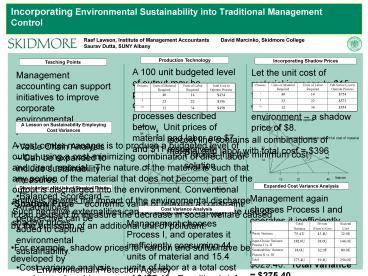
A 100 unit budgeted level of output may be
produced using any one of three production
processes described below. Unit prices of
material and labor are 7 and 11 respectively
Let the unit cost of material increase to 15 to
allow for the cost of discharges into the
environment a shadow price of 8.
- Management accounting can support initiatives to
improve corporate environmental performance. - Value Chain Analysis Can be expanded to include
sustainability measures. - Balanced Scorecard An additional perspective
can be added to capture environmental
sustainability. - Cost variance analysis can be employed to address
the full social cost of departures from efficient
resource use.
Process Units of Material Required Units of Labor Required Full Social Cost to Operate Process
I 40 14 754
II 22 22 572
III 12 34 554
Process Units of Material Required Units of Labor Required Total Cost to Operate Process
I 40 14 434
II 22 22 396
III 12 34 458
Process III is now optimal
A Lesson on Sustainability Employing Cost
Variances
Isocost line contains all combinations of
material and labor with total cost 396
Isocost has rotated to reflect full cost of
material
A cost center manager is to produce a budgeted
level of output using a cost-minimizing
combination of direct labor and direct material.
The nature of the material is such that any
portion of the material that does not become part
of the output is discharged into the environment.
Conventional analysis ignores the impact of the
environmental discharge. Such negative
externalities can be assessed through the use
of shadow prices.
Process II is the minimum cost solution
Expanded Cost Variance Analysis
Development and Use of Shadow Prices
Management again chooses Process I and operates
it inefficiently consuming 44 units of material
and 15.4 units of labor. Full social cost
829.40. Total variance 275.40 The firm only
absorbs private costs resulting in the variances
below
- Shadow Price - economic value of relaxing a
constraint. - It can be used to measure the decrease in social
welfare caused - by the emission of an additional unit of
pollutant. - For example, shadow prices for carbon and sulfur
have been - developed by
- Environmental Protection Agency
- Stern Report
- UK Department for Environment Food and
Rural Affairs - The Regional Greenhouse Gas Initiative
- The shadow price provides a signal to managers
regarding - the relative cost of activities resulting in
emissions.
Cost Variance Analysis
Management chooses Process I, and operates it
inefficiently consuming 44 units of material and
15.4 units of labor at a total cost of 477.40.
Resulting total variance 477.40 - 396
81.40 Input-choice Variance Difference in cost
between efficient operation of Process I and
Process II 434 - 396 38 Waste variance
Actual cost of operating Process I less the cost
of efficiently operating Process I 477.40 -
434 43.40
Total Variance Private (Firms) Cost Societal Cost
Waste Variance 75.4 U 43.4U 32.0U
Input-Choice Variance Process I vs. II 182.0U 38.0U 144.0U
Sustainability Variance Process II vs. III 18.0U 62.0F 80.0U
Total 275.4U 19.4U 256.0U
Recommended

