

Large hail is not a killer, but does considerable damage PowerPoint PPT Presentation
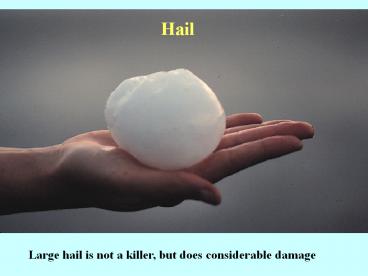
Title: Large hail is not a killer, but does considerable damage
1
Hail
Large hail is not a killer, but does considerable
damage
2
Falling from 20,000 feet or higher, large
hailstones pack quite a punch!
3
Large hail does significant damage to cars.
4
Average annual number of days with hail
5
This is the Aurora hailstone, the largest one at
the time. It fell at Aurora, NE on June 22, 2003.
6
The Aurora hailstone was 7 inches in diameter.
Imagine that falling on your head from 20,000
feet up!
7
This is the previous record-holder, the
Coffeyville hailstone with some props (egg, hand)
for comparison.
8
The Coffeyville hailstone cut into sections.
Notice the layers This stone fell on Coffeyville,
KS on Sept 3, 1970.
9
The rings are caused by different growth regimes.
Clear ice is deposited slowly and contains few
air bubbles. Cloudy ice occurs when water
freezes quickly, trapping the air bubbles.
10
The current record-holder is the Vivian (SD)
hailstone, July 23, 2010. (https//www.weather.gov
/abr/vivianhailstone)
11
Hail is often categorized by its size in relation
to everyday objects
12
Marble
Sizes of hail and the everyday objects used as
adjectives (e.g., baseball-sized hail is 2.75 in
diameter)
13
Oneonta hail, June 15, 2009. This is marble-sized
14
Those are small pine cones for comparison.
15
A schematic supercell radar echo with a hook
echo. Tornadic thunderstorms often also have
large hail. The hailfall area is close to the
tornado.
16
Ingredients for Hail Growth
In a basic sense, 3 Main ingredients are
required 1. Adequate updraft to keep
hailstone aloft for an appropriate amount of
time, -10 to -30C 2. Sufficient supercooled
water near the hailstone to enable growth during
transit through an updraft 3. A piece of ice or
snow (embryo) for it to grow upon
17
Vertical cross section of a supercell hailstorm.
18
(No Transcript)
19
(No Transcript)
20
Forecasting Hail
- Deep, Moist Convection (DMC) has 3 Ingredients
- Sufficiently deep low level moisture
- Steep lapse rates (related to instability)
- Sufficient lifting from LCL to LFC
? Once DMC identified as possibility, look for
hail signal
21
Hail Ingredients
- Strong updrafts necessary but not sufficient
- ? High CAPE in hail growth zones
22
Hail Ingredients (continued)
2. Storm scale winds Speed/Direct-ional shear
is important. Directional shear helps create a
rotating updraft. Rotation can enhance updraft
strength by a factor of 2 or more, above that of
an updraft created by buoyancy alone.
23
(No Transcript)
24
12 hours earlier
25
The concept of the Wet-bulb Zero
Wet-bulb Zero (WBZ) This is the level where
evaporative cooling reduces a parcel temperature
to 0C. It correlates well with large hail when
the altitude of the WBZ is between 2200 meters
and 2800 meters. If the WBZ is higher than 2800
meters, hailstones must fall through a large
layer which is above 0C and usually do not reach
the ground in frozen form. If the WBZ is lower
than 2200 meters, the lower atmosphere is
relatively cold and stable so the large updrafts
needed for hail formation dont exist. The
exception to the above guidelines is when the
ground level is significantly above sea level.
That usually reduces the thickness of the
low-level warm layer and hail becomes more
common. This is the reason for the hail maximum
in the High Plains and especially east of the
Colorado Rockies. Source A World of Weather by
Lee Grenci and Jon Nese (2001)
26
Example of Skew-T Log P determination of WBZ
27
WBZ
729 mb 2788m
28
(No Transcript)
29
(No Transcript)
30
(No Transcript)
31
(No Transcript)
32
(No Transcript)
33
SHIP - Significant Hail Parameter
Strengths Weaknesses
Based on large number of soundings and is simple to calculate High POD of SIG HAIL (gt90) Statistically separates SIG from NON SIG hail Widely available (SPC Mesoanalysis page, SFCOA, NMAP, NSHARP) Only forecasts SIG Category, not actual hail size(values gt 1 favorable for SIG) Conditional on gt0.75 hail going to occur Based on MUCAPE, thus may exhibit noise at times Again, dependent upon accurate thermodynamic profile forecast Will instability be realized? Forcing is not parameterized
SHIP MUCAPE MUMR 7-5LR 500T 0-6 SHR /
Constant
MUMR Mixing Ratio of Most Unstable Parcel
34
(No Transcript)
35
SPC Mesoanalysis page. Not a forecast but lots
of information. Use the dropdown menus.
36
Next The most common type of severe weather
Downbursts
Recommended

