

Stations of the Cross from Latin America 1492 - 1992 PowerPoint PPT Presentation
Title: Stations of the Cross from Latin America 1492 - 1992
1
Stations of the Cross from Latin America 1492 -
1992
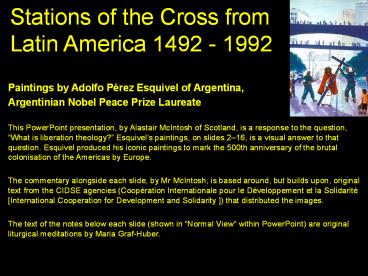
- Paintings by Adolfo Pérez Esquivel of Argentina,
- Argentinian Nobel Peace Prize Laureate
- This PowerPoint presentation, by Alastair
McIntosh of Scotland, is a response to the
question, What is liberation theology?
Esquivels paintings, on slides 216, is a visual
answer to that question. Esquivel produced his
iconic paintings to mark the 500th anniversary of
the brutal colonisation of the Americas by
Europe. - The commentary alongside each slide, by Mr
McIntosh, is based around, but builds upon,
original text from the CIDSE agencies
(Coopération Internationale pour le Développement
et la Solidarité International Cooperation for
Development and Solidarity ) that distributed
the images. - The text of the notes below each slide (shown in
Normal View within PowerPoint) are original
liturgical meditations by Maria Graf-Huber.
2
1st Station
Condemnation to death Pilate handed Jesus over
to be crucified. (Mark 1515) Theme Human
Rights. Christ is led from prison, watched by
the mothers of the Plaza de Mayo in Buenos Aires
the mothers of the disappeared. Their posters
read No more repression and Where is my son?
Jesus himself is also a victim of false
accusations, of unfair arrest and torture. And in
the 21st century, European airports have been
used by America for extraordinary rendition
torture flights in violation of human rights, and
people jailed for years without trial in
Guantanamo Bay.
3
2nd Station
Rejected and abandoned And carrying his own
cross he went out of the city. (John
1917) Theme The Loneliness of Cities. Christ
in the scarlet mocking coat is arrested in the
city of São Paulo. The Roman soldiers are armed
not with swords, but guns. Meanwhile, most people
go about their daily business, turning a blind
eye to and taking no action over the tyranny
being played out before them. The only witnesses
are a shoe-shine boy and an elderly couple
people of low social status. Liberation theology
is contextual theology the stories about
Jesus are contextualised in our world today, for
we imprison them if we trap them in the past.
4
3rd Station
Crushed by the Cross He has sent me to set the
downtrodden free. (Luke 419) Theme War
Civil Wars Jesus falls for the first time under
the burden of the Cross. Brutal violence has
weighted him down, just like that which afflicts
peasants, farm workers and the urban poor today.
In the foreground we see Archbishop Oscar Romero
of El Salvador, a man of peace who was
assassinated at the altar when celebrating Mass
on 24 March 1980. Jesus never taught just war
theory he taught nonviolence, telling Peter to
put away his sword - No more of this (Luke
2251). As such, the cross becomes the supreme
symbol of nonviolence the power of love that
exceeds the love of power.
5
4th Station
Mother and son His mother stored up all these
things in her heart. (Luke 251) Theme
Suffering, Solidarity Community. In one of the
favelas or urban slums of Latin America, Mary,
overwhelmed with grief, meets her condemned son.
The people lack such essentials for life as safe
water, sanitation, nutritious food, transport and
wonted work work that is meaningful. In spite
of this, they survive by self-help and solidarity
that builds community. Marys suffering is that
of all those who are unable to do enough to save
their loved ones. It is our suffering, too, when
beauty is crushed around us and we are unable to
do enough to save our world.
6
5th Station
Helped by an outsider They compelled a passer-by
who was coming in from the country, to carry his
cross. (Mark 1521) Theme Racial Prejudice.
Simon of Cyrene is portrayed as one of the
millions of black people living in Latin America
descendents of those who were brought there
under slavery while the native Amerindians were
being exterminated. This ethnic group have the
lowest status in Latin America. They are often
subject to victim blaming - a form of prejudice
where the powerful scapegoat the powerless to
justify their power. Because of this, Paulo
Freire of Brazil said that the great work of the
oppressed is to liberate both themselves, and
their oppressors!
7
6th Station
Community of the oppressed If you did this to
the least of my people, you did it to me.
(Matthew 2540) Theme Indigenous Peoples. Of
the 22 million Aztecs alive in 1519 when Hernán
Cortez entered Mexico, only a million remained by
1600. Here, Indian women represent Saint
Veronica. They have wiped the face of Jesus. His
features, now imprinted on the cloth, are their
features. Could they be ours too? Once, we were
all indigenous peoples. Perhaps today we must
rediscover this quality if we are to re-make
communities of place and care for the Earth
whereon we tread. But we must shape identity
inclusively just as Jesus was challenged to be
inclusive by the Canaanite woman (Mark 724-30).
8
7th Station
The Land Question Give us this day our daily
bread. (Matthew 611) Theme The Landless Poor.
Jesus falls for the 2nd time under the weight of
the cross. Each rope on the cross that can be
seen amongst the land reform (Reforma Agraria)
marchers represents a murdered Campesino
Derecho a la tierra Right to the land, say
their banners. Jesus taught people to pray for
bread, and he rejected the temptation of landed
power (Luke 45-8). Today, 2.25 of the people of
Guatemala own 64 of the land. And rich
landowners representing 0.08 of the population
claim to control 80 of Scottish land. But were
learning from the South with the Land Reform
(Scotland) Act 2003.
9
8th Station
The Outcry of the Women Many women cried and
lamented for him. (Luke 2327) Theme Womens
Empowerment. Full of compassion the women bewail
the fate of Jesus. He, however, refers them to
their own fate Do not weep for me The
Biblical scene is transferred to Ayacucho, Peru,
where many fathers and sons are killed and the
women are left alone to provide for their
families. They say Yesterday in the Bible group
we read how the people of Israel were oppressed
in Egypt. Arent we in the same position? God
wants to lead us to the promised land too. We
should discuss this with the others!
10
9th Station
Cast Out and Abused Whoever welcomes such a
child in my name welcomes me. (Mark
937) Theme Children in Need. Jesus falls for
the 3rd time, amid homeless children and
unemployed youth. In Brazil hundreds of street
children were murdered by death squads every
year. In Scotland, youth at Govans GalGael
Trust, who started on drugs as young as 12, say
I took heroin because it took away the pain but
it also took away my soul. Alice Millers work
shows how a child not loved for itself in its
primal integrity - becomes destructive. Christ
took children in his arms and blessed them. As a
child, he himself was a refugee in Egypt, and
Josephs love made him socially acceptable
through fostership.
11
10th Station
Destruction of the Rainforests They divided his
garments among them. (Matthew 2735) Theme The
Death of Nature. Jesus is stripped of his clothes
by soldiers who gamble for them. In the same way,
the Earth is stripped of her clothes - her soils,
waters and forests - to fuel our great casino
economy where need is dwarfed by greed. As the
Roman soldiers prepare to crucify Jesus, the
Brazilian environmentalist and rubber-tappers
union leader, Chico Mendes, lies assassinated in
the foreground (22 Dec 1988). To Jesus, the Earth
was Gods footstool the sacred resting place
of divine presence (Matthew 535).
12
11th Station
Nailed to the Cross You cannot serve both God
and money. (Matthew 624) Theme The Debt
Crisis. Jesus is nailed to the cross, just as the
poor are nailed by the rich through monetarism
and the sin of usury (making money out of money
by lending only for interest). Investors may
think theyre innocently seeking the best rate
of return, but so doing drives an economic
system where the poor supply unearned income to
the relatively rich. In this picture, the poor
carry resources up the scaffold, transferring
wealth from South to North. Might Christians
consider learning from attempts within Islamic
banking to overcome usury, as well as by
promoting Fair Trade? (Ezekiel 28 Rev.
1811-18)
13
12th Station
Death on the Cross But Jesus gave a loud cry and
breathed his last. (Mark 1537) Theme A World
Ripped Apart. The whole world is crucified by the
spirit of violence. The two halves rich and
poor, North and South, Heaven and Earth have
been pulled asunder, yet still the Cross unites
them. It is love that hangs crucified a love
that transcends even tortured death. All who take
risks and put their necks on the line for justice
in this world stand here in solidarity. Amongst
this communion of the saints are those
powerless to do anything but testify with their
powerful presences the spirituality of the
foot of the Cross. Such, often, is our Station.
14
13th Station
The Seed of Hope If a grain of wheat dies, it
bears much fruit. (John 1224) Theme Base
Communities. Jesus is taken down from the cross.
The people gather in anticipation of Easter. All
around the world, small groups gather, For where
two or three are gathered together in my name,
there am I in the midst of them (Matthew 1820).
Jesus was a man who died, but Christ is an
understanding of the deathless spirit of life as
love made manifest, beyond gender (Galatians
328). We might see this as alive in all, also in
other faiths. Where institutional churches flee,
ego-inflated, from such mystical insight, base
communities of grassroot seekers of truth can
rise above spiritual materialism and so renew
Gods church.
15
14th Station
Walking in the Shadow of Death Joseph took the
body, wrapped it in a linen cloth and laid it in
his own tomb. (Matthew 2759) Theme Return to
the Earth. Jesus is laid to rest in a tomb, here
beside a rubbish tip in a polluted industrial
nation. We come from the clay of Mother Earths
womb, are nourished from the fields, and in the
end return to the soil ashes to ashes, dust to
dust - at one with rock-building geological
processes set in time when place began. I lift a
stone it is the meaning of life I clasp, said
the Scots bard, Hugh MacDiarmid, in On a Raised
Beach We must reconcile ourselves to the
stones/ Though slow as the stones the powers
develop/ To rise from the grave to get a life
worth having.
16
15th Station
Triumph of LifeWhy do you seek the living among
the dead? He is not here but has risen. (Luke
245) With the ships of the Conquistadors and the
factories of globalisation in the background,
Christ out in nature with the sun symbolically
overhead leads a march of landless Campesinos
with martyrs of the struggle, including Alice
Dumont (Argentina), Santa Dias da Silva (Brazil),
Óscar Romero (El Salvador), Chico Mendes
(Brazil), Ita Ford (El Salvador), Zumbi (Brazil),
Dana Tingo (Dominican Republic), Luisito Torres
(El Salvador), Túpac Amaru (Peru), Enrique Angel
Angelelli (Argentina), Luis Espinal (Bolivia) and
Vicente Menchú (Guatemala). R.I.P. (See next
slide for exegesis).
17
The15th Station and Mystical Experience(Photogra
ph of Adolfo Pérez Esquivel the artist)
In preparing the commentaries shown to the right
of each slide, I have drawn from text published
in 1992 by Misereor of Germany and also from the
1992 CIDSE handbookWay of the Cross from Latin
Americathat accompanied the original 35 mm
photographic slides from which this presentation
was digitised. Bible passages are also as given
by CIDSE. Commenting upon the Easter Picture,
Lenten Veil or Hunger Cloth that comprises
the15th and final Station, the CIDSE booklet had
this to say Mystical experience is of central
importance in Liberation Theology. Jesus can be
experienced in and with those who suffer. For
those who have faith, the act of turning to the
oppressed, of serving the poor, of search for
freedom from exploitative structures, is also an
act of love for the suffering Christ. By the same
token, the resurrection will be experienced
whenever life is defended. Furthermore, all life
which is oppressed and extinguished by power is
included in the resurrection. This concept is
expressed by Adolfo Perez Esquivel in his Easter
picture.
18
Background to this Material
As a Scottish Quaker of universalist disposition
and Presbyterian background, it seems a little
strange to be placing onto the web devotional
material that was widely distributed by the Roman
Catholic church in 1992, but has since vanished
from view. I have searched the web, but in vain,
to locate the material for use in my teaching and
activism. I therefore resorted to having my own
35 mm transparency set scanned. I first came
across Esquivels Way of the Cross paintings
through the Scottish Catholic International Aid
Fund (SCIAF) - the official overseas relief
agency of the Scottish Catholic bishops. Between
the late-eighties and 1999, I was the only
non-Catholic serving on their Management
Committee, laterally as Chair of the Projects
Committee, which then disbursed 2 million of
grants annually in accordance with what radical
Catholics call Our best kept secret namely,
their churchs rich and challenging social
teaching. At that time, liberation theology was
being vibrantly supported and celebrated within
Catholic agencies and especially SCIAF. This made
it easy for me to participate, enthusiastically,
in their work something I had actually begun in
1977, when Voluntary Service Overseas had posted
me, rather surprisingly, to work for two years
with Archbishop Virgil Copas and the Missionaries
of Charity sisters in Gulf Province, Papua New
Guinea, as a vocational school deputy-headteacher
and wiring up micro hydro-electric
schemes. Esquivels Stations of the Cross
exemplified my admiration for radical Catholic
theology which I saw as speaking to all who
understand God as love. The images were
distributed in Europe by CIDSE the umbrella
organisation of such Catholic relief agencies as
Misereor, CAFOD, Trócaire and SCIAF. I am
puzzled as to why Esquivels iconic paintings
seem now to have fallen into oblivion. Id have
thought that one of the big Catholic agencies
might have put them on the web, the better to
teach what liberation theology means. But this
has not happened, so here they are - and I would
welcome any opportunity that might arise to thank
and ask the formal blessing of Adolfo Pérez
Esquivel. Christmas 2005 (23 Dec) Alastair
McIntosh, Scotland ( www.AlastairMcIntosh.com )
Recommended

