

A Multi-platform Co-array Fortran Compiler for High-Performance Computing PowerPoint PPT Presentation
Title: A Multi-platform Co-array Fortran Compiler for High-Performance Computing
1
A Multi-platform Co-array Fortran Compiler for
High-Performance Computing John Mellor-Crummey,
Yuri Dotsenko, Cristian Coarfa johnmc,
dotsenko, ccristi_at_cs.rice.edu
Research Focus
Co-Array Fortran Language
Programming Models for High-Performance
Computing
PUT Translation Example
- Enhancements to Co-Array Fortran model
- Point-to-point one-way synchronization
- Hints for matching synchronization events
- Collective operations intrinsincs
- Split-phase primitives
- Synchronization strength-reduction
- Communication vectorization
- Platform-driven communication optimizations
- Transform as useful from 1-sided to two-sided
and collective comm. - Generate both fine-grain load/store and calls to
communication libraries as necessary - Multi-model code for hierarchical architectures
- Convert Gets into Puts
- Compiler-directed parallel I/O with UIUC
- Interoperability with other parallel programming
models
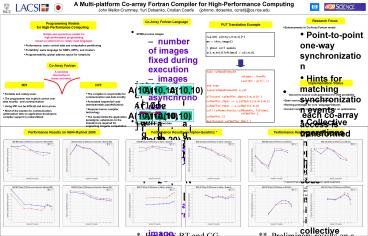
- SPMD process images
- number of images fixed during execution
- images operate asynchronously
- Both private and shared data
- real a(20,20) private a 20x20 array in
each image - real a(20,20) shared a 20x20 array in
each image - Simple one-sided shared memory communication
- x(,jj2) a(r,) pp2 copy rows from
pp2 into local columns - Flexible synchronization
- sync_team(team ,wait)
- team a vector of process ids to synchronize
with - wait a vector of processes to wait for (a
subset of team) - Pointers and dynamic allocation
- Parallel I/O
. . . real(8) a(0N1,0N1) me
this_image() . . . ! ghost cell
update a(1N,N1)left(me) a(1N,0) . . .
- Simple and expressive models for
- high performance programming
- based on extensions to widely used languages
- Performance users control data and computation
partitioning - Portability same language for SMPs, MPPs, and
clusters - Programmability global address space for
simplicity
Co-Array Fortran
A sensible alternative to these extremes
type CafHandleReal8 integer handle real(8)
ptr(,) end type type(CafHandleReal8) a_caf . .
. allocate( cafBuffer_1ptr(1N,00)
) cafBuffer_2ptr gt a_cafptr(1N,N1N1) cafBuf
fer_1ptr a_cafptr(1N,0) call
CafArmciPutS(a_cafhandle, left(me),
cafBuffer_1, cafBuffer_2) deallocate(
cafBuffer_1ptr ) . . .
integer A(10,10)
Implementation Status
MPI
HPF
- Source-to-source code generation for wide
portability - Open source compiler will be available
- Working prototype for core language features
- Current compiler implementation performs no
optimization - each co-array access is transformed into a
get/put operation at the same point in the code - Code generation uses the widely-portable ARMCI
communication library - Front-end based on production-quality Open64
front end, modified to support source-to-source
compilation
- Portable and widely used
- The programmer has explicit control over data
locality and communication - Using MPI can be difficult and error prone
- Most of the burden for communication
optimization falls on application developers
compiler support is underutilized
- The compiler is responsible for communication
and data locality - Annotated sequential code (semiautomatic
parallelization) - Requires heroic compiler technology
- The model limits the application paradigms
extensions to the standard are required for
supporting irregular computation
if (me .eq. 1) then A(13,15)me1
A(13,15)me
Performance Results on IA64Myrinet 2000
Performance Results on AlphaQuadrics
Performance Results on SGI Altix 3000
For NAS BT and CG the base case is synthetic,
so that the first measurable point has efficiency
1.0
Preliminary results on a loaded system in the
presence of other users competing for the memory
bandwidth
Recommended

