

.NET common type system PowerPoint PPT Presentation
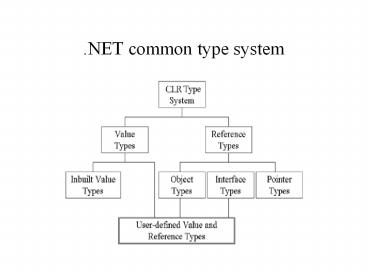
Title: .NET common type system
1
.NET common type system
2
Role of type system
- provides a logically consistent and unchanging
foundation - ensures that programs can be checked for
correctness at runtime ? type safety (a robust,
stable, secure runtime environment) - type checking can be specified
- informal
- formal algorithm-specific language and
denotational semantics - put automatic checking into software tools ?
anyone can use them compilers, linkers,
source-code analyzer
3
- in Rotor ECMA specification contains rules
- when a component is passed to the JIT compiler
from the execution engine and is transformed into
executable code, during this transformation code
is verified according to the rules - ? component are typesafe
4
Benefits type system
- detecting errors
- maintenance
- abstraction
- documentation
- efficiency
- security
5
Reference Types
- combination of a location ( identity) and a
sequence of bits - location - designates an area in memory where
values can be stored and type - are type-safe - object types are always reference types, but not
all reference types are object types
6
Object types
- object - anything that match the criterion
classified as of type System.Object in CLI type
system and used according to types specification
within the CLI execution engine - ? all object types inherit either directly or
indirectly from the Object class. - objects in SSCLI implementation are represented
at runtime by the C class Object, from file
object.h in clr/src/vm directory - all object types descend from this base type,
whose definition is
7
- public class System.Object
- public Object( )
- public virtual bool Equals (object obj)
- public static bool Equals (object objA, object
objB) - //returns true if 2 objects are equal may be
overriden in subtypes - public virtual int GetHashCode ( )
- // returns the hash code for an object
- public Type GetType ( )
- // returns the type object for this object
allows access to the metadata - // for the object
- public static bool ReferenceEquals (object objA,
object objB) - public virtual string ToString ( )
- // returns a string representatiom of the
object - . . .
8
- Others
- MemberwiseClone returns a shallow copy of the
object - Finalize invoked by the garbage collector
before an objects memory is reclaimed - Most of the methods are public
- Some (MemberwiseClone, Finalize) have protec-ted
access.
9
Components
- abstract units of interoperability and reuse
for programmers working with languages that
target CLI - defined using types manipulated using
high-level languages - autonomous, replaceable units, adaptive over time
- modified and deployed without changing other
components - in Rotor
- object instance of type System.Object
- component more general role (used when others
say object)
10
Interface types
- a partial specification of a type
- partition types into categories of related
functionality - A contract that binds implementers to provide
implementations of the methods contained in the
interface. - Object types may support several interface types,
and several different object types would normally
support an interface type - By definition, an interface types can never be an
object type or an exact type. - Interface types may extend other interface types.
11
- May contain
- Methods (both class and instance)
- Properties
- Events.
- Cannot contain instance fields
- (major difference from object or value type)
- respects interface purposes from other languages
(C, Java) - method declaration on an interface (state
represented as accessor and mutator set get) - behavior is represented as nonstate-related
methods - notification involves a callback interface that
client components must implement
12
- Example
- using ltmscorlib.dllgt
- using namespace System
- _gc _interface Ipoint
- _property int get_X ( )
- _property void set_X (int value)
- _property int get_Y ( )
- _property void set_Y (int value)
- _gc class Point public Ipoint
- . . .
13
- CLR provides a number of interface types
- Example IEnumerator interface supported by array
objects - Allows clients of arrays to enumerate over the
array by requesting an IEnumerator interface
supports 3 methods - Current returns the current object
- MoveNext moves the enumerator on to the next
object - Reset reset the enumerator to its initial
position.
14
Pointer Types
- Provide a means of specifying the location of
code or value - 3 categories
- Function pointers refer to code
- Managed pointers can point at objects located on
the garbage-collected heap - A managed pointer is similar to the object
type, but points to the interior of an object.
Managed pointers are not interchangeable with
object references.
15
- Unmanaged pointers can address local variables
and parameters - are the traditional pointers of other runtime
systems, that is, the addresses of data - are an essential element for the interoperation
of CLI programs with native code components. Such
pointers may not point into the managed heap
since such heap values are under the control of a
garbage collector that is free to move and
compact objects. - Conversely, values of managed pointer type may
safely point outside the managed heap, since the
garbage collector knows the heap limits.
16
Built-in Types
- There are built-in value and reference types
- Have special instructions in the intermediate
langauge, so that they can be handled efficiently
by the execution engine - Built-in types are
- Bool
- Char (16-bit Unicode)
- Integers (signed unsigned 8-, 16-, 32-,
64-bit) - Floating point numbers (32- and 64-bit)
- Object // inbuilt reference type
- String // inbuilt reference type
- Machine-dependent integers (signed unsigned)
- // hold the largest value that an array index
can support on a machine - Machine-dependent floating point
17
Metadata
- the essential link that bridges the runtime type
system and the execution engine - 2 problems
- information about the component (its metadata) is
often not stored with the component often stored
in auxiliary files (IDL files, type libraries,
interface repositories, implementation
repositories, Registry) ? CLR stores metadata
with types - metadata facilities are primitive allow
developer to specify syntax but not semantics of
interfaces ? CLR provides a standardized metadata
extension system known as custom attributes
18
- Compilers targeting .NET describe types with
metadata for 2 reasons - metadata allow types defined in one language to
be used in another langauge - ensures langauge
interoperability in CLR - the execution engine requires metadata to manage
objects. - Metadata are stored in files in a binary format
the format is not specified, but there are
methods for reading and writing metadata. - Metadata are extensible through custom attributes.
19
Using types in data-driven code
- to use type information to drive program
decisions is called introspection or reflection
components code is reflec-ting on its own
structure and making decisions based on this
information - programs (when having permission) can create,
manipulate and examine type metadata from - managed code using System.Reflection family of
types - unmanaged code using unmanaged APIs described
in clr/src/inc/metada.h - type descriptions are used to defer decisions
until runtime, enabling unbound linkages between
components
20
- What we want ability to place information at the
type level into the code, available to interested
parties, but otherwise a non-intrusive
specification - Case study to take an existing in-memory object
instance and save its current state to some
secondary storage stream (e.g. the filesystem,
sent as part of an HTTP request a.s.o.) - object-oriented approach
- common behavior across types, should be
represented as a base type from which derived
types inherit their functionality
21
C style (multiple inheritance)
- one problem base type knows nothing of the
derived types data, although need to store its
data - second problem with multiple inheritance,
require the argument for multiple inheritance
within the system
22
Java style (single inheritance interface)
- one solution create an interface that serves as
a well-understood flag to components to
indicate that this type wants to participate in
the object-to-disk behavior. - a type inherits this marker interface, which
has no methods, and when instances of this type
are passed to the object-to-disk APIs, the flag
is checked to ensure that this type does want to
be stored.
23
- BUT
- the level of granularity on the interface is
centered on methods - if the component wants additional information
about storing on the disk, needs a method in the
interface, called by the storing APIs, to obtain
that information - components to be stored must implement those
methods gt API of the component will contain code
that isnt domain related
24
CLI approach
- solution custom attributes
- attributes are metadata attached to various
facets of types, using either special language
syntax or tools that enable after-the-fact type
annotation - because metadata for any object instance is
available through the reflection APIs, the code
to implement the writing out of values is easy
25
Example
- using System // gradfather in Cnamespace
Smith public class Grandfather
public Grandfather()
Name "Smith" FirstName
"GrandDad" public string
Name public string FirstName - public virtual int Age()
return(85)
26
- Imports System //father in VB
- Namespace Smith
- Public Class Father Inherits
Grandfather - Public Sub New( ) FirstName
"Father" End Sub - Public Overrides Function Age() As
Integer Age 45 End
Function - End Class
- End Namespace
27
- using ltmscorlib.dllgt //son in managed C
- using namespace System
- using "Father.dll
- namespace Smith __gc public class Son
public Father public
Son() FirstName
S"Son" - int Age()
return(5)
Recommended

