

Composition, Physical State and Distribution of Ices at the Surface of Triton PowerPoint PPT Presentation
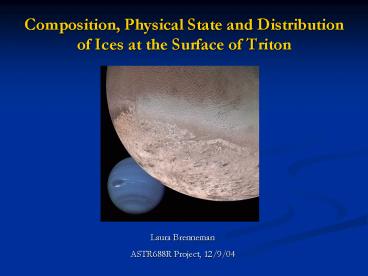
Title: Composition, Physical State and Distribution of Ices at the Surface of Triton
1
Composition, Physical State and Distribution of
Ices at the Surface of Triton
Laura Brenneman ASTR688R Project, 12/9/04
2
Triton Basics
- T 38 ? 4 K (Voyager 2, 1989)
- d 30 AU, a 14 RNep (icy)
- e lt 0.0005, i 159?, retro
- R 1353 km (Europa)
- ? 2 g/cm3
- Varied terrain, cryovolcanoes
- How was Triton formed? Still an open question
- Similar to Pluto-Charon, KBOs.
- Understanding equation of state could yield
important clues about the early solar system
beyond the frost line.
3
Polar Regions N2 Frost
4
Tritons Tenuous Atmosphere
5
The work of Quirico et al. (1999)
- Attempted to discern physical state of Tritons
surface via IR spectroscopy on UKIRT (Mauna Kea). - 6 1-hr. integrations along latitudinal strips at
99? longitude in H, K bands. - 2.65 nm spectral resolution, s/n 300.
- Compared with lab transmission spectra of ice
crystals made in liquid phase in closed cryogenic
cells ? composition, T, ?, crystalline lattice
phase of N2. - Created plane-parallel model of radiative
transfer within these icy media (absorption,
single and double scattering). - Use this to refine global model of observed
spectrum ? abundances and distribution of ices.
6
Ices Matching the Observed Spectra
?
?
?
Ice templates used C2H2, C2H4, C2H6, C3H8, NH3,
NO, NO2, SO2, CH3OH, CH4, CO, CO2, H2O, N2.
7
Methane Ice None in Pure Form??
8
Carbon Dioxide Ice Pure Fraction Significant
9
Best-Fit Model Two Regions
10
Fitting to Temperature and Grain Size
11
Conclusions
- Two region model of the surface works best 55
N2CH4CO, 45 H20 CO2 with CH4 0.11, CO
0.05 - N2 ice embeds methane, carbon monoxide T ?
35.6 K inferred since most of solid nitrogen
observed is in ß-phase (hexagonal). - Radiative transfer model indicates grain size of
10 cm too big for surface to be granular.
Probably polycrystalline with large crystals. - Large concentrations of pure CH4 ice are
unlikely lead to inconsistent global spectral
fits. - Still unsure of exact equation of state for the
H20 CO2 ice mixture uncertainty in spectral
fits.
12
Future Work
- Need more data to resolve the equation of state
more clearly for the H20 CO2 regions, to
further constrain T, and to identify the new
spectral features detected. - Some of this can be accomplished nicely with
future ground based observations with high
signal-to-noise ratios and high spectral
resolution in the 1.0 - 2.5 ?m range. - More of Tritons surface needs to be examined!
- It will also be helpful to have future missions
for the specific purpose of observing the outer
solar system with greater scrutiny, both in
imaging and spectroscopy.
13
References
- Cruikshank, D.P. et al. 1993 Science 261,
742-745. - de Pater, I. and Lissauer, J. Planetary
Sciences. - Quirico, E. et al. 1999 Icarus 139, 159-178.
- http//www.solarviews.com/eng/triton.htm
Recommended

