

Electrochemistry Generating Voltage (Potential) PowerPoint PPT Presentation
Title: Electrochemistry Generating Voltage (Potential)
1
Electrochemistry Generating Voltage (Potential)
2
Historically
- Historically oxidation involved reaction with O2.
- i.e., Rusting
- 4 Fe(s) 3O2 (g) ??Fe2O3 (s)
- Other example
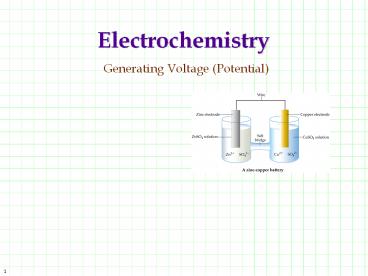
- Zn(s) Cu2(aq) g Zn2(aq) Cu(s)
- In this reaction
- Zn(s) g Zn2(aq) Oxidation
- Cu2(aq) g Cu(s) Reduction
- In a redox reaction, one process cant occur
without the other. Oxidation-Reduction reaction
must simultaneously occurs.
3
Redox Between
- If Zn(s) and Cu2(aq) is in the same solution,
then the electron is a transferred directly
between the Zn and Cu.
No useful work is obtained. However if the
reactants are separated and the electrons shuttle
through an external path...
4
Electrochemical Cells
- Voltaic / Galvanic Cell Apparatus which produce
electricity - Electrolytic Cell Apparatus which consumes
electricity - Consider
Initially there is a flow of e- After some time
the process stops Electron transport stops
because of charge build up
The charge separation will lead to process where
it cost too much energy to transfer electron.
5
Completing the Circuit
- Electron transfer can occur if the circuit is
closed - Parts
- Two conductors
- Electrolyte solution
- Salt Bridge / Porous membrane
3 process must happen if e- is to flow. A. e-
transport through external circuit B. In the
cell, ions a must migrate C. Circuit must be
closed (no charge build up)
Anode (-) Black Negative electrode generates
electron Oxidation Occur
Cathode () Red Positive electrode accepts
electron Reduction Occur
A
C
B
Cathode/Cation()
Anode/Anion (-)
6
Voltaic Cell
- Electron transfer can occur if the circuit is
closed - Parts
- Two conductors
- Electrolyte solution
- Salt Bridge / Porous membrane
3 process must happen if e- is to flow. A. e-
transport through external circuit B. In the
cell, ions a must migrate C. Circuit must be
closed (no charge build up)
Anode (-) Black Negative electrode generates
electron Oxidation Occur
Cathode () Red Positive electrode accepts
electron Reduction Occur
Cathode/Cation()
Anode/Anion (-)
7
Completing the Circuit Salt Bridge
- In order for electrons to move through an
external wire, charge must not build up at any
cell. This is done by the salt bridge in which
ions migrate to different compartments neutralize
any charge build up.
8
Sign Convention of Voltaic Cell
- _at_ Anode Negative Terminal (anions).
- Source of electron then repels electrons.
Oxidation occurs. - Zn(s) g Zn2(aq) 2e- Electron source
- _at_ Cathode Positive Terminal (cation)
- Attracts electron and then consumes electron.
Reduction occurs. - Electron target 2e- Cu2(aq) g Cu(s)
- Overall
- Zn(s) Cu2(aq) g Zn2(aq) Cu(s) E
1.10 V - Note when the reaction is reverse Cu(s)
Zn2(aq) g Cu2(aq) Zn(s) - Sign of E is also reversed E -1.10 V
- Oxidation Zn(s) g Zn2(aq) E 0.76 V
- Reduction Cu2(aq) g Cu(s) E 0.34 V
- 1.10 V ECELL
- or ECELL Ered (Red-cathode) - Ered
(Oxid-anode)
9
Other Voltaic Cell
- Zn(s) 2H (aq) g Zn2(aq) H2 (g) E
0.76 V
_at_ Anode Negative Terminal (anions) Zn(s) g
Zn2(aq) 2e- Source of electron then repels
electrons. Oxidation occurs. _at_ Cathode
Positive Terminal (cation) 2e- 2H(aq) g H2
(g) Attracts electron and then consumes electron.
Reduction occurs. Net Zn(s) 2H (aq) g
Zn2 (aq) H2 (g)
10
Other Voltaic Cell
- Zn(s) 2H (aq) g Zn2(aq) H2 (g) E
0.76 V
_at_ Anode Negative Terminal (anions) Zn(s) g
Zn2(aq) 2e- Source of electron then repels
electrons. Oxidation occurs. _at_ Cathode
Positive Terminal (cation) 2e- 2H(aq) g H2
(g) Attracts electron and then consumes electron.
Reduction occurs. Net Zn(s) 2H (aq) g
Zn2 (aq) H2 (g)
11
Line Notation Convention
- Line notation Convenient convention for
electrochemical cell - Schematic Representation
- 1. Anode g Cathode
- oxidation (-) reduction ()
- 2. phase boundary
- (where potential may develop)
- 3. Liquid junction
- 4. Concentration of component
- Zn(s) ZnSO4 (aq,1.0M) CuSO4 (aq,1.0M) Cu(s)
4
3
2
12
Line Notation Examples
- Consider Zn(s) Cu2(aq) g Zn2(aq) Cu(s
- Anode Zn g Zn2 2e-
- Cathode Cu2 2e- g Cu
- Shorthand Line notation
- Zn (s) Zn2 (aq)(1.0M) Cu2(aq) (1.0M)
Cu(s) - 2nd Example Zn(s) 2H (aq) g Zn2(aq)
H2(g) - Anode Zn g Zn2 2e-
- Cathode 2H 2e- g H2 (g)
- Shorthand Line notation
- Zn (s) Zn2 (aq)(1.0M) H(aq) (1.0M), H2(g,
1atm) Pt(s)
13
Other Voltaic Cell Their Line Notation
Oxidation half-reaction Cr(s) g Cr3(aq) 3e-
Oxidation half-reaction Zn(s) g Zn2(aq) 2e-
Oxidation half-reaction 2I- (aq) g I2 (s) 2e-
Reduction half-reaction MnO4-(aq) 8H(aq)
5e- g Mn 2(aq) 4H2O(l)
Reduction half-reaction Ag(aq) e- g Ag (s)
- Zn(s) Zn2 (aq)H(aq) , H2 (g,1atm)Pt
Cr(s) Cr3 (aq)Ag(aq) Ag(s)
C(s) I-(aq) , I2 (g,1atm) MnO4-(aq) , Mn2
(aq) C(s)
14
Line Notation Examples
- Example 1 BL 20.13
- Zn(s) Ni2(aq) g Zn2(aq) Ni (aq)
- Example 2 BL 20.19
- Tl3(aq) 2Cr2(aq) g Tl(aq) Cr3(aq)
15
Voltage of Galvanic / Voltaic Cell
- Transport of any object requires a net force.
- Consider water flowing through pipes. This
occurs because of pressure gradient.
Flow (Fluid Transport)
Pressure (h)
Pressure (i)
Or
Similarly, electron are transported through wires
because of the electromotive force EMF or Ecell.
Object falling or transport down due to Dh
()
(-) e -
16
EMF - ElectroMotive Force
- Potential energy of electron is higher at the
anode. This is the driving force for the
reaction (e- transfer)
e
Anode (-)
D P.E. V J e - C
e- flow toward cathode
() Cathode
Larger the gap, the greater the potential
(Voltage)
17
ElectroMotive Force
- EMF - Electro Motive Force
- Potential energy difference between the two
electrodes - The larger the DP.E. the larger EMF value.
- The magnitude of P.E. for the reaction (half
reaction) is an intensive property) - i.e., Size independent r, Tbpt, Cs.
- Therefore EMF is also an intensive property.
- Analogy
- Size of rock not important, only the height from
ground. - (Electron all have the same mass)
- Unit EMF V - Volts
- 1V - 1 Joule / Coulomb
- 1 Joule of work per coulomb of charge
transferred.
18
Stoichiometry Relationship to E
- EMF - Intensive Property
- Ecell Standard state conditions 25C, 1atm,
1.0 M - Ecell Intensive property, Size Independent
- Consider
- Li e- g Li (s) ECell -3.045
V - x 2 2 Li 2 e- g 2 Li (s) ECell
(-3.045 V) x 2 ?? - But E Voltage per electron
- E E x 2 ? g - 3.045 V 2
-3.045 V - 2 e-
- \ Stoichiometry does not change E, but
reversing the reaction does change the sign of E.
19
Standard Reduction Potential
- Cell Potential is written as a reduction
equation. - M e- g M E std red. potential
Most spontaneous ltReduction occursgt Oxidizing
Agent
Written as reduction
Most non-spontaneous Spontaneous in the reverse
direction. ltOxidation occursgt Reducing Agent
20
Zoom View of Std. Reduction Potential
- Cell Potential is written as a reduction
equation. - M e- g M E
- F2 (g) 2e- g 2 F - (aq) 2.87 V
- Ce4 e- g Ce3 (aq) 1.61 V
- 2H 2e- g H2 (g) 0.00 V
- Li(aq) e- g Li(s) -3.045 V
Most spontaneous Reduction Oxidizing Agent
Written as reduction
Most non-spontaneous Spontaneous in the reverse
direction. Oxidation Reducing Agent
All reaction written as reduction reaction. But
in electrochemistry, there cant be just a
reduction reaction. It must be coupled with an
oxidation reaction.
21
ECell Evaluation
- ECell Function of the reaction
- g Oxidation Process (Anode reaction)
- g Reduction Process (Cathode reaction)
- or
- ECell ECathode EAnode
- Cathode ()
- Anode (-) Most Negative Reduction reaction
- Therefore,
- ECell Ered (Cathode) - Ered (anode)
- Neg Minus (Large negative)
- (Very Positive Value)
- Very Positive
- \ Very Spontaneous
22
Standard Reduction Potential
- How is Ered (Cathode) and Ered (Anode)
determine. - E (EMF) - State Function there is no absolute
scale - Absolute E value cant be measured
experimentally - The method of establishing a scale is to measure
the difference in potential between two
half-cells. - Consider
Zn g Zn2 2e- E? Cant determine
because the reaction must be coupled
How can a scale of reduction potential be
determine ? Use a half reaction as reference and
assign it a potential of zero. Electrochemical
reaction more spontaneous than this reference
will have positive E, and those less spontaneous
will have negative E.
23
Side-Bar Relative Scale
- Consider a baby whose weight is to be determine
but will not remain still on top of a scale. How
can the parents determine the babies weight?
Carry the child in arms and weight both child
and parent then subtract the weight of the parent
from the total to yield the baby weight.
24
Reference Potential
- Selected half reaction is
- H / H2 (g) couple half reaction 2H (aq,
1.0M) 2e- g H2 (g,1atm) - by definition c E 0.0 V, the reverse is also
0.0 V - H/H2 couple - Standard Hydrogen Electrode (SHE)
- To determine E for a another half reaction, the
reaction of interest needs to be coupled to this
SHE. The potential measured is then assigned to
the half-reaction under investigation.
ECell 0.76 V Ered (Cat) - Ered (Anode)
0.0 V - (?) Ered (Anode) - 0.76
V \Zn2/Zn E -0.76 V Reduction rxn
25
Determining Other Half-Cell Potential
- Now consider the reaction
- Zn(s)Zn2 (1.0 M)Cu2(1.0 M)Cu(s)
- ECell 1.10 V
- ECell Ered (Cat) - Ered (Anode)
- recall, E Zn2/Zn - 0.76 V
- Therefore,
- ECell ECu2/Cu - E Zn2/Zn
- 1.10 V (?) - (- 0.76 V)
- ECu2/Cu 0.34 V
26
Example Half-Cell Potential
- Example BBL20.19
- For the reaction Tl3 2Cr2 ? Tl
2Cr3 ECell 1.19 V - i) Write both half reaction and balance
- ii) Calculate the ECell Tl3 ? Tl
- iii) Sketch the voltaic cell and line notation
- i) Tl3 2e- ? Tl
- (Cr2 ? 2Cr3 2e- ) x 2 E 0.41 V
- ii) ECell 1.19 V Ered (Cat) - Ered
(Anode) - 1.19 V Ered (Cat) - 0.041 V
- for Tl3 2e- ? Tl
- 1.19 V - 0.41 Ered (Cat) 0.78 V
27
Voltaic Vs. Electrolytic Cells
Voltaic Cell Energy is released from spontaneous
redox reaction
Electrolytic Cell Energy is absorbed to drive
nonspontaneous redox reaction
General characteristics of voltaic and
electrolytic cells. A voltaic cell generates
energy from a spontaneous reaction (DGlt0),
whereas an electrolytic cell requires energy to
drive a nonspontaneous reaction (DGgt0). In both
types of cell, two external circuits provides the
means or electrons to flow. Oxidation takes
place all the anode, and reduction takes place at
the cathode, but the relative electrode changes
are opposite in the two cells.
Surrounding (power supply) do work on system
(cell)
System does work on load (surroundings)
Anode (Oxidation)
Oxidation Reaction A- g A e-
Oxidation Reaction X g X e-
Reduction Reaction e- Y g Y
Reduction Reaction e- B g B
Overall (Cell) Reaction A- B g A B, DGgt 0
Overall (Cell) Reaction X Y g X Y,
DG 0
Recommended

