

The origin of heavy elements in the solar system PowerPoint PPT Presentation
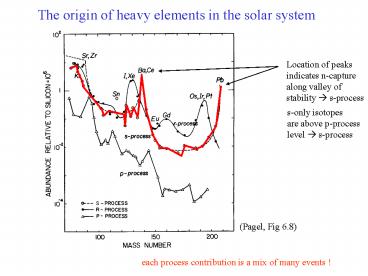
Title: The origin of heavy elements in the solar system
1
The origin of heavy elements in the solar system
Location of peaksindicates n-capture along
valley of stability ? s-process
s-only isotopesare above p-processlevel ?
s-process
(Pagel, Fig 6.8)
each process contribution is a mix of many events
!
2
The sites of the s-process
weak s-process core He/ shell C burning in
massive stars
main s-process He shell flashes in low mass
TP-AGB stars
approx. steady flow
can easily interpolates-contribution for
sr-nucleiif neutron capture crosssections are
known
3
The weak s-process
Site Core He burning (and shell C-burning) in
massive stars (e.g. 25 solar masses)
14N is rapidly converted to 22Ne
22Ne
He burning corecontainsinitially 14N
a capture
18F
b
a capture
18O
14N
Towards the end of He burning T3e8 K 22Ne(a,n)
provides a neutron source
preexisting Fe (and other nuclei) serve as seed
for a (secondary) s-process
4
Typical conditions (Raiteri et al. ApJ367 (1991)
228 and ApJ371(1991)665
Temperature 2.2 - 3.5 e8 K
Density 1 - 3e3 g/cm3
Average neutron density 7e5 cm-3
Peak neutron density 2e7 cm-3
Neutron exposure t ) 0.206 / mb
) time integrated neutron flux
Results
produced abundance/solar
5
The main s-process
Site low mass TP-AGB stars ( thermally
pulsing stars on the asymptotic giant
branch in the HR diagram, 1.5 - 3
solar masses )
H-burning shell
CO core
He-burning shell
unstable - burns in flashes(thin shell
instability)
6
H/He burning in a TP-AGB star
75k years
H-shell burning
(convective envelope)
CO core
He shell
From R. Gallino
7
H/He burning in a TP-AGB star
- number of He flashes in stars life few 100
- period of flashes 1000 100,000 years
13C(a,n)
Transport of s-process products to the surface
22Ne(a,n)
s-process in
- He flash via 22Ne(a,n)
- 13C pocket via 13C(a,n)
13C pocket formation by mixingHe burning
products with Hvia 12C p ? 13N ? 13C
8
Conditions during the main s-process
13C(a,n) in pocket 22Ne(a,n) in He flash
Temperature 0.9 x 10⁸ K 2.7 x 10⁸ K
Neutron density 7 x 107 cm-3 1010 cm-3
Duration 20,000 yr few years
Neutron exposure t ) 0.1 / mb 0.01 / mb
short, intense burstslight modificationof
abundances(branchings !)
weaker but longermain contribution(90 of
exposure)
9
Results for main s-process model
s-only
(Arlandini et al. ApJ525 (1999) 886)
10
Grains from AGB stars
11
Murchison CM chondrite
12
(No Transcript)
13
Zr in the s-process
Even this can have s-contribution(for large Nn
and slow 96Zr(n,g) helps maybe 50 s?)
14
Definition d(X/Y) (X/Y) / (X/Y)sol -1 x 10³
d(90Zr/94Zr)
d(91Zr/94Zr)
d(92Zr/94Zr)
(Ddivide, Umultiply amount of 13C formed
pocket efficiency)
Lugaro et al., 2003, ApJ
15
d(90Zr/94Zr)
d(91Zr/94Zr)
d(92Zr/94Zr)
Lugaro et al., 2003, ApJ
Recommended

