

Chapter 2: Sections 3 Ionic Bonds What is an Ion? PowerPoint PPT Presentation
1 / 22
Title: Chapter 2: Sections 3 Ionic Bonds What is an Ion?
1
Chapter 2 Sections 3 Ionic BondsWhat is an Ion?
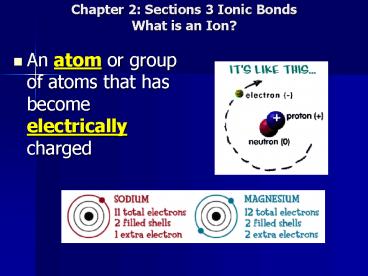
- An atom or group of atoms that has become
electrically charged
2
What happens when an atom loses an electron? What
type of ion does it become?
- When an atom loses an electron, it loses a
negative charge and become a positive ion
3
What happens when an atom gains an electron? What
type of ion does it become?
- When an atom gains an electron, it gains a
negative charge and becomes a negative ion
4
In the bond between sodium and chlorine, what
changes each atom into an ion?
- The transfer of sodiums one valence electron to
chlorine
5
What type of ion does sodium become after it
transfers its one valence electron?
- The sodium atom becomes a positive ion (Na)
6
What type of ion does chlorine become after it
accepts sodium's one valence electron?
- The chlorine atom becomes a negative ion (Cl-)
7
Why are sodium and chlorine attracted to one
another?
- Negative and Positive electric charges attract
each other Na and Cl- come together to form
sodium chloride
8
Why do atoms not have a charge but ions do?
- An atom has an equal number of electrons and
protons, ions have an unequal number
9
What is an ionic bond?
- The attraction between two oppositely charged
ions - When the two ions come together, the opposite
charges cancel out (Na 1 and Cl 1-)
10
What charge do compounds have?
- Compounds are electrically neutral
- When ions come together, they do so in a way that
balances out the charges on the ions
11
If Mg has a charge of 2 and Cl has a charge of
1-, how many Cl ions would be needed to cancel
out the 2 charge of Mg?
- 2
12
Checkpoint What effect does gaining an electron
have on the charge of an atom?
- An atom that gains an electron becomes a
negatively charged ion
13
What is a polyatomic ion?
- Ions that are made up of more than one atom
- A group of atoms that react as one
- Has an overall positive or negative charge
- Example CaCO3 calcium carbonate
14
How do you name Ionic Compounds?
- The name of the positive ion comes first,
followed by the name of the negative ion - If the negative ion is an element, the end
changes to ide. Example MgO (Magnesium Oxide) - If the negative ion is polyatomic, its name
remains unchanged. Example NaHCO3 (Sodium
Carbonate)
15
What are the characteristic properties of ionic
compounds?
- Crystal shape in an ionic compound every ion is
attracted to ions near it that have an opposite
charge - High melting points Ions are held together by
attractions between them - Electrical conductivity When ionic compounds
dissolve in water the solution conducts
electricity
16
What is a Crystal?
- An orderly, three dimensional arrangement
- When ions combine, they form alternating patterns
and bond with each other on all sides this
makes crystals
17
Section 4 Covalent BondsWhat is a covalent bond?
- A chemical bond formed when two atoms share
electrons
18
How are covalent bonds different from ionic bonds?
- Ionic bonds form between metals and nonmetals,
covalent bonds form between two or more nonmetals
19
How many bonds can each atom form?
- The number of bonds these atoms can form equals
the number of valence electrons needed to make a
total of 8 - Example Oxygen has 6 valence electrons
therefore it can form 2 bonds because it needs 2
more electrons to equal 8
20
What is a double bond?
- A chemical bond formed when atoms share two pairs
of electrons - Example Carbon Dioxide
21
What is a molecular compound?
- A compound consisting of molecules of covalently
bonded atoms - Example Carbon Dioxide
- Molecules are close together but the forces are
weaker than those holding ions together
22
Checkpoint Why are molecular compounds poor
conductors?
- Molecular compounds are poor conductors because
they do not contain any charged particles that
are available to move - Example pure water, plastic
Recommended

