

Influence of cross-shore sediment movement on long-term shoreline change simulation PowerPoint PPT Presentation
1 / 25
Title: Influence of cross-shore sediment movement on long-term shoreline change simulation
1
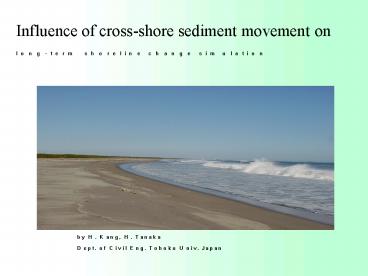
Influence of cross-shore sediment movement on
long-term shoreline change simulation
by H. Kang, H. Tanaka Dept. of Civil Eng. Tohoku
Univ. Japan
2
Outline of this presentation
Measured data including both influence of LST
and CST
- Introduction
- Study area
- Measured data
- Empirical Orthogonal Function
- One-line model
- Comparison of calibration K
- (sediment transport coefficient)
- Summary
Numerical simulation of shoreline change by
one-line model
Longshore Sediment Transport, Cross-shore
Sediment Transport
3
- Introduction
- Objective of this presentation
- To calibrate K (Sediment transport coefficient)
in one-line model. - To compare K based on measured data and
separated data by EOF method.
Longshore Sediment Transport, Cross-shore
Sediment Transport
4
- Study area
the breakwater
- Length
- about 12km
- Bounded by Sendai Port and Natori River mouth
Breakwaters
the jetties
5
- Measured data
the breakwater at Sendai Port
Nanakita River
Breakwaters
St.13
the jetties at the Natori River mouth
6
- Measured data
the breakwater at Sendai Port
Nanakita River
St.8
Breakwaters
the jetties at the Natori River mouth
7
- Measured data
the breakwater at Sendai Port
Nanakita River
St.4
- Length about 12km
- Bounded by solid boundaries (Sendai Port
Natori River mouth)
Breakwaters
the jetties at the Natori River mouth
8
E.O.F
- Empirical Orthogonal Function
1/2
- EOF method separated data of a complex topography
change on the coast into parts of data that have
the same characteristic of topography change on
the coast as simple data.
- It assume that shoreline position combines
temporal function with spatial function.
?(1)
9
- 2nd E.O.F. component
2/2
Longshore Sediment Transport
10
- One-line model
1-line model
One-line(shoreline) model, beach evolution is
represented by the shoreline change, is a
numerical prediction model based on the sediment
continuity equation and an equation for the
longshore sediment transport rate.
Definition sketch for shoreline change calculation
- Governing equation
Shoreline position of on-offshore
The Longshore Sediment Transport Rate
The closure depth
q Cross-shore sediment transport rate
11
- Long shore sediment transport rate
wave energy
(3)
wave group speed
b wave breaking condition
(CERC equation)
angle of breaking waves to the local shoreline
sediment transport coefficient
Boundary conditions Breakwater at Sendai port LST is perfectly intercepted by the breakwaters at Sandai Port and Yuriage Port. Discharged sediment rate from Nanakita River is ignored.
Boundary conditions River mouth of Natori River LST is perfectly intercepted by the breakwaters at Sandai Port and Yuriage Port. Discharged sediment rate from Nanakita River is ignored.
Closure depth Tohoku Regional Bureau Ministry of Land, Infrastructure and transport, Miyagi Prefecture Public Works Department ,2000
Discharged sediment rate from Natori River Tohoku Regional Bureau Ministry of Land, Infrastructure and transport, Miyagi Prefecture Public Works Department ,2000
Longshore Sediment Transport
12
- Conditions for calculation
Bathymetry data In 1980 from Geographical Survey Institute
Initial shoreline position Aerial photo on Nov. 1996
Wave conditions T0 8.55(s), H0 0.75(m), a 121.86
Wave transformation Wave ray method Wave breaking (Goda, 1973 )
Sediment transport coefficient (K) from 0.01 to 0.09
13
Data set
Calibration of K (sediment transport coefficient)
is carried out using three data set to examine
influence of cross-shore sediment transport.
- Data 1 separated data that shoreline change
caused by longshore sediment - transport, C2e2 ( )
14
(No Transcript)
15
(No Transcript)
16
- Comparison of calibration K
- K is calibrated based on three data set in order
to examine influence of cross-shore sediment
movement on calibration of K.
- Error is calculated in three case to decide
value of K. - Case 1 To calculate error between obtained
shoreline position by 1-line model and data1 - Case 2 To calculate error between obtained
shoreline position by 1-line model and data2 - Case 3 To calculate error between obtained
shoreline position by 1-line model and data3
- Error calculate between calculated shoreline
position and measured data
?(4)
ycal shoreline position calculated by 1-line
model ydata1 shoreline position based on
separated data ydata2 shoreline position based
on measured data ydata3 shoreline position
based on measured data once a year T the number
of survey times from Nov. 1996 to Aug. 2003 N
the number of station, from 1 to 13
17
- Relationship between error and K
18
- Summary
- Case1 using separated data, the error is
smaller in whole area than that of the other
cases. Because separated data is shoreline
evolution cased by longshore sediment transport. - Case2 the optimum value of K is same value as
that obtained by separated data because survey is
carried out in a relative short-term period.
However, the error is bigger than that based on
separated data because data2 include influence of
shoreline change due to cross-shore sediment
transport. - Case3 using survey data in once a year, the
optimum value of K is bigger than that in case 1
and 2. it includes an error due to cross-shore
change. - According to these results, shoreline evolution
due to cross-shore sediment transport has effect
on calibration of K value. Therefore, it is
important that raw survey data are separated into
a part of data caused by longshore sediment
transport and cross-shore sediment transport,
when value of K is calibrated in one-line model.
19
(No Transcript)
20
(No Transcript)
21
Characteristic of shoreline change on study area
Nanakita River
Advance of Shoreline St. 10, St. 11 and St. 4
22
E.O.F.
- The 1st temporal eigenfunction
- 1st EOF component
- rate of change of the first temporal
eigenfunction
- The 1st spatial eigenfunction
Accretion
Erosion
Simultaneous erosion and accretion occur along
the coast.
23
- Prediction of first temporal eigenfunction
continuity of time is low.
(mori and tanaka 1998)
C1 is predicted in the other term and verified.
24
- 2nd E.O.F. component
2/2
- 2nd temporal eigenfuncion and Energy flux of
longshore direction
Wave direction at breaking point. b
breaking point H wave height Cg group
celerity density of seawater
gravitational acceleration
(2)
Longshore Sediment Transport
25
2/2
Beach evolution is classified into two types
according to direction one is cross-shore change
occurred in short term and the other is longshore
change occurred in long-term. It is difficult to
analyzes a complicated evolution of shoreline
using measured data, because it is containing
both influence of longshore and cross-shore
sediment movement.
If measured data are separated into shoreline
change caused by longshore and cross-shore
sediment transport, a shoreline behavior will be
clearly analyzed and understood.
Recommended

