

RISK MANAGEMENT FOR SMALL FLIGHT TEST TEAMS: LESSONS LEARNED SPINNING LIGHT AEROPLANES PowerPoint PPT Presentation
1 / 19
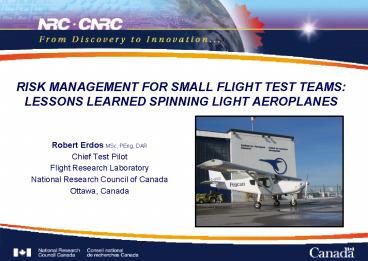
Title: RISK MANAGEMENT FOR SMALL FLIGHT TEST TEAMS: LESSONS LEARNED SPINNING LIGHT AEROPLANES
1
RISK MANAGEMENT FOR SMALL FLIGHT TEST TEAMS
LESSONS LEARNED SPINNING LIGHT AEROPLANES
- Robert Erdos MSc, PEng, DAR
- Chief Test Pilot
- Flight Research Laboratory
- National Research Council of Canada
- Ottawa, Canada
2
At Issue
- FTSW often facilitates discussion of flight test
safety practices and risk management principles. - Most participants are from large organizations
with large resources. - But, what if
- You are the flight test team and
- The client has limited resources or experience.
3
Presentation Outline
- Outline an example of a small aircraft
certification team - Review applicable risk management strategies
- Relate an incident and
- Discuss lessons learned.
4
Flight Research Laboratory
- Part of the National Research Council of Canada
- Canadas agency for research, development and
technology-based innovation - Operates 9 specialized research aircraft
- Diverse program of research
- Commercial and government clients
- From fundamental research to product
development/certification - Fee-for-service work makes Labs personnel
accessible to small companies - Contracted by Ultravia Aero Intl in 1999.
5
The ProjectCertification of the Ultravia Pelican
- Successful Canadian kitplane manufacturer
- Sought to certify under CAR 523-VLA
- Two-place single-engine high-wing trainer
- Rotax 912 engine
- Max. gross weight 1450 lb
- Design Vs0 43 KCAS
- Ultravia 5 full-time employees
- NRC provided consulting flight test services
- No one on the project had prior certification
experience
6
The ProjectCertification of the Ultravia Pelican
- Successful Canadian kitplane manufacturer
- Sought to certify under CAR 523-VLA
- Two-place single-engine high-wing trainer
- Rotax 912 engine
- Max. gross weight 1450 lb
- Ultravia 5 full-time employees
- NRC provided consulting flight test services
- No one on the project had prior certification
experience.
7
The Situation
- Very limited in-house resources
- Time constraints
- Financial constraints
- Desire to please the client
8
Risk Management Resources Internal
Axiom 1 Murphys Law
9
Risk Management Resources External
- Transition from military or research test flying
to civil certification can present challenges - Online resources present acceptable certification
methodologies and lessons-learned - A good working relationship with the regulatory
authority is essential
10
The Risk Management Contract
- It is far more productive to discuss risk than
safety. - The consulting test pilot can assume
responsibility for the clients most valuable
asset. - Organizational cultures and expectations may
vary. - Risk management protocols need to be stated
explicitly. - A contract is the application of plan the
flight, fly the plan. - It may be wise to have the client sign it.
11
The Risk Management Contract, Contd
- Following a partial power loss or non-critical
malfunction indication, a contingency approach to
the nearest prepared landing area will be
initiated. An off-airport landing will not be
executed unless imminent complete loss of power
or danger of significant damage to the aircraft
precludes a landing on a runway - Following a complete loss of engine power, a
force-landing will be executed to the most
suitable available area - In the event of an inability to recover from a
spin, or entry into an unrecognizable flight
regime, efforts will continue to recover the
aircraft to controlled flight to a minimum
altitude of 4000 feet AGL. Upon reaching 4000
feet AGL, the test pilot will abandon the
aircraft and - Following a catastrophic structural failure,
failure of the flight control system or
uncontrollable fire, the test pilot will
immediately abandon the aircraft.
Axiom 3 Common Sense Varies
12
Spin Tests Spin Chute Installation, Yes?
- CAR 523-VLA certification for non-intentional
spins requires recovery from a one-turn spin or
a three-second spin, whichever takes longer, in
not more than one additional turn after
initiation of the first control action for
recovery. - Typically relies upon an airframe-mounted spin
recovery parachute - Small aircraft present WB challenges
13
Pelican Weight and Balance Spin Chute
Installation, No.
- System includes chute, structure, deployment and
jettison mechanisms, rocket motor and interface - Prohibitively large mass at aft fuselage station.
- Need to test at 4 corners of WB
- Engine ballast offset prohibits light weights
- BRS considered
- Does not avoid considerable aircraft damage
- Bail-out chute the only practical option
14
Sortie 71 One-Turn Spins, Revisited
- Sortie was a continuation of spins conducted
Heavy-Forward CG - Power ON spins repeatable with recovery after 1
turn. - Strong influence of power. Cant spin lt3000 RPM
- Recovery slightly slower in left spins
- Very rapid spin rates after 1 turn (240 deg/sec)
- Prior sortie repeated to ascertain recovery
compliance - Did not feel that recovery was in question
15
Sortie 71 Spinning, spinning, spinning
- 10th repetition of the same test point
- Clean 1-turn erect spin to the right
- Recovery initiated after 1 turnno effect
- Prop stopped after 2-3 turns
- Counter-spin control inputs held firmly
- Accidentally discovered limited pitch rocking
authority - Recovered, restarted engine, went home
16
Sober Second Thought
- A plane lacking the control power to spin may
lack the control power to recover - Rehearse all the recovery actions
- Full forward stick may not be helpful until after
rotation stops
- Risk management for small test teams presents
special challenges - Spin testing of very light plans not yet
adequately addressed
17
Thank You
Robert Erdos MSc, PEng, DAR Chief Test
Pilot Flight Research Laboratory National
Research Council of Canada Ottawa,
Canada robert.erdos_at_nrc.ca 613-998-3180
18
The Bail-Out Option Reconsidered
- Spin trajectory not vertical
- Descending helix determined by inertial and
aerodynamic forces - Highly wing-loaded airplanes will have a higher
tangential velocity.
19
The Bail-Out Option Reconsidered, Contd
- Lightly-loaded aircraft can have a very tight
spin and a low tangential velocity - Confidence in a manual bail-out may not be
warranted.
Uh oh!
Recommended

