

Recent LGT results and their implications in Heavy Ion Phenomenology PowerPoint PPT Presentation
1 / 16
Title: Recent LGT results and their implications in Heavy Ion Phenomenology
1
Recent LGT results and their
implications in Heavy Ion
Phenomenology
K. Redlich
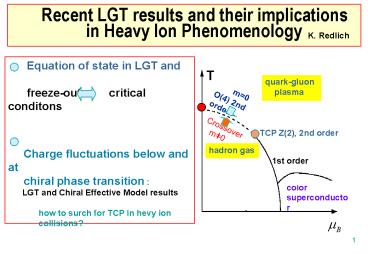
Equation of state in LGT and
freeze-out critical conditons
Charge fluctuations below and at
chiral phase transition LGT and Chiral
Effective Model results
how to surch for TCP in hevy ion
collisions?
T
quark-gluon plasma
m0 O(4) 2nd order
Crossover m0
TCP Z(2), 2nd order
hadron gas
1st order
color superconductor
2
Chemical freeze-out and its characteristics
Cleymans et al.. , A.Tawfik
J. Cleymans K.R
measures of the effective number
of degrees of freedom
expected for if there are
leading quasiparticles
since
with
3
Deconfinement is density driven -
(percolation)
Hadron resonance gas partition function
LGT result shows strong dependence of on
and , however for
and for all
provides a good description of m and
depen. of deconfinement temperature
A. Peikert, et al..
condition for deconfinement
hadrons
hadrons
gluballs
H. Satz
percolation deconfinement
lines of constant energy density in HRG
4
Phase boundary of the fixed energy
density versus
chemical freezeout
Splitting of the chemical freeze-out and the
phase boundary surface appears when the
densities of mesons and baryons are comparable?
particles production processes
LGT (Allton et al..)
R. Gavai, S. Gupta
Meson Dominated
QGP hadronization
Baryon Dominated
Hadronic rescattering
Z. Fodor et al..
5
Scaling properties of particle production
yields
A. Andronic, P. Braun-Munzinger K.R.
SPS
RHIC
H. Oeschler, et al..,
- Scalings appear due to the strangeness exchange
production processes in the hadronic fireball,
6
Scaling relations of
production
P. Koch, B. Muller J. Rafelski
However,
thus
and
C. M. Ko
H. Oeschler et al..
A. Andronic, P.Braun-Munzinger K.R..
7
EQS and evolution path of fixed entropy/baryon
S. Ejiri, F. Karsch, E. Laermann C. Schmidt,
(2006) LGT 2-flavor
V.D. Toneev , J. Cleymans , E.G. Nikonov , K.
Redlich , A.A. Shanenko , (2001,2006) Mixed phase
model
L. Bravina et al.. (2001) UrQMD
8
QCD at non-vanishing chemical potential C.
Allton, M.Doring,S. Ejiri, S.Hands, O. Kaczmarek,
F. Karsch, E. Laermann K. Redlich (2005)
Expansion valid for
interesting region for heavy ions SPS
RHIC LHC
Problem (0.18)
complex fermion determinant
Taylor expansion of
9
Quark-fluctuations and chiral symmetery
restoration
- Free energy
- expected 2-order transition in 3-d, O(4)
universality class
1st order
Net Quark Fluctuations
10
Derivatives of pressure and susceptibilities
- Difference between and is small at
m0. As pQCD - Large spike in for
as in pQCD
Interesting in Heavy Ion Collisions
11
Ratios of cumulants reflect carriers of the
net-quark and charge
HRG
S. Ejiri, F. Karsch K.R. (2006)
12
The Hadron Resonance Gas model and
net-quark
fluctuations
Allton et al.. O(4)
S. Ejiri, F. Karsch K.R , O(6)
HRG provides good description of LGT charge
fluctuations in confined phase
13
factorization on the Lattice as in HRG
HRG-partition function
fixed ratios of
baryonic observables
independent of
14
Charge Fluctuations in the NJL model
Ch. Sasaki, B. Friman K.R.
- Generic structure of the phase diagram as
expecetd in different chiral models see eg. Y.
Hatta T. Ikeda M. Stephanov, K. Rajagopal,..
quark and isovector
chemical potentials
/
15
Quark and isovector susceptibilities
along the critical
curve
Non-monotonic behavior of the net quark
susceptibility in the vicinity to TCP
Ch. Sasaki et al..
Ch. Sasaki et al..
Crude estimate of the critical region in
using chemical freeze-out condition gives
16
Conclusions
- For the chemical
- freeze-out appears in the near vicinity
- to deconfinement
- Phenomenological partition function of
- the Hadron Resonance Gas provides a good
- approximation of the reqular part of the QCD
- partition function in the hadronic phase
- To identify the chiral end-point experimentally
one needs to - search for non-monotonic in
dependence - of charge fluctuations
Recommended

