

Developing Quality IEPs Part 4: IEP Implementation, Review, and Revision PowerPoint PPT Presentation
1 / 16
Title: Developing Quality IEPs Part 4: IEP Implementation, Review, and Revision
1
Developing Quality IEPsPart 4 IEP
Implementation, Review, and Revision
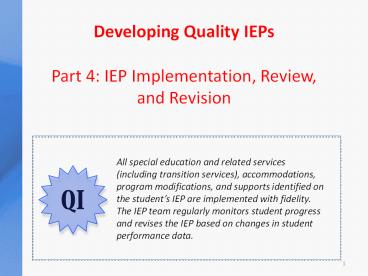
All special education and related services
(including transition services), accommodations,
program modifications, and supports identified on
the students IEP are implemented with fidelity.
The IEP team regularly monitors student progress
and revises the IEP based on changes in student
performance data.
2
You Will Learn to
- Make the IEP a reality
- Plan and implement the IEP
- Monitor student progress and use results to make
decisions - Report progress to parents
- Review and amend the IEP
- Identify IEP resources in Florida
3
Using the Problem-Solving Process
MTSS
IEP
- Present Level of Academic Achievement and
Functional Performance
Step 1. Problem Identification Whats the
problem? Step 2. Problem Analysis Why is it
taking place?
Step 3. Intervention Planning and
Implementation What are we going to do
about it?
- Measurable Annual Goals
- Special Education Services and Supports
Step 4. Response to Instruction/Intervention Is
it working?
- IEP Implementation, Review, and Revision
4
Understanding Responsibilities
- Teachers and other service providers must be
informed of specific responsibilities related to
the students IEP. - Each general education teacher, ESE teacher, and
other service provider who works with the student
must have access to the students IEP.
5
Who Will be Responsible for
- Planning the intervention for the annual goals?
- Implementing the intervention with integrity?
- Monitoring student performance and reporting
progress to parents? - Interpreting student performance data and making
decisions concerning effectiveness of the
intervention?
6
Implementation with Fidelity
- Requires advance planning
- Staff may require professional development and
coaching - How to implement the instructional procedures,
accommodations, etc. - Assistance with data collection and progress
monitoring - Involves collaborative planning
7
Implementing with Fidelity
- Was the intervention provided in the way it was
designed or intended? - Key aspects materials, instructional approach
- Instructional procedures used systematically
- According to documented level of intensity
- Verified through direct observations,
self-reports, and student products
8
Monitoring Student Progress
- Identify the measurement procedures
- Check the annual goals
- What conditions are required?
- What specific assessment methods/tools will be
used? - What are the mastery criteria?
- Make a plan
- When will student be assessed?
- Who will interpret results?
9
What Evidence Should Be Collected?By Whom?
- Given a travel checklist, Stuart will
independently use the city bus to travel to his
work site, completing all of the steps in five
consecutive opportunities over a week. - What is the behavior?
- What are the conditions?
- What is mastery?
- How often to assess?
- What assessment tools may be used?
- Who is responsible?
10
If the Response Has Been Positive
- Possible Actions
- Continue services and supports with current
annual goal. - Continue services and supports and increase
annual goal. - Gradually fade services or supports to determine
if the student can perform independently.
11
If the Response Is Questionable
- Possible Actions
- Determine if the services and supports were
implemented as intended. - If not, improve implementation of services and
supports. - If yes, increase intensity of current services
and supports and assess impact. If rate doesnt
improve, return to problem solving.
12
If the Response Has Been Poor
- Possible Actions
- Determine if the services and supports were
implemented as intended. - If not, improve implementation of services and
supports. - If yes, return to problem solving.
13
Reviewing the IEP
- The IEP must be reviewed at least annually and
revised to address - Any lack of progress toward annual goals or in
the general curriculum - Results of reevaluation
- Information about the student provided to or by
parents - Students anticipated needs
- Other
14
Its Important to Stay Informed!
- Florida Department of Educationhttp//www.fldoe.o
rg - Bureau of Exceptional Education and Student
Services http//www.fldoe.org/ese/ - Project 10 Transition Education
Networkhttp//project10.info - Technical Assistance and Training Systems (TATS)
for prekindergarten programshttp//www.tats.ucf.e
du/about/index.html
15
Local Resources/Supports
- FDLRS
- District ESE Department
- District Website
16
Today You Learned How to
- Follow a systematic problem-solving process to
develop and implement a quality IEP.
A Quality IEP
Is there any other kind?
Recommended

