

fMRI: Biological Basis and Experiment Design Lecture 14: Localization I PowerPoint PPT Presentation
Title: fMRI: Biological Basis and Experiment Design Lecture 14: Localization I
1
fMRI Biological Basis and Experiment
DesignLecture 14 Localization I
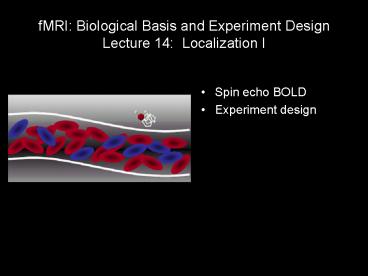
- Spin echo BOLD
- Experiment design
1 light year 5,913,000,000,000 miles?
2
Harrison, Harel et al., Cerebral Cortex 12225
(2002)
100?m
3
Duvernoy et al., (1981) Brain Res. Bull. 7518
4
BOLD fMRI is differentially sensitive to large
and small vessels
Spin echo sequences refocus dephasing caused by
susceptibility-induced gradients near large veins
Dynamic averaging regime diffusion of water
molecule is large compared to field gradient
- In both cases magnitude of field perturbation
depends on - field strength
- deoxyhemoglobin concentration
Static averaging regime diffusion of water
molecule is small compared to field gradient
5
Spin Echo
180 deg.
90 deg.
M?
T2
T2
time (ms)
6
Signal contributions gradient echo (T2)
Harrison, Harel et al., Cerebral Cortex 12225
(2002)
Extravascular protons near large vessels
Relative contribution
Extravascular protons near small vessels
100?m
Blood signal
Large venuole
Field strength
Small venuole/capillary
Intravascular
7
Signal contributions spin echo (T2)
Relative contribution
Extravascular protons near small vessels
100?m
Blood signal
Large venuole
Field strength
Small venuole/capillary
Intravascular
8
BOLD response 1st approximation
Cortical columns
0.75 mm increased blood flow
Neural activity (column)
Signal near small veins and venuoles 2.0mm
capillary signal
GE BOLD, 2.5 mm PSF
1.5mm FWHM, SE
SE BOLD, 1.5 mm PSF
2.5 mm FWHM, GE
9
(No Transcript)
10
Experiment design practice
- Pick a system to study
- Make up a task
- Predict a neural response
- Predict a BOLD response
- What can you measure?
- What can't you measure?
Recommended

