

Prohibiting Payment for Organs is Unjust, Incoherent, and Misguided PowerPoint PPT Presentation
1 / 23
Title: Prohibiting Payment for Organs is Unjust, Incoherent, and Misguided
1
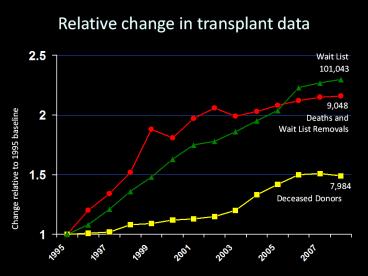
Relative change in transplant data
Wait List
101,043
9,048
Deaths and Wait List Removals
Change relative to 1995 baseline
7,984
Deceased Donors
2
What To Do?
- All efforts so far nibbling at the edges
- Dramatic, effective change is needed
- If there are insufficient volunteers to work
- construction atop skyscraper
- as diplomat in dangerous 3rd world country
- other undesirable jobs
- How do we ?volunteers?
- We pay them more
3
Financial Incentives (FI)
- We should
- make all reasonable efforts to ? organ donation
- reasonable defined by evidence, not by emotions
- study FI for deceased donations w pilot studies
- FI not intrinsically unethical (benefitsharms)
- pilot studies can measure benefitsharms
- pilot studies in limited area (1 state or small
group) - Change NOTA, based on high benefits/harms
- FI highly effective in every sector of economy
b/c they expand options in personal lives
4
Reasons Not to Donate
- Desire to bury body intact (religion, own belief)
- Avoidance of confronting loss, own mortality
- Distrust of medical community
- Belief that allocation is not equitable
- Misunderstanding of tx effectiveness
- Lack of understanding of brain death
- Stresses at time of sudden unexpected death
5
NOTA Allows 1 Reason to Donate
- The sole permissible incentive Service to others
(altruism)
6
Objections to FI for Deceased Donors
- Main objections
- FI Will ? Harm/Benefit, ? ?Organ Donation
- FI will undermine social fabric
- dilute desirable spirit of altruism
- commodify human body parts
- introduce coercion, ? voluntariness
7
FI Will ? Harm/Benefit ?Organ Donation
- Donation ? b/c ?anger/insult
- BUT, ppl familiar w payment for valuable goods
- We can measure this in pilot study
8
FI Will Undermine Social FabricDilute Desirable
Spirit of Altruism
- Impulse to do good not binary (all-or-none)
- most ppl part altruist, part self-interested
- FI might add enough motivation to persuade
- Motivation variable, law blunt instrument
- FI token of societal gratitude (tax incentives)
- Level of social cohesion measurable!
9
FI Will Undermine Social FabricCommodify Human
Body Parts
- Donors of blood and other tissues paid
- no compelling ethical distinction from organs
- Donation implies property rights in organs
- One cannot give away what one does not own any
more than one can sell it (AMA 1995) - Recipients pay for organsonly the donor does not
benefit financially! - Type of FI amt regulated, no organ bazaar
10
FI Will Undermine Social FabricCoercion ?
Voluntariness
- Informed consent must be voluntary
- FI more likely ?poor to donate, so
- burden of donation on poor un , unfair
- Circumstances of poor make FI coercive
- BUT, well-off dont clean toilets, pick berries
- we dont ban toilets and berries
- we allow free choice, make conditions safe
- What is coercion? In context of free society
- Forcing others to do what they would not
otherwise do. So FI not coercive.
11
Inferences
- FI not intrinsically unethical
- FI acceptable when benefits/harms positive
- every fear about FI based on assumptions
- yet, effects of fears about FI measurable
- no good reason to prohibit pilot study of FI
- policy/law then based on evidence, not emotion
- Pilot studies must be ethically designed
- sound science, measurable outcomes, set time
- FI moderate value, lowest level to ? donation
- FI only for deceased donors, not living
- no buying organs allocation by UNOS algorithms
12
FI for Pilot Studyfor SC or Region 11
- Examples, (likely) most to least effective
- Deposit of 1,000-5,000 into donors estate
- Estate tax credit 10,000
- Funeral expenses up to 5,000
13
(No Transcript)
14
- The case for FI fundamentally a moral one
- Which is morally preferable
- prohibit FI because society might degenerate or
more poor might choose to donate - offer 1,000-5,000 and save up to 8 lives for
every new donor
15
Relative change in transplant data
A Final Word
Wait List
101,043
We have never encountered a single policy more
at odds with public welfare than the current
altruism-only organ procurement policy in the
United States . . . If the current policy is
maintained, the shortage will continue to grow
worse, as will the needless suffering.
9,048
Deaths and Wait List Removals
Change relative to 1995 baseline
7,984
Deceased Donors
--Blair and Kaserman, Yale Journal of Regulation,
1991
16
(No Transcript)
17
- Rapid Organ Recovery Ambulances Update
- Last Updated Thu, 11/19/2009 - 157pm
- Early in 2008, Judicial Watch initiated an
investigation of a government sponsored organ
procurement program. The program, known as Rapid
Organ Recovery Ambulances (RORA), was
administered in New York City and received
funding from the Health Resources and Services
Administration of the Department of Health and
Human Services. As highlighted in a June blog
series, the program breached ethical and medical
standards, discriminately targeted minorities,
and raised institutional credibility questions. - As part of its investigation, Judicial Watch
sued the Fire Department of New York (FDNY) and
reached a favorable settlement after FDNY
obfuscated transparency by not disclosing related
records. Following its publications on this
dubious program, Judicial Watch continued to
follow-up to receive the actual program data.
Judicial Watch recently received some additional
documents that further shed light on the program
and demonstrate the power of public exposure. - Many of the program goals for which RORA was
funded have yet to be met. As noted in a previous
blog entry, the ethical White Paper that was
slated to be written by February 2008 has yet to
be written as of October 2009. According to
HRSA's letter, data from the ambulance and
procurement activities have yet to be gathered as
there have been no ambulance or EMS dispatches
for rapid organ recovery. On one hand, readers
should be relieved that the program has yet to
actually be put into action. On the other hand,
however, the US government provided millions of
dollars based on a proposal that was not fully
carried out. The documents provided do not
demonstrate that HRSA stopped funding RORA even
after the White Paper was not provided. The
documents further do not demonstrate where the
money actually went - http//www.judicialwatch.org/foiablog/2009/nov/ra
pid-organ-recovery-ambulances-update.
18
Donation-procurement steps
- Take referral call
- Assess potential donor
- Talk with family, request donation
- Manage donor in ICU
- Place organs (UNOS algorithm)
- Move donor to OR, manage surg teams
- Package, ship organs
- Complete all paperwork
19
Basic strategy division of labor, specialized
personnel
- Family Support Counselor (counseling, nursing)
- emotional support
- education (brain death, value of tx)
- Nurse Clinician (ICU nurse)
- manage donor in ICU
- Organ Recovery Coordinator (OR nurse/tech)
- manage donor in OR, distribute organs
- Clinical Services Liaison (business PR/sales)
- staff education
- record review
- Aftercare Counselor (counseling)
- follow-up counseling, support groups,
satisfaction surveys
20
HRSA Transplant Center Growthand Management
Collaborative
- Best Practices Evaluation (2003-2007)
- Institutional Vision And Commitment
- Dedicated Team
- Aggressive Clinical Style
- Patient And Family Centered Care
- Aggressive Management of Performance Outcomes
21
Donation Rate by Year
60
50
40
Donors per million of population
30
20
10
All OPO's
2 S.D.
Lifepoint
0
1996
1997
1998
1999
2000
2001
2002
2003
2004
2005
2006
2007
Year
22
Origin of Prohibition of FI
- UAGA 1968 no ban on selling/buying
- Cyclosporine tested 1979, clin use 1982
- Tx rapidly ? growth industry
- Organ entrepreneurs
- NOTA 1984 no valuable consideration
- harms of pmnt substantially outweigh benefits
- Benefitsharms has changed in last 20 yrs
23
Sources of Organs for Tx
- Deceased donors (brain death)
- Living donors
- Donors after cardiac death
- Xenografts
- De novo organs (regenerative technologies)
Greatest potential gain with least ethical
controversy
Recommended

