

The Globally Harmonized System (GHS) for Hazard Classification and Labeling PowerPoint PPT Presentation
1 / 47
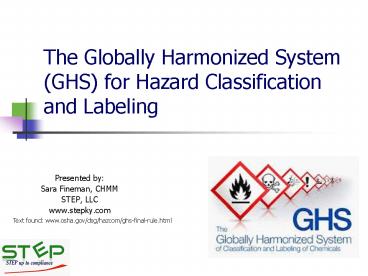
Title: The Globally Harmonized System (GHS) for Hazard Classification and Labeling
1
The Globally Harmonized System (GHS) for Hazard
Classification and Labeling
- Presented by
- Sara Fineman, CHMM
- STEP, LLC
- www.stepky.com
Text found www.osha.gov/dsg/hazcom/ghs-final-rule
.html
2
- Sara Fineman, CHMM at a glance
- Worked at Federal OSHA, Region IV
- JT Baker Chemical Company
- Senior Consultant
- Hazmat instructor
- Compliance audits
3
What To Discuss?
- A little history about GHS
- The new 2012 Hazard Communication
- Written program
- Labels
- Safety data sheets
- Training
- Compliance dates and game plan
4
What is the GHS?
- A common and coherent approach
- Defines and classifies hazards
- Communicates information on labels and safety
data sheets - Provides infrastructure for establishment of
- national and international
- comprehensive chemical safety programs
5
Why is the GHS needed?
- Variation from country to country and state to
state - United States -estimated 650,000 such products
- Adoption of requirements
- Better employee protection
- Better trade for companies
6
Comprehensibility
- Guiding principles
- Information should be conveyed in more than one
way - Comprehensibility looks at all existing evidence
- Phrases used to indicate the severity of hazard
should be consistent across different hazard
types
7
Major Existing Systems
- UN Transport Recommendations
- European Union Directives
- Canadian Requirements for Workplace, Consumers
and Pesticides - US Requirements for Workplace, Consumers and
Pesticides
8
International Mandate
- Brazil 1992
- International mandate to harmonize
- Adopted at UN Conference on the Environment and
Development - A globally-harmonized hazard classification and
compatible labeling system, including material
safety data sheets and easily understandable
symbols, should be available, if feasible, by the
year 2000.
9
Principles Of Harmonization
- Protections not be reduced
- Comprehensive system
- All types of chemicals will be covered
- based on intrinsic properties (hazards) of
chemicals
10
The Scope of the GHS
- Covers all hazardous chemical substances, dilute
solutions, and mixtures - Pharmaceuticals, food additives, cosmetics and
pesticide residues in food - not be covered at the point of intake
- will be covered where workers may be exposed and
in transport
11
The GHS Elements
- Classification Criteria
- Health and Environmental Hazards
- Physical Hazards
- Mixtures
- Hazard Communication
- Labels
- Safety Data Sheets
12
Whats The Difference?
- Written program mostly unchanged
- Training new labels/sds
- keep same training add info as it comes into
workplace - Labels - new standards
- (M)SDS extensive changes
13
Written program
- Definitions have changed or been revised
- Some sections called differently
- Hazard determination now
- Hazard classification
- Mandatory appendices give guidance
14
Revised Definitions
- Chemical
- Chemical name
- Hazardous chemical
- Health hazard
- Label
- Mixture
- Physical hazard
- Trade secret
15
New Definitions
- Precautionary statement
- Product identifier
- Pyrophoric gas
- Safety data sheet
- Signal word
- Simple asphyxiant
- Substance
- Hazard classification
- Hazard category
- HNOC
- Hazard statement
- Label elements
- Pictogram
16
New Definition - HNOC
- Hazards Not Otherwise Classified
- New name of unclassified hazards
- Not to be listed on labels
- Must identify in SDS section 2
- Not classified by GHS, but OSHA added
- Pyrophoric gases
- Simple asphyxiants
- Combustible dust OSHA hasnt defined
17
New Definition Hazard Classification
- Specific criteria for classifying health and
physical hazards into - hazard class indicates the nature of hazard (e.g.
flammability) and - hazard category is the degree of severity within
each hazard class (e.g. four levels of
flammability)
18
Hazard Classification Health Environmental
Hazards
- Acute Toxicity
- Skin Corrosion/Irritation
- Serious Eye Damage/Eye Irritation
- Respiratory or Skin Sensitization
- Germ Cell Mutagenicity
- Carcinogenicity
- Reproductive Toxicity
- Target Organ Systemic Toxicity Single and
Repeated Dose - Aspiration
- Hazardous to the Aquatic Environment
19
Appendix A Class w/category
ACUTE ORAL TOXICITY - Class ACUTE ORAL TOXICITY - Class ACUTE ORAL TOXICITY - Class ACUTE ORAL TOXICITY - Class ACUTE ORAL TOXICITY - Class ACUTE ORAL TOXICITY - Class
Category 1 Category 2 Category 3 Category 4 Category 5
LD50 5 mg/kg gt 5 lt 50 mg/kg ³ 50 lt 300 mg/kg ³ 300 lt 2000 mg/kg ³ 2000 lt 5000 mg/kg
Pictogram No symbol
Signal word Danger Danger Danger Warning Warning
Hazard statement Fatal if swallowed Fatal if swallowed Toxic if swallowed Harmful if swallowed May be harmful if swallowed
20
Physical Hazards
- Definition, test methods and classification
- Used criteria for transport as basis for the work
since they were already harmonized
21
Physical Hazards
- Explosives class with categories 1.1-1.6
- Flammability gases, aerosols, liquids, solids
- Oxidizers liquid, solid, gases
- Self-Reactive
- Pyrophoric liquids, solids
- Self-Heating
- Organic Peroxides
- Corrosive to Metals
- Gases Under Pressure
- Water-Activated Flammable Gases
22
Labels
- Standardization for all labels
- Reprocess of all labels in transit
- Enhance communication
- Standard pictograms
- Signal words (Danger or Warning)
- Hazard statements
- Precautionary statements
23
New Label REquirements
GHS Label
Workplace Label
XYZ Chemical, 234 E. 3rd St Murray KY 42071
227.777.6565
- Updated OSHA GHS Standard
- Product identifier
- Signal word
- Hazard statements
- Precautionary statements
- Pictograms
- Supplier information
- Supplemental information
XYZ Chemical, 234 E. 3rd St Murray KY 42071
227.777.6565
- Current OSHA Standard
- Material identity
- Hazard warnings
- Supplier information
24
GHS Pictograms
Flammables, pyrophoric, Self-heating, emits flam
gas, self-reactive, organic peroxides
oxidizers
Explosives, self-reactives, organic peroxides
Gases under pressure
!
Aquatic toxicity
Irritant, skin sensitizer, acute toxicity,
narcotic effects, resp tract irritant, haz to
ozone layer
Acute toxicity, fatal or toxic
Carcinogen, mutagenicity, Repro toxicity, resp
sensitizer, target organ toxicity, aspiration
toxicity
Skin corrosion/burns, eye damage corrosive to
metals
25
Signal Words
- Danger or Warning
- Used to emphasize hazard and discriminate between
levels of hazard
26
Hazard Statements
- A specific harmonized hazard statement for each
level (degree of hazard) within each hazard
class - Example Flammable liquids
- Category 1 Extremely flammable liquid and vapor
- Category 2 Highly flammable liquid and vapor
- Category 3 Flammable liquid and vapor
- Category 4 Combustible liquid
27
Precautionary Information
- Include appropriate precautionary information
- Examples of precautionary statements are provided
- Intent is to harmonize
- Prevention Response Storage
28
Update to GHS
Tetraethyl Resin
Tetraethyl Resin
Danger Heating may cause a fire. Combustible
liquid. May cause damage to organs through
prolonged or repeated exposure. Harms public
health and the environment by destroying ozone in
the upper atmosphere. May cause damage to organs
through prolonged or repeated exposure by skin
contact. Contains epoxy constituents. May produce
an allergic reaction. If medical advice is
needed, have product container or label at
hand. Keep out of reach of children. Read label
before use. Obtain special instructions before
use. Do not handle until all safety precautions
have been read and understood. Keep away from
heat/sparks/open flames / hot surfaces. No
Smoking.
4 severe 3 serious 2 Moderate 1 Slight 0
Minimal
Health
Flammability
Reactivity
PPE
2
1
1
B
Refer to (M)SDS for more details
Contains Isocyanic acid, polymethylenepolypenylene
ester gtgt Benzene, methylenbis
Supplemental Label Information For further
information on this product, see Safety Data Sheet
Dow Chemical 1181 West Oak Parkway, Marietta,
Georgia 30062-221, United States Phone
800-366-4740
- GHS Template
- Product Identifier
- Pictograms
- Signal word
- Precautionary statements
- Hazardous Statements
- Supplemental Information
- Supplier Identification
- Current OSHA Template
- Identify of hazardous chemical
- Hazard warnings
- Contact information for manufacturer/importer/
responsible party
29
GHS Label
Identity
Signal Word
Pictograms
Hazard Statements
Precautionary statements
Manufacturer or Distributor
30
Internal Label Requirementscheck out appendix C
- Product identifier
- AND
- Words, pictures, symbols or combination
- Product identifier
- Signal word
- Hazard statements
- Pictogram(s)
- Precautionary statements
OR
Mandatory App C may not allow both of these
pictograms to be used
31
Pictogram Shape and Color
- For transport (DOT), pictograms will have the
background and symbol colors currently used - For other sectors, pictograms will have a black
symbol on a white background with a red diamond
frame. - Black frame may be used for shipments within one
country - Where transport pictogram appears - GHS pictogram
for same hazard should not appear
32
Transport Pictograms
33
Pictograms Not Incorporated Into GHS
Class 6.2 Class 7 Class 7 Class 7 Class 7 Class 9
Infectious substances Radioactive material Radioactive material Radioactive material Radioactive material
Miscellaneous dangerous substances and articles
34
Basis of SDS
- Flexibility of format removed
- Classified for health and physical hazards based
on GHS criteria - Consistency of the 16 mandated sections
35
Tiered Approach to Classification
- Generally use test data for the mixture, when
available - ?
- Use bridging principles, if applicable
- ?
- For health and environmental hazards, estimate
hazards based on the known ingredient information
36
(M)SDS Format
- 1. Identification
- Product identifier, emergency number
- 2. Hazard(s) identification
- Class/category
- Signal word
- HNOC
- Mixture comment
37
Understand the numbers
NFPA
GHS Nomenclature Cat. 1 severe hazard Cat 2
serious hazard Cat 3 moderate hazard Cat 4
slight hazard Cat 5 minimal hazard
4 severe 3 serious 2 Moderate 1 Slight 0
Minimal
Flammability criteria GHS Category NFPA Rating HMIS Rating
Flpt lt73F, bpt lt100F 1 or 2 4 4
Flpt lt73, bpt gt100F Flpt gt73 lt100 2 or 3 3 3
Flpt gt 100F lt200F 3 or 4 2 2
Flpt gt200 . None 1 1
38
(M)SDS Format
- 3. Composition/information on ingredients
- Chem name, common name, CAS, ingredient or cut
off limits - 4. First-aid measures
- Necessary measures, symptoms/effects
- 5. Fire-fighting measures
- Suitable and un hazards from fire
39
(M)SDS Format
- 6. Accidental release measures
- Precautions, PPE, emergency procedures
- 7. Handling and storage
- Precautions, special handling
- 8. Exposure control/personal protection
- PEL, TLV, NTP, IARC, eng controls
40
(M)SDS Format
- 9. Physical and chemical properties
- Appearance, odor threshold, pH, flash point,
LEL/UEL, vapor pressure/density - 10. Stability and reactivity
- Possible hazardous reactions, incompatible
materials - 11. Toxicological information
- Routes of exposure, symptoms, acute/chronic
41
(M)SDS Format- non-mandatory
- Ecological information
- Disposal consideration
- Transport information
- Regulatory information
- Except
- Other information is mandatory
- Date of preparation/last revision
42
Communication/Training
43
Compliance Dates
- Employers must
- Dec 1, 2013 Train employees on new labels SDS
- June 1, 2016 Update labels, complete training
update hazcom program - Chemical manufacturers, distributors, importers
- June 1, 2015 Comply with provisions of rule
except can continue to - December 1, 2015 ship under old system until
this date
Other countries have been and still are phasing
in GHS
44
Summary
- Update SDS
- Update labels
- Begin training on new pictograms/info
- Results
- Better employee protection
- Consistent information
- Clear chemical hazard info
45
Other OSHA Standards affected.
- OSHA is modifying provisions in
- Flammable/comb liquid, 1910.106
- PSM, 1910.119
- Substance-specific health standards
46
Whats My Plan?
- Acquire, update manage new SDS
- Database may need to be expanded
- Update posters with new pictograms
- Look at in-house label technology
- Database need to be expanded/changed
- New in-house printed
- Develop training for site specific needs
47
Questions?
Recommended

