

9.2 Hormonal Regulation of Growth, Development, and Metabolism PowerPoint PPT Presentation
1 / 22
Title: 9.2 Hormonal Regulation of Growth, Development, and Metabolism
1
9.2 Hormonal Regulation of Growth, Development,
and Metabolism
UNIT 4
Chapter 9 The Endocrine System
Section 9.2
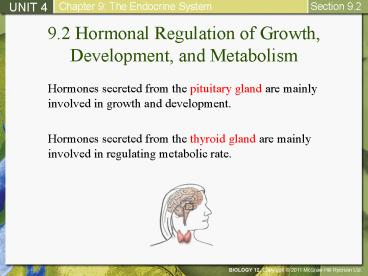
- Hormones secreted from the pituitary gland are
mainly involved in growth and development. - Hormones secreted from the thyroid gland are
mainly involved in regulating metabolic rate.
2
The Pituitary Gland
UNIT 4
Chapter 9 The Endocrine System
Section 9.2
- The pituitary gland has two lobes (posterior
pituitary and anterior pituitary) and is about
the size of a pea (1 cm). It is located below the
hypothalamus at the base of the brain. - The pituitary gland secretes
hormones involved in
the bodys
growth, development, metabolism,
reproduction, and other essential
life
functions.
Continued
3
The Pituitary Gland
UNIT 4
Chapter 9 The Endocrine System
Section 9.2
- The posterior pituitary gland is part of the
nervous system. It stores and secretes the
hormones antidiuretic hormone (ADH) and oxytocin,
which are produced in the hypothalamus.
Continued
4
The Pituitary Gland
UNIT 4
Chapter 9 The Endocrine System
Section 9.2
- The anterior pituitary gland produces and
secretes six major hormones.
5
Human Growth Hormone
UNIT 4
Chapter 9 The Endocrine System
Section 9.2
- The anterior pituitary gland regulates growth,
development, and metabolism through the
production and secretion of human growth hormone
(hGH). This hormone affects almost every body
tissue. - Growth factors from the liver and hGH
increase the following
processes
- protein synthesis
- cell division and growth
- breakdown and release
of fats in adipose tissue
The targets of hGH include the liver, muscle
cells, and bone cells.
Continued
6
Human Growth Hormone
UNIT 4
Chapter 9 The Endocrine System
Section 9.2
- Human growth hormone stimulates the growth of
muscles, connective tissue, and bones. - If the pituitary gland secretes
excess amounts of hGH
during childhood, it can result
in gigantism.
Insufficient
hGH production results in
pituitary
dwarfism.
(A) The worlds tallest man stands 2.36 m in
height. His wife is 1.68 m tall. (B) People with
pituitary dwarfism have typical body proportions.
Continued
7
Human Growth Hormone
UNIT 4
Chapter 9 The Endocrine System
Section 9.2
- Overproduction of hGH in adulthood can lead to
acromegaly. Since skeletal growth has been
completed in adulthood, hGH can no longer cause
an increase in height. Instead, there is widening
of the bones and soft tissues of the body.
Acromegaly results from excessive production of
hGH during adulthood. It may be difficult to
diagnose the condition in the early stages before
a persons appearance noticeably changes.
8
The Thyroid Gland
UNIT 4
Chapter 9 The Endocrine System
Section 9.2
- The thyroid gland is known as a metabolic
thermostat because the hormones it secretes
regulate metabolic rate.
The thyroid gland lies below the larynx and has
two lobes. It produces and secretes thyroxine
(T4), a hormone that increases the rate at which
the body metabolizes fats, proteins, and
carbohydrates for energy. Thyroxine stimulates
cells in the heart, skeletal muscles, liver, and
kidneys to increase cellular respiration.
Continued
9
The Thyroid Gland
UNIT 4
Chapter 9 The Endocrine System
Section 9.2
- Low production of thyroxine is called
hypothyroidism and can result in cretinism.
Individuals with cretinism are stocky and shorter
than average. Hormonal injections are required in
childhood so that mental development delays do
not occur. Adults with hypothyroidism experience
fatigue and weight gain due to a slow metabolism. - Overproduction of thyroxine is called
hyperthyroidism. Symptoms include anxiety,
insomnia, and weight loss. It can result in
Graves disease, where the immune system attacks
the thyroid gland. Hyperthyroidism can be treated
with medication or removal of part of the thyroid
gland.
Continued
10
The Thyroid Gland
UNIT 4
Chapter 9 The Endocrine System
Section 9.2
- Thyroxine secretion is controlled by negative
feedback.
(1) The hypothalamus secretes a releasing hormone
that stimulates the anterior pituitary gland. (2)
The anterior pituitary releases TSH into the
bloodstream. (3) TSH targets the thyroid
gland. (4) TSH causes the thyroid to secrete
thyroxine into the bloodstream. Thyroxine
stimulates increased cellular respiration in
target cells throughout the body. (5) High levels
of thyroxine cause negative feedback on the
pituitary and hypothalamus, shutting down
production of TSH.
Continued
11
The Thyroid Gland
UNIT 4
Chapter 9 The Endocrine System
Section 9.2
- The thyroid gland requires iodine to make
thyroid hormones. If there is insufficient iodine
in the diet, thyroxine cannot be made, and there
will be no signal to stop TSH secretion. Constant
stimulation of the thyroid gland by TSH causes a
goitre, which is an enlargement of the thyroid
gland. - In Canada, it is uncommon for people to have
goitres because iodine is added to table salt.
Other dietary sources of iodine include seafood
and dairy products.
12
The Parathyroid Gland andCalcium Homeostasis
UNIT 4
Chapter 9 The Endocrine System
Section 9.2
- Calcium is an essential mineral for nerve
conduction, muscle contraction, skeletal
development, and healthy teeth. Calcium levels in
the blood are regulated in a negative feedback
system by two hormones calcitonin and
parathyroid hormone (PTH). - When blood calcium levels are too high, the
thyroid gland secretes calcitonin to promote
uptake of calcium by the bones.
13
Calcium Homeostasis
UNIT 4
Chapter 9 The Endocrine System
Section 9.2
- When blood calcium levels are low, the
parathyroid glands release PTH. PTH stimulates
bones to break down bone material and secrete
calcium into the blood. - PTH also stimulates the kidneys to reabsorb
calcium from the urine. This activates vitamin D,
which stimulates the absorption of calcium from
the digestive tract.
14
9.3 Hormonal Regulation of the Stress Response
and Blood Sugar
UNIT 4
Chapter 9 The Endocrine System
Section 9.3
- What happens to your body when you experience
stress? - The endocrine system helps you cope with
stressful situations. The stress response
involves many interacting hormone pathways,
including those that regulate metabolism, heart
rate, and breathing.
15
The Adrenal Glands
UNIT 4
Chapter 9 The Endocrine System
Section 9.3
- The adrenal glands are a pair of organs involved
in regulating the stress response and blood sugar
levels. - Each adrenal gland is composed of two layers
- the adrenal medulla (inner layer)
- the adrenal cortex (outer layer)
Each layer produces different hormones and
functions as an independent organ.
16
The Adrenal Medulla Regulating the Short-Term
Stress Response
UNIT 4
Chapter 9 The Endocrine System
Section 9.3
- The adrenal medulla secretes two hormones
epinephrine and norepinephrine. - These hormones regulate a short-term stress
response that is also known as the
fight-or-flight response. In response to a
stressor, the following events occur in the
short-term stress response
- Neurons in the sympathetic nervous system carry a
signal from the hypothalamus to the adrenal
medulla.
Continued
17
The Hormones of the Pancreas
UNIT 4
Chapter 9 The Endocrine System
Section 9.3
- The pancreas functions in both the digestive and
endocrine systems. There are over 2000 clusters
of endocrine cells, called the islets of
Langerhans, scattered throughout the pancreas.
These cells secrete the following hormones
- insulin (secreted by beta cells) lowers blood
glucose by making target cells more permeable to
glucose - glucagon (secreted by alpha cells) increases
blood glucose by stimulating the liver to convert
glycogen to glucose
Both hormones are regulated by negative feedback
loops.
Continued
18
The Hormones of the Pancreas
UNIT 4
Chapter 9 The Endocrine System
Section 9.3
(A) The silhouette shows the location of the
pancreas in the human body. (B) A close-up view
of the pancreas shows one of the many islets of
Langerhans on the surface of the pancreas.
Continued
19
The Hormones of the Pancreas
UNIT 4
Chapter 9 The Endocrine System
Section 9.3
Negative feedback regulates blood glucose levels
within a very narrow range.
20
The Effects of Glucose Imbalance
UNIT 4
Chapter 9 The Endocrine System
Section 9.3
- Diabetes mellitus is a condition that results
when the body does not produce enough insulin or
does not respond properly to insulin. Glucose
stays in the blood after meals instead of
entering the cells as blood glucose levels rise
after meals and stay high, the result is high
blood sugar (hyperglycemia). - Without glucose inside the cells, an individual
becomes fatigued and begins using fat and protein
for metabolic energy. The kidneys cannot reabsorb
the excess glucose, so glucose is excreted in the
urine. Over the long term, permanent damage
occurs to the eyes, nerves, and kidneys. Severe
infection (gangrene) can occur in the limbs.
21
Causes of Diabetes
UNIT 4
Chapter 9 The Endocrine System
Section 9.3
- There are two major types of diabetes
- Type 1 The immune system attacks and destroys
the insulin-producing beta cells in the pancreas.
People with type 1 diabetes are diagnosed in
childhood and need daily insulin injections. - Type 2 Insulin receptors on the bodys cells
stop responding to insulin. People who are
overweight have a greater chance of developing
this condition. It is usually diagnosed in
adulthood and can be controlled with diet,
exercise, and oral medications.
A light micrograph of pancreatic beta cells from
someone with type 1 diabetes. Many of the beta
cells have been destroyed, leaving behind only
non-beta cells (stained purple), and so the islet
is malformed.
22
Toward a Cure for Diabetes
UNIT 4
Chapter 9 The Endocrine System
Section 9.3
- In 1921, Canadian scientists Frederick Banting
and Charles Best were the first to isolate
insulin and use it successfully to treat a person
with diabetes. - Today, transgenic bacteria are used to produce
synthetic insulin in large quantities for
diabetes treatment. Successful islet cells
transplants have also been performed to restore
beta cell function.
A continuous blood glucose monitor and insulin
pump. The pump releases small amounts of insulin
throughout the day, which minimizes the need for
insulin injections.
Recommended

