

ORegAnno: Open Regulatory Annotation (www.oreganno.org) PowerPoint PPT Presentation
1 / 1
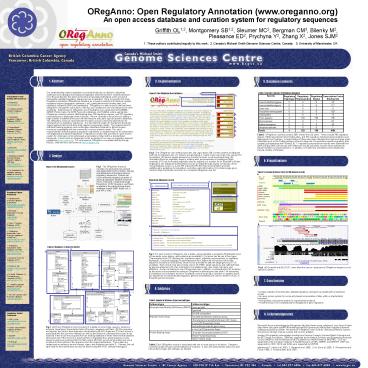
Title: ORegAnno: Open Regulatory Annotation (www.oreganno.org)
1
ORegAnno Open Regulatory Annotation
(www.oreganno.org) An open access database and
curation system for regulatory sequences
Griffith OL1,2, Montgomery SB1,2, Sleumer MC2,
Bergman CM3, Bilenky M2, Pleasance ED2, Prychyna
Y2, Zhang X2, Jones SJM2
1. These authors contributed equally to this
work 2. Canadas Michael Smith Genome Sciences
Centre, Canada 3. University of Manchester, UK
1. Abstract
3. Implementation
5. Database contents
Our understanding of gene regulation is currently
limited by our ability to collectively synthesize
and catalogue transcriptional regulatory elements
stored in scientific literature. Over the past
decade, this task has become increasingly
challenging as the accrual of biologically-validat
ed regulatory sequences has accelerated. Here,
we present the Open Regulatory Annotation
(ORegAnno) database as a dynamic collection of
literature-curated regulatory regions (promoters,
enhancers, etc), transcription factor binding
sites, and regulatory mutations (SNPs and
haplotypes). ORegAnno is a web resource that has
been designed to manage the submission, indexing,
and validation of new annotations from users
worldwide. Submissions to ORegAnno are
immediately cross-referenced to EnsEMBL, dbSNP,
Entrez Gene, the NCBI Taxonomy database, and
PubMed, where appropriate. ORegAnno currently
contains 1804 binding sites, 780 regulatory
regions, and 107 regulatory polymorphisms or
haplotypes from 9 species. We are currently in
the process of adding a large number of
additional records from the literature and public
species-specific databases. The ORegAnno
resource represents the first open-access
community-based forum for annotation of
cis-regulatory sequences. It is also the first
system to incorporate structured experimental
evidence and allow both negative and positive
results. The requirements for sufficient
flanking sequence and verified gene identifiers
(Ensembl or Entrez) ensure maximum compatibility
with the communitys various research needs. This
set of experimentally verified regulatory
sequences represents a valuable resource for
researchers investigating transcriptional
regulation or regulatory variation and provides
an open-access system for continued, community
based accumulation of sites within a standardized
framework. It also forms an integral part in the
evaluation of our own cis-regulatory element
predictions (www.cisred.org). For convenience,
ORegAnno is available directly through MySQL, Web
services, and online at www.oreganno.org.
Table 2. Current contents of ORegAnno database
Figure 3. The ORegAnno User Interface
Species Regulatory Haplotype Regulatory Polymorphism Regulatory Region Transcription Factor Binding Site
Caenorhabditis briggsae 0 0 0 24
Caenorhabditis elegans 0 0 8 117
Danio rerio 0 0 2 0
Drosophila melanogaster 0 0 0 1331
Gallus gallus 0 0 0 13
Homo sapiens 4 103 765 196
Mus musculus 0 0 1 87
Rattus norvegicus 0 0 4 35
Xenopus tropicalis 0 0 0 1
Totals 4 103 780 1804
Transcription Factor Binding Site Resources gt
TRANSFAC www.biobase.de gt Drosophila DNase I
Footprint Database www.flyreg.org gt
Transcription Regulatory Regions Database
(TRRD) www.bionet.nsc.ru/trrd/ gt Transcriptional
Regulatory Element Database (TRED) rulai.cshl.edu/
TRED gt Riken Transcription Factor Database
(TFdb) genome.gsc.riken.jp/ TFdb/ gt
plantCARE intra.psb.ugent.be8080/PlantCARE/ gt
Arabidopsis thaliana Promoter Binding Element
Database (AtProbe) rulai.cshl.edu/cgi-bin/atprobe/
atprobe.pl gt The Arabidopsis cis-regulatory
element database (AtcisDB) arabidopsis.med.ohio-st
ate.edu/AtcisDB/
Table 2. ORegAnno currently contains 2691 entries
from 20 users. These include 780 regulatory
regions, 1804 transcription factor binding sites,
and 107 regulatory mutations (polymorphisms and
haplotypes) from 9 species. A large fraction of
these sites were obtained from previous
large-scale collections such as the FlyReg
resource 2 and a large set of
muscle/liver-specific regulatory sites curated by
Wasserman and Fickett 3,4. 11 regulatory
polymorphism records were obtained from rSNP_DB
5 rSNP_DB records were filtered to include
only those records which pertained to natural
mutations or polymorphisms. In addition, over
200 new annotations were obtained by manual
curation of literature.
2. Design
Fig 3. The ORegAnno user interface provides (A)
Login status (B) Current contents of database
(with link for detailed view) (C) Options to
login/logout or create a new user (login only
required for annotation) (D) Search engine
(powered by Lucene) for basic or advanced
searching (E) Annotation forms for regulatory
regions, binding sites, polymorphisms or
haplotypes (login required) (F) Tools for
locating regulatory sites by sequence or position
for an Ensembl or Entrez target gene (G)
Database downloads/access are available through
regular xml dumps, direct mysql database access,
or a perl API (using SOAP) (H) Help
documentation provides walkthroughs, guidelines
for annotation, and other useful information (I)
A citation page gives credit to major
contributors and links to a complete ORegAnno
user list.
6. Visualizations
Figure 1. The ORegAnno Resource
Fig 1. The ORegAnno resource consists of a
(primarily) Java-based web application for the
curation, storage and distribution of literature
derived regulatory sequences. Entries are
cross-referenced against a number of external
databases (dbSNP, Ensembl, eVOC, Pubmed),
visualized through Ensembl or UCSC browsers, and
freely available to the public through direct
database access (db01.bcgsc.ca), a perl API or
XML.
Figure 5. Genome browser views for ORegAnno
records
A.
Figure4. An ORegAnno record
Regulatory Region Resources gt Hematopoiesis
Promoter Database (HemoPDB) bioinformatics.med.ohi
o-state.edu/HemoPDB/ gt MPromDb Mammalian
Promoter Database rulai.cshl.edu/ CSHLmpd2/ gt
Osteo - Promoter Database (OPD) www.opd.tau.ac.il/
gt Orthologous Mammalian Gene Promoter datababse
(OMGProm) bioinformatics.med.ohio-state.edu/OMGPro
m/ gt Arabidopsis transcription factor database
(AtTFDB) arabidopsis.med.ohio-state.edu/AtTFDB/ gt
Eukaryotic Promoter Database (EPD) www.epd.isb-si
b.ch/ gt PlantProm DB mendel.cs.rhul.ac.uk/mendel.
php gt Promoter Database of Saccharomyces
cerevisiae (SCPD) rulai.cshl.edu/SCPD/ gt C.
elegans promoter database (CEPDB) rulai.cshl.edu/c
gi-bin/CEPDB/home.cgi gt The Liver Specific Gene
Promoter Database rulai.cshl.edu/LSPD/
B.
Figure 2. Database schema for mySQL
Fig 4. For each record in ORegAnno (A) a stable,
unique identifier is assigned (B) Detailed views
of comments, score history, and evidence are
available (C) A record can be one of four types
(Transcription factor (TF) binding site,
regulatory region, regulatory polymorphism, or
regulatory haplotype). Outcome indicates if
experiments proved or disproved a functional role
for the sequence. Ensembl or NCBI Entrez Gene IDs
are provided for both the target gene and TF (if
available). Each record must also include a
taxon ID, PMID, target sequence and sufficient
flank for genome alignment. (D) User information
is available (email, user name, full name, and
affiliation). A user can belong to one of three
roles (user, validator, or administrator) (E)
evidence for the record is documented according
to ORegAnno evidence types (see table 1 for
examples) (F) Validators can validate a record
or invalidate a record by giving it a positive or
negative score (G) Sequences are automatically
mapped to genome coordinates and can be viewed in
UCSC or Ensembl genome browsers.
Fig 5. (A) Ensembl and (B) UCSC views allow the
user to visualize any ORegAnno sequence in its
genomic context.
7. Conclusions
4. Evidence
gt A large collection of functionally-validated
regulatory annotations available with
unrestricted access. gt An open-access system for
community based accumulation of sites within a
standardized framework. gt Incorporates a
structured system for experimental evidence. gt A
useful resource for computational investigations
of gene regulation.
Table1. Sample of Evidence types and subtypes
Evidence type Evidence subtype
Electrophoretic Mobility Shift Assay (EMSA) Direct gel shift
Electrophoretic Mobility Shift Assay (EMSA) Supershift
Electrophoretic Mobility Shift Assay (EMSA) Gel shift competition
Reporter Gene Assay Transient transfection luciferase assay
Reporter Gene Assay Chloramphenicol acetyltransferase (CAT) Assay
Reporter Gene Assay In-vivo GFP Expression Assay
Reporter Gene Assay Dual luciferase reporter gene assay
Reporter Gene Assay In-vivo LacZ Expression Assay
Protein Binding Assay Chromatin immunoprecipitation (ChIP)
Protein Binding Assay DNase Footprinting Assay
Protein Binding Assay Yeast 1-hybrid assay
8. Acknowledgments
Regulatory Variant Resources gt
rSNP_Guide wwwmgs.bionet.nsc.ru/mgs/systems/rsnp/
gt Human Gene Mutation Database
(HGMD) www.hgmd.org/ gt dbQSNP qsnp.gen.kyushu-u.a
c.jp/ gt PromoLign polly.wustl.edu/promolign/main.
html
We would like to acknowledge the Wasserman lab
(http//www.cisreg.ca/tjkwon/), and James Fickett
(http//www.cbil.upenn.edu/MTIR/HomePage.html)
for generously making their regulatory element
catalogues publicly available. We thank the
ORegAnno users for their continuing efforts to
improve this resource through manual curation and
record validation. funding We gratefully
acknowledge funding from Genome Canada, Genome
British Columbia and the BC Cancer Foundation.
SBM was supported by the Natural Sciences and
Engineering Research Council (NSERC) and the
Michael Smith Foundation for Health Research
(MSFHR). OLG was supported by the Canadian
Institutes of Health Research (CIHR), NSERC and
MSFHR. EDP was supported by CIHR. MCS and SJMJ
were supported by MSFHR. references 1. Kelso
et al. 2003 2. Bergman et al. 2005 3. Ho Sui
et al. 2005 4. Wasserman and Ficket. 1998 5.
Ponomarenko et al. 2001.
Fig 2. (A) Every ORegAnno record consists of a
stable id, record type, species, reference,
outcome, target gene, transcription factor (if
known), sequence and flank (B) The sequence and
species are used to derive genomic coordinates by
BLAST alignment (C) Each record is associated
with the user who entered it as well as the
history of comments and scores it has received.
If the record was acquired from an existing
database it will be linked to that datasets
information (D) If the record is a polymorphism
or haplotype the variant sequence is also stored
as well as any external links for that variant
(E) Each record will normally have some evidence
for the function of the sequence from the
original publication. This evidence is
categorized according to several classes, types,
and subtypes (see table 2). If known, the cell
type used for the experiments can also be stored
using the eVOC cell type ontology1.
Table1. Each ORegAnno record is associated with
one or more pieces of evidence. Oreganno
currently contains 9 types and 30 subtypes of
evidence. A user with administrator status can
add new evidence types and subtypes as needed.
Recommended

