

To compare people or things that are equal to PowerPoint PPT Presentation
1 / 13
Title: To compare people or things that are equal to
1
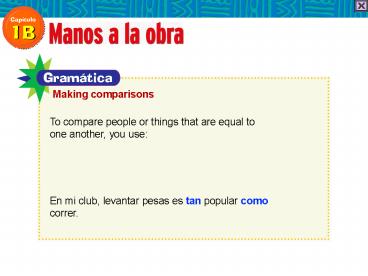
Making comparisons
To compare people or things that are equal to one
another, you use
En mi club, levantar pesas es tan popular
como correr.
2
Making comparisons
To say that things are not equal, you can use the
negative. En el club atlético, levantar pesas no
es tan popular como correr.
3
Making comparisons
To say as much as or as many as, you use
4
Making comparisons
Note that tanto agrees in gender and number with
what is being compared. Hay tantas actrices en
el ensayo como actores.
5
Making comparisons
6
The verbs saber and conocer
You already know the present-tense forms of saber
and conocer. Saber and conocer both follow the
pattern of regular -er verbs in the
present tense, but each has an irregular yo form.
7
The verbs saber and conocer
8
The verbs saber and conocer
Saber means to know facts and information. You
can also use saber with the infinitive of another
verb to say that you know how to do
something. Sabes si tenemos tarea para
mañana? Sabes quién es el director de la
banda? Sé jugar al ajedrez.
9
The verbs saber and conocer
10
The verbs saber and conocer
Conocer means to know a person or to be familiar
with a place or thing. Conoces al profesor de
esta clase? No, no lo conozco. Conoces el club
atlético de la calle Ocho?
11
The verbs saber and conocer
12
Hace time expressions
To ask how long something has been going on,
use Cuánto tiempo hace que present-tense
verb? Cuánto tiempo hace que eres miembro del
club atlético? How long have you been a member of
the athletic club? Cuánto tiempo hace que Uds.
practican con el equipo de básquetbol? How long
have you been practicing with the basketball team?
13
Hace time expressions
To tell how long something has been going on,
use Hace period of time que present-tense
verb Hace más de dos años que soy miembro del
club atlético. Ive been a member of the athletic
club for more than two years. Hace tres semanas
que practicamos con el equipo de
básquetbol. Weve been practicing with the
basketball team for three weeks.
Recommended

