

Strongly correlated materials from Dynamical Mean Field Perspective. PowerPoint PPT Presentation
1 / 37
Title: Strongly correlated materials from Dynamical Mean Field Perspective.
1
Strongly correlated materials from Dynamical Mean
Field Perspective.
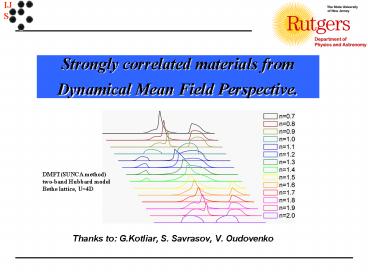
DMFT(SUNCA method) two-band Hubbard model Bethe
lattice, U4D
- Thanks to G.Kotliar, S. Savrasov, V. Oudovenko
2
Overview
- Application of DMFT to real materials (LDADMFT)
- Extensions of DMFT to clusters and its
application to models for high-Tc
3
Dynamical Mean Field Theory
Basic idea of DMFT reduce the quantum many body
problem to a one site or a cluster of sites, in a
medium of non interacting electrons obeying a
self consistency condition. Basic idea of
Spectral density functional approach instead of
using functionals of the density, use more
sensitive functionals of the one electron
spectral function. density of states for adding
or removing particles in a solid, measured in
photoemission
4
Coherence incoherence crossover in a model
Phase diagram of a Hubbard model with partial
frustration at integer filling. M. Rozenberg
et.al., Phys. Rev. Lett. 75, 105-108 (1995). .
5
DFT and DMFT
Density functional theory
observable of interest is the electron density
Dynamical mean field theory
observable of interest is the local Green's
function (on the lattice uniquely defined)
DMFT approximation
exact BK functional
6
Spectral density functional theory
Spectral density functional theory use local
Green's function (spectral function) instead of
local density
observable of interest is the "local" Green's
functions
LDADMFT basic idea sum-up all local diagrams
for electrons in correlated orbitals
LDAU corresponds to LDADMFT when impurity is
solved in the Hartree Fock approximation
7
LDADMFT Calculation
8
weakly correlated
Mott isolator
strongly correlated metal
LDA bandwidth
Coulomb interaction
9
Overview
10
Cerium
11
Ce overview
? isostructural phase transition ends in a
critical point at (T600K, P2GPa) ? ? (fcc)
phase magnetic moment (Curie-Wiess law), large
volume, stable high-T, low-p ? ? (fcc) phase
loss of magnetic moment (Pauli-para), smaller
volume, stable low-T, high-p with large
volume collapse ?v/v ? 15?
volumes exp. LDA LDAU
a 28Å3 24.7Å3
g 34.4Å3 35.2Å3
- Transition is 1.order
- ends with CP very similar to gas-liquid
condesation of water
12
LDA and LDAU
ferromagnetic
volumes exp. LDA LDAU
a 28Å3 24.7Å3
g 34.4Å3 35.2Å3
f DOS
total DOS
13
LDADMFT alpha DOS
TK(exp)1000-2000K
14
LDADMFT gamma DOS
TK(exp)60-80K
15
Photoemissionexperiment
Kondo volume colapse (J.W. Allen, R.M. Martin,
1982)
Fenomenological Landau approach
16
Optical conductivity
K. Haule, V. Oudovenko, S. Y. Savrasov, and G.
Kotliar Phys. Rev. Lett. 94, 036401 (2005)
17
Americium
18
Americium
Mott Transition?
"soft" phase
"hard" phase
A.Lindbaum, S. Heathman, K. Litfin, and Y.
Méresse, Phys. Rev. B 63, 214101 (2001)
J.-C. Griveau, J. Rebizant, G. H. Lander, and
G.KotliarPhys. Rev. Lett. 94, 097002 (2005)
19
Am within LDADMFT
S. Y. Savrasov, K. Haule, and G. KotliarPhys.
Rev. Lett. 96, 036404 (2006)
20
Am within LDADMFT
very different "soft" localized phase from g
Ce not in local moment regime since J0 (no
entropy)
Comparisson with experiment
nf6
nf6.2
J. R. Naegele, L. Manes, J. C. Spirlet, and W.
MüllerPhys. Rev. Lett. 52, 1834-1837 (1984)
"Hard" phase similar to a Ce, Kondo physics due
to hybridization, however, nf still far from
Kondo regime
Different from Sm!
from J0 to J7/2
21
high Tc's
22
Models of high Tc's
cluster in real space
cluster in k space
23
Coherence scale and Tc
24
optics
25
power laws
Nature 425, 271-274 (2003)
26
optics mass and plasma w
Basov, cond-mat/0509307
27
SC density of states
28
Kinetic and Exchange energy
cond-mat/0503073
29
41meV resonance
30
pseudoparticle insights
31
Conclusions
- In many correlated f metals, single site LDADMFT
gives the zeroth order picture - 2D models of high-Tc require cluster of sites.
Optimally doped regime can be well described with
smallest cluster 2x2.
32
Partial DOS
4f
Z0.33
5d
6s
33
More complicated f systems
- Hunds coupling is important when more than one
electron in the correlated (f) orbital - Spin orbit coupling is very small in Ce, while it
become important in heavier elements
The complicated atom embedded into fermionic
bath (with crystal fileds) is a serious chalange
so solve!
Coulomb interaction is diagonal in the base of
total LSJ -gt LS base while the SO coupling is
diagonal in the j-base -gt jj base Eigenbase of
the atom depends on the strength of the Hund's
couling and strength of the spin-orbit
interaction
34
Classical theories
Mott transition (B. Johansson, 1974)
Hubbard model
f electrons insulating
changes and causes Mott tr.
spd electrons pure spectators
Anderson (impurity) model
Kondo volume colapse (J.W. Allen, R.M. Martin,
1982)
hybridization with spd electrons is crucial
(Lavagna, Lacroix and Cyrot, 1982)
changes ? chnange of TK
bath
f electrons in local moment regime
either constant or taken from LDA and rescaled
Fenomenological Landau approach
35
LDADMFT
ab initio calculation
is self-consistently determined
bath for AIM
contains tff and Vfd hopping
Kondo volume colapse model resembles DMFT
picture Solution of the Anderson impurity model
? Kondo physics Difference with DMFT the
lattice problem is solved (and therefore ? must
self-consistently determined) while in KVC ? is
calculated for a fictious impurity (and needs to
be rescaled to fit exp.) In KVC scheme there is
no feedback on spd bans, hence optics is not much
affected.
36
An example
Atomic physics of selected Actinides
37
(No Transcript)
Recommended

