

OBJECTIVES Strategy for Monitoring Post-fire Rehabilitation Treatments PowerPoint PPT Presentation
1 / 13
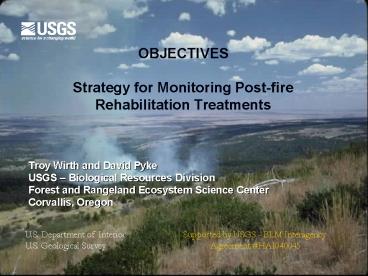
Title: OBJECTIVES Strategy for Monitoring Post-fire Rehabilitation Treatments
1
OBJECTIVESStrategy for Monitoring Post-fire
Rehabilitation Treatments
- Troy Wirth and David Pyke
- USGS Biological Resources Division
- Forest and Rangeland Ecosystem Science Center
- Corvallis, Oregon
U.S. Department of Interior U.S. Geological Survey
Supported by USGS - BLM Interagency Agreement
HAI040045
2
Monitoring Approach
- Objectives
- Stratification
- Control Plots
- Random Sampling
- Data Quality
- Statistical Analysis
- Repeatable, objective field methods using
Rangeland Monitoring Database
3
Objectives
- Objectives are statements of conditions that
result in a successful treatment - Objectives should be clearly defined prior to ESR
treatment implementation - Quantitative
- Measurable
- Attain, increase, decrease a level of a certain
parameter - Compare objective to monitoring data to make a
determination of success
4
Objectives
- Two types of Objectives Management and Sampling
- Management Objectives - set specific goals for a
parameter or ecological condition - Sampling Objectives - set specific goals for the
measurement of the parameter or ecological
condition
5
Management Objectives
- Components of a management objective (From
Elzinga et al. 1998) - Action attain, decrease, increase
- Attribute cover, density, etc.
- Species or Habitat Indicator ARTR2 or shrub
height - Location where the objective applies
- Status numerical goal
- Time Frame when the objective will be met
6
Example Management Objective
- Management Objective Attain (action) a density
(attribute) of perennial native seeded grasses
(species or indicator) in monitoring unit 1
(location) of at least 2.5 plants/m2 (status) by
the end of the third growing season (time frame)
following treatment. - Management Objective Attain 35 cover of native
perennial grasses in monitoring unit 2 by the end
of the third growing season.
7
Sampling Objectives
- Companion sampling objectives are written for
each management objective - Two types Target and change objectives
depending on the action of the management
objective - Target set quantitative objective
- Change change from one time period to another or
difference rather than a quantified target,
expressed as an absolute value or a percentage of
a measured value (control)
8
Sampling Objectives
- Target objectives consist of
- Confidence Level how confident are you that the
true mean lies within the confidence interval - Confidence Interval interval around the
estimated mean where you believe the true mean
lies - Precision ½ confidence interval width
9
Example Target Sampling Objectives
- Obtain estimates of mean number of plants/m2 with
90 confidence (confidence level) that are within
20 (confidence interval width or precision) of
the estimated density (a 0.1, d 0.2) - Estimate the percent cover of bluebunch
wheatgrass with 95 confidence that is within
25 of the estimated cover (a 0.05, d 0.25)
10
Using Target Sampling Objectives
11
Sampling Change Objectives
- Change objectives consist of
- Acceptable Type I and Type II error
- Type I (false-change error)
- Type II (missed-change error)
- Minimum detectable change
- The change that can be detected by the monitoring
effort. Depends on variability in the monitoring
data.
12
Example Sampling Change Objective
- Change Sampling Objective Detect a change
(positive or negative) of 20 (MDC) in the mean
number of plants/m2 with 90 confidence (Type I).
We are also willing to take a 20 chance (Type
II) that we will conclude there is no change when
there was a change.
13
Using Change Objectives
Recommended

