

What the UV SED Can Tell Us About Primitive Galaxies PowerPoint PPT Presentation
1 / 19
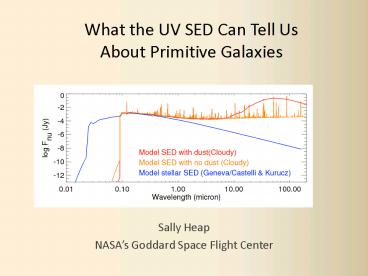
Title: What the UV SED Can Tell Us About Primitive Galaxies
1
What the UV SED Can Tell UsAbout Primitive
Galaxies
- Sally Heap
- NASAs Goddard Space Flight Center
2
Outline of Talk
- The UV SED introduction to b, why b is important
- The challenge interpreting b f(age, Z, Fneb,
dust) - Meeting the challenge using the full SED to
identify the various contributors to b via case
study of galaxy, I Zw 18 - Results of case study
- The full SED is needed to make a quantitative
interpretation of b - Improvements will be possible through
- New stellar evolution/spectra models
- Inclusion of nebular gas dust in model SEDs
3
b is the power-law index in F(l) lb
Calzetti 94
I Zw 18
4
The UV SED is the basis of our knowledge about
very high-redshift galaxies
ACS i ACS z WFC3 Y
WFC3 J WFC3 H
Fl lb bphot 4.29(J125-H160)
-2.77 Age lt 100 Myr Metallicity low Extinction
low LFUV SFR 40 M?/yr M 7.8x10⁸
M?
ff
Finkelstein 10
5
b is sensitive to many factors
- b is sensitive to
- stellar age
- metallicity
- dust extinction
- nebular emission
beta_age_Z.jou
(Duration of Star Fomation)
6
Use the full SED to identify contributors to b
Lya
CII
Stars HII Emission
Dust
7
Use the full SED of I Zw 18 as a test case
H II Region Young,
massive stars H I Envelope
HST/WFPC2 He II F469N OIII F502N Ha F656N
HST/STIS Far-UV
VLA 21-cm with optical image superposed
8
I Zw 18 has been observed at all wavelengths
xray
21cm
(Chandra)
(VLA)
The spectrum reveals MXRBs (xray), stars
(UV-optical), HeIII and HII regions (UVOIR lines
continuous emission), dust (IR), HI envelope
(far-UV, 21 cm)
9
I Zw 18 is similar to high-redshift galaxies
Property I Zw 18 z7-8 Galaxies
Stellar Mass (M?) 2x10⁶ 108 - 109
HI Gas Mass (M?) 2.6x10⁷
Dynamical mass (M?) 2.6x10⁸
SFR (M?/yr) 0.1 10-100
Age of young stars (Myr) Age of older stars (Myr) 15 500? 1000? lt200
Metallicity (Z/Z?) lt 0.03 lt 0.05
Dust low Low
Measured b -2.45 -2.13 (H160lt28.5) -3.07 (H160gt28.5)
10
Phases of Galaxy Formation
- Birth Phase Galaxies affected by
photoionization. - Mhalolt109 M?
- Growth Phase Star formation fueled by cold
accretion, modulated by strong, ubiquitous
outflows. - Mhalolt1012 M?
- Death Phase Accretion quenched by AGN, growth
continues via dry mergers. - Mhalogt1012 M?
R. Dave et al. (2011) Galaxy Evolution Across
Time Conference Star Formation Across Space
and Time, Tucson AZ April 2011
11
Evolutionary phase of I Zw 18 vs. WFC3 z7-8
galaxies
- I Zw 18 is in the birth phase of galaxy
evolution - Dynamical mass (halo mass) lt 109 M?
- No evidence of strong outflows
- Strong stellar ionizing radiation regulating
star formation - Huge HI cloud enveloping optical system
suggesting SF in its early phase - WFC3 z7-8 galaxies are in the growth phase
- Stellar mass 108 M?, so halo mass (Mstar
Mgas DM) must be gt109 M? - High SFR (10-100 M? per year)
- Large (negative) b suggests incomplete
absorption of stellar ionizing radiation - ? HI envelope is perforated, thin, or non
existent - Mass inflow rate (1z)2.25 (Dekel09) so that
SFR is higher in higher-z galaxies of the same
mass - Maximum possible age of stars
Redshift-dependent differences
12
Construct model SEDs to compare with observation
Geneva evolutionary tracks CastelliKurucz
spectral grid Nebular geometry
spherical Dust treatment dust included
Z Age IMF SFH (iSB vs. CSF) Z, grains H
density (HI, HII, H2) Inner radius Outer radius
log NHI21.3
iso_geneva
Model stellar SED
cloudy
Galaxy SED
13
Stellar Models. I. Evolutionary tracks dont
account for rotation
- Rotation is a bigger factor at lower metallicity
(Maeder2001, Meynet2006) - Low-Z stars are more compact, so on average are
born rotating faster - Low-Z stars retain their angular momentum since
their rates of mass-loss are low - Rotational mixing is more efficient at low Z
- Stars rotating above a certain threshold will
evolve homogeneously - Stars evolving homogeneously move toward the
helium MS (higher Teff)
CK 03
Brott et al. (2011) astro-ph 1102.0530v2
14
II. Spectral grids for very hot stars (Teffgt50
kK) are unavailable
UV CMD for
Teff50 kK Teff30 kK
Isochrones for log Z/Zsun-1.7 (Lejeune
Schaerer 2002)
15
III. Spectral grids for massive stars with winds
e.g. WC stars, are unavailable
NW
HST/COS Spectrum of I Zw 18-NW
Izotov97
16
CMFGEN model spectra for low-Z stars are on the
way!
17
Comparison of model SED to observations of I Zw 18
18
Comparison of model UV SED to observations
19
Conclusions
- The spectra of star-forming galaxies near and far
are composite, with contributions from stars, HII
region, HI region, and dust. - The flux contributions of these components are
prominent at different spectral regions - Young, massive stars UV
- Nebular emission near-IR
- Dust thermal IR
- HI cloud absorption (e.g. Lya) and emission
lines (e.g. CII 158 m) - A robust understanding of a star-forming galaxy
requires the full SED - Progress in our understanding of high-redshift
galaxies requires - Evolutionary tracks spectra of very hot stars
(Teffgt50,000 K) at low Z - Inclusion of nebular emission in model SEDs
Recommended

