

Judicial branch of the U.S. government PowerPoint PPT Presentation
1 / 25
Title: Judicial branch of the U.S. government
1
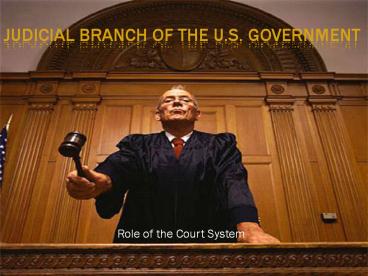
Judicial branch of the U.S. government
- Role of the Court System
2
UEQ and LEQ
- UEQ Where does the Supreme Court derive its
power from? How does the Supreme Court
effectively use its power? - LEQ What is the purpose of having a court system
with different courts? How do criminal cases
differ from civil cases?
3
Vocabulary
- Plaintiff
- Defendant
- Prosecution
- Precedent
- Original Jurisdiction
- Appeal
- Appellate Jurisdiction
4
5 minute mental notes
- Lets see what you already know.
- Individually take the next five minutes and write
down as many things that you can about courts,
judges, juries, or even crimes (types,
punishments, etc.) basically everything you know
about the justice system. - Brainstorming With the other members of your
group, read off your notes, once all members are
finished, as a group come up with a statement
that answers this question, Why do crimes exist
and how do courts deal with crimes?
5
Federal Court system
- The Judicial Branch contains the U.S. Supreme
Court and over 100 other courts, plus hundreds of
smaller courts. - Judges in any court are apart of the government,
however they are nearly free from government
control. - Judicial Branch Courts
6
Courts Main Job
- When happens when an accident occurs?
- Grandmother VS. Mercedes Benz
- Orwhat happens when there is a dispute (fight)
or a crime is committed? - Student Disputes
- Seriously though Nanny Abuse
7
Main job continued
- All courts solve legal conflicts, they apply the
laws to the conflicts and determine punishments. - Courts solve two case types
- Criminal Cases- person breaks a law, court
determines punishment. - Civil Cases- people disagree, court determines
settlement.
8
Criminal case Hacking
9
Civil case trespassing
10
Parties in a civil court case
- plaintiff
- defendant
- Person or group that bring a complaint to court
against another person or group.
- Person or group that the complaint is about and
that defends their side.
11
Suing santa claus civil court case
- Imagine that Santas reindeer get tired of
hauling him around year after year. Their job
security is not good, pay is low, food is stale
and rotten, and living conditions are horrible,
so the nine reindeer decide to sue Santa. - The case would be titled Reindeer v. Santa
- The plaintiffs name is always listed first, the
defendants name is listed second. (Always)
12
Or imaginetheft civil court case
13
Parties in a criminal court case
- Prosecution
- defendant
- Government body that brings a charge against a
person or group who broke a law. - A.K.A The People
- Represented by a lawyer called a prosecutor.
- Person or group that answer a charge.
- Usually an arrested criminal or arrested group
that are brought to trial from prison or jail. - Represented by a lawyer.
14
People of the state of california v. Simpson
- In 1994, then hall of famer OJ Simpson supposedly
killed his former wife Nicole Simpson and her
friend Ronald Goldman. - Due to the mishandling of evidence by police and
falsified claims, after nearly two years in
court, Simpson is found not guilty. - However, in 1997 a civil case is brought
- against Simpson, he is found guilty, and
- required to pay both families 60 million.
- 1995 Simpson Trial
- Breakdown of the Case
15
Members of the Court Judge
- Applies the law to the case and the problem.
- Remains neutral and cannot take sides.
- Judge Judy
- Clip Questions
- With TV courts, do you think judges take sides???
- With TV courts, in your opinion do you think
judges are actually breaking the law??? - The PEOPLE'S Court
16
Members of the court jury
- Most criminal cases require a jury.
- A jury must be of mixed ages and races.
- (What amendment gives you the right to a jury?)
- Why?
- Right guaranteed by the Constitution.
- Illegal to do this in a jury
- Sequestered Jury
- Impossible jury to win against Homer v. The
Devil
17
A one sided juryis it illegal???
18
Civil rights era jury
19
Going through the minds of a jury
20
Interpreting the law
- Gun Control Laws Do they mean control or ban all
guns??? - All courts must decide what a law means and
how/can it be used in only one case or multiple
cases. - Once a court decides on how to use a law and
decides a case, the court sets precedent. - Guideline for how all future similar cases should
be decided. - Example In Brown v. Board of Education, the
Supreme Court said and made segregation illegal,
all future laws that segregated were made illegal.
21
Law Books and codes today
22
Compare and contrast State and federal courts
- Using the graphic organizer that I have given you
and pages 269-270 in your textbook, fill in the
graphic organizer so that you can see how state
and federal courts are similar but different. - On the back of the graphic organizer or somewhere
in your notes, list the steps for the appeal
process of a court case. The information on the
appeal process is mixed in between pages 269 and
270, begins under jurisdiction.
23
Two kinds of courts
- State courts
- Federal courts
- Most cases begin here.
- Multi-purpose courts. (traffic court, juvenile
court) - Have original jurisdiction- can hear a case
first. - Usually only have a judge but can have a jury
present.
- Decisions in cases can affect the country for
years. - If a case is decided, a person can appeal- ask a
higher federal court to look at the case. - Have appellate jurisdiction- authority to hear an
appeal. - Hear cases beyond state authority.
- Appealing a Court Case
24
Differences appeal court and regular court
- In an appeal court, no trial is held, the court
only reviews the case. - Determines if the law was used and applied
fairly. - After determination, two things can be done
- Decision of lower court is upheld.
- Decision of lower court is reversed.
- Your Opinion If a new case is held, wouldnt
this still be considered double jeopardy??? - Case can continue to be appealed until it reaches
the state supreme court. (final court)
25
Law and Court case review (20 points)
- In St. Louis County, Missouri, a judge ruled that
the county could keep people under the age of 17
from buying, renting, or playing violent video
games without parental consent. The Interactive
Software Association argued that video games have
First Amendment protection, just like movies and
books. However, the judge would later rule that
video games are not a form of speech protected by
the First Amendment. - What constitutional right is at stake here?
- Can video games be considered a form of
expression like books and movies? How So/How Not
So? Explain. - Do you think people under 18 should be restricted
from playing violent video games? Why/Why Not?
Give an example and explain. - Which group in the case could appeal the
decision? What kind of decision do you think the
appeal court could make?
Recommended

