

Early Stages of the French Revolution PowerPoint PPT Presentation
1 / 16
Title: Early Stages of the French Revolution
1
Early Stages of the French Revolution
2
Objectives
- Explain how the political crisis of 1789 led to
popular revolts. - Summarize the moderate reforms enacted by the
National Assembly in August 1789. - Identify additional actions taken by the National
Assembly as it pressed onward. - Analyze how other European nations reacted to the
events unfolding in France.
3
Terms and People
- factions dissenting groups of people
- Marquis de Lafayette the leader of the National
Guard, a largely middle-class militia fought
alongside George Washington in the American
Revolution - Olympe de Gouges a journalist who believed that
the Declaration of the Rights of Man should grant
equal citizenship to women - Marie Antoinette Austrian-born queen of France
Louis XVIs wife
4
Terms and People (continued)
- émigré a person who flees his or her country
for political reasons - sans-culottes working-class men and women who
made the French Revolution more radical - republic system of government in which
officials are chosen by the people - Jacobins members of a revolutionary political
club made during the French Revolution
5
What political and social reforms did the
National Assembly institute in the first stage of
the French Revolution?
The members of the National Assembly voted to end
their own privileges after the storming of the
Bastille. From providing equal rights to all male
citizens before the law, to the abolishment of
their exclusion from taxes, the National Assembly
aimed to change an unjust system.
6
Historians have divided the period of the French
Revolution into four different phases.
National Assembly France became a constitutional monarchy
Reign of Terror A radical phase with escalating violence End of the monarchy
Directory A period of reaction against extremism
Age of Napoleon Consolidation of many changes A period of war throughout Europe
7
The political crisis of 1789 in France coincided
with the worst famine in memory.
- Rumors were rampant and created panic.
- During the period known as the Great Fear,
peasants believed that government troops were
seizing their crops. - Believing that nobles were trying to reinstate
medieval dues, peasants stole grain and set fire
to old manor records. - Although the violence died down, peasant anger
against the ancient regime remained high.
8
In Paris, the revolutionary center of France,
several factions competed for power.
National Guard Moderate Led by the Marquis de Lafayette A mainly middle-class militia
Paris Commune Radical Replaced the royalist government of Paris Mobilized violent action for the revolution
9
The National Assembly reacted to the uprisings
and voted to end the privileges of the nobility.
- Nobles gave up old manorial dues and exclusive
hunting rights. - Nobles ended their special legal status and their
exemptions from paying taxes. - The assembly enacted the equality of all male
citizens before the law.
10
At the end of August, 1789, the National Assembly
issued the Declaration of the Rights of Man and
the Citizen.
Free and equal rights for all men
Natural rights for all men
Equality before the law for all men
Freedom of religion for all citizens
Taxes levied fairly for all citizens
Modeled after the American Declaration of
Independence, it announced
11
The Declaration of the Rights of Man did not
please everyone.
Women such as Olympe de Gouges called for equal
citizenship for women.
12
Some 6,000 women marched on Versailles on October
5, 1789.
- They were angry about the famine resented Queen
Marie Antoinette, who lived a life of luxury - They demanded to see the king.
- The women brought the king and queen to Paris,
where they lived as virtual prisoners.
13
The National Assembly placed the Church under
state control.
It dissolved convents and monasteries. It ended
papal authority over the French Church. The Civil
Constitution of the Clergy made bishops and
priests elected, salaried officials.
This move was condemned by the pope, many bishops
and priests, and large numbers of French peasants.
14
The National Assembly produced the Constitution
of 1791. This set up a limited monarchy.
- Make laws
- Collect taxes
- Decide on issues of war and peace
- The new Legislative Assembly had the power to
Moderate reformers considered that the
Constitution of 1791 completed the French
Revolution.
15
At the time of the creation of the Constitution
of 1791, Louis XVI and Marie Antoinette attempted
to escape France.
As French émigrés spread fear of revolution in other nations, France prepared for war.
To many, this attempt meant that Louis was a
traitor to the revolution. The emperor of Austria
and king of Prussia signed the Declaration of
Pilnitz supporting Louis and threatening to
intervene.
16
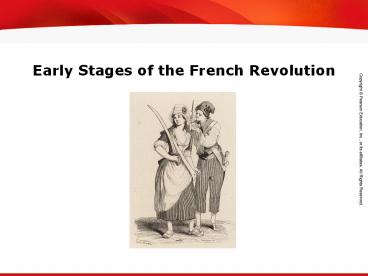
The sans-culottes and the Jacobins pushed the
revolution to more radical action.
- Sans-culottes demanded a republic and an end to
monarchy. - Jacobins gained the upper hand in the Legislative
Assembly and declared war on Austria, Prussia,
Britain, and other states. - Fighting began in 1792 and lasted on and off
until 1815.
Sans-culottes
Recommended

