

Effects of Music and Feedback on Psychophysiological Responses to Running PowerPoint PPT Presentation
1 / 1
Title: Effects of Music and Feedback on Psychophysiological Responses to Running
1
Effects of Music and Feedback on
Psychophysiological Responses to Running
Jasmin Hutchinson, Ph.D. Springfield College,
Springfield, MA.
Introduction Research evidence suggests that
appropriately selected music can influence a
range of dependent variables during exercise. The
most consistent finding seems to be that exercise
endurance, performance perception and perceived
exertion levels are positively influenced by
music versus non-music conditions (Pujol
Langenfeld, 1999). The proposed mechanisms
through which music produces psychophysical
benefits include lowered perceived effort,
arousal control, improved affective states, and a
synchronization effect (Karageorghis Terry,
1997). Recent technologies allow runners to
conveniently tap into the psychophysical effects
of music and performance feedback during
exercise. One such advance is the Nike iPod
sports kit. The Nike system combines music,
delivered via an iPod, with real time performance
feedback. A sensor, worn in the running shoe, and
is coupled with a receiver that attaches to the
iPod. The sensor uses an accelerometer to track
running activity and wirelessly transmits that
data to the receiver. The receiver then transmits
verbal feedback to the runner concerning current
time, current pace, and total distance travelled.
Performance feedback is known to be an
effective strategy to improve athletic
performance and motivation. Research has also
shown that performance feedback can lead to
superior running performances (Oliver
Kreger-Stickles, 2006). Thus the Nike iPod
system represents an interesting device in that
it combines two supposed performance enhancing
applications music and performance feedback.
Objective To assess the combined and
independent effects of music and feedback on
running performance and feelings experienced
during exercise. Hypotheses A combination of
music plus feedback will be associated with
enhanced running performance. Running while
listening to music will be associated with lower
perceived exertion, higher arousal, and more
positive affect and than running without music.
- For the music conditions participants selected
their own preferred music. Music was played
through an Apple iPod Nano and personal
headphones supplied by the experimenter. The iPod
was fitted with a Nike iPod sports kit, which
provided the participant with verbal feedback
during the run regarding pace, distance and time.
Distance feedback was automatically provided at
half-mile intervals, with a countdown in 100m
intervals from 400m until the end of the 2-mile
run. Participants could request additional
feedback at any stage of the run by pressing a
button on the iPod. - Each 2-mile run was completed on a motorized
treadmill (Marquette T2000, location) and
participants were instructed to run at their
preferred pace. Prior to the first run
participants completed a brief familiarization
session on the treadmill, during which time the
Nike iPod system was calibrated to their
running stride. This familiarization session
entailed a 400m run at a comfortable pace. Each
test run was completed under laboratory
conditions at the same time of day, and runs were
all 48 hours apart. The order of the four running
conditions was counterbalanced among subjects.
Participants were not able to view the display
panel of the treadmill during testing, but were
able to adjust the treadmill speed at will. - At ½ mile intervals during the run, including the
end of the run, participants rated the following - Perceived Exertion was measured using a 10-point
Ratings of Perceived Exertion scale (Borg, 1998) - Affective Valance was measured using the Feeling
Scale (FS Hardy Rejeski, 1989). The feeling
scale measures affect on an 11-point scale from
very good (5) through neutral (0) to very bad
(-5). - Perceived Activation/Arousal was measured using
the Felt Arousal Scale (FAS Svebak Murgatroyd,
1985) which is a 6-point scale ranging from low
arousal (1), to high arousal (6). - Immediately after the run the participants also
rated their perceived enjoyment of the run and
the perceived usefulness of the run for their
training purposes on a 0-10 likert scale. The FS
and FAS were also administered 10 min post-run. - Running pace (min per mile) was used as a measure
of performance. - Data were analyzed in SPSS 15.0 using separate
repeated measures ANOVAs
Conclusions As expected, and consistent with
other research in the area, participants reported
more positive affect and increased arousal in the
conditions where music was present compared to
control conditions. Interestingly, performance
feedback had virtually the same effect as music
when it came to arousal and affect. The presence
of music had the greatest positive effect on the
perceived usefulness of the run, regardless of
the presence of feedback, although feedback was
percieved as more useful than none. Regarding
enjoyment of the run, music plus feedback was
preferred, but feedback alone was as strong a
factor as music alone. These findings point to a
potentially important role of real-time
performance feedback on various psychological
factors experienced during running. These
findings also support the arousal control and
improved affective valance theories of the
psychophysical effect of music on performance
(see Karageorghis Terry, 1997). The argument
for reduced percieved exertion was not supported,
but given that intensity was not standarized
across conditions (indeed, particpants were
working harder with music) this is
unsurprising. Running performance was superior
in the music plus feedback condition, followed by
the music only condition. This is consistent with
other research that indicates that music has a
positive influence on running performance. The
addition of coincident performance feedback
appears to enhance this effect. While these
results fell just short of statistical
significance (p .06), a difference in running
time from 855 min per mile (C) to 817 min per
mile (MF) would likely be of high practical
significance to a runner. Further research
examining the effect is warranted. Particularly,
one might want to pay attention to task
motivation as a factor that is influenced by both
music and performance feedback.
When examined across all conditions, arousal
shows significant positive quadratic curvature
over time F(1, 12) 27.80, p lt .00, ?2 .70
while affective valance demonstrates a
significant negative quadratic trend over time,
F(3, 36) 15.73, p lt .00, ?2 .57.
References Borg, G. (1998). Borgs perceived
exertion and pain scales. Champaign, IL Human
Kinetics. Hardy, C.J., Rejeski, W.J. (1989).
Not what, but how one feels The measurement of
affect during exercise. Journal of Sport and
Exercise Psychology, 11, 304-317. Karageorghis,
C. I., Terry, P. C. (1997). The psychophysical
effects of music in sport and exercise A review.
Journal of Sport Behavior, 20(1), 54-68. Oliver,
N., Kreger-Stickles, L. (2006). Enhancing
exercise performance through real-time
physiological monitoring and music A user study.
Pervasive Health Conference and Workshops (First
International Conference on Pervasive Computing
Technologies for Healthcare) (IEEE Cat No.
06EX1728), 122-31. Svebak, S., Murgatroyd, S.
(1985). Metamotivational dominance A multimethod
validation of reversal theory constructs. Journal
of Personality and Social Psychology, 48,
107116. Pujol, T., Langenfeld, A. (1999).
Influences of music on Wingate anaerobic test
performance. Perceptual Motor Skills, 88(1),
292296.
- Method
- Thirteen recreationally active male and female
participants (M age 23.53, SD 4.53)
volunteered for the study. Participants completed
four 2-mile runs under different conditions using
the Nike iPod system - Music and feedback (MF)
- Music only (MO)
- Feedback only (FO)
- Control no music or feedback (C)
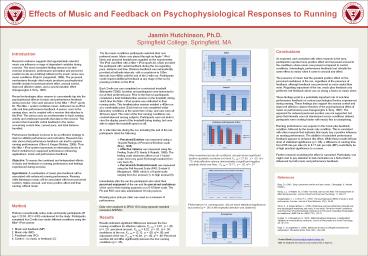
Performance (i.e. running pace), did not reach
statistical significance, but a trend (p .06)
in the expected direction was observed.
Results Results indicated significant differences
between the four running conditions for affective
valance, F(3, 36) 3.01, p lt .05, ?2 .23
perceived arousal, F(3, 36) 5.22, p lt .01, ?2
.30 usefulness of the run, F(3, 36) 12.12,
p lt .00, ?2 .50 and enjoyment of the run, F(3,
36) 10.04, p lt .00, ?2 .46. Perceived
exertion did not differ significantly between the
four running conditions (p .35).
Contact Email jhutchinson_at_springfieldcollege.edu
Note No funding for this research was provided
by Nike or Apple Inc.
Recommended

