

Methods to manipulate a collection of values under one name. PowerPoint PPT Presentation
1 / 17
Title: Methods to manipulate a collection of values under one name.
1
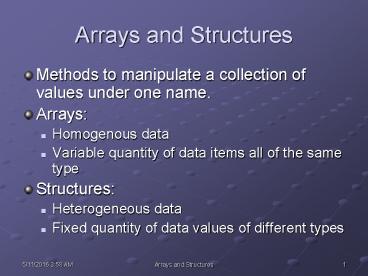
Arrays and Structures
- Methods to manipulate a collection of values
under one name. - Arrays
- Homogenous data
- Variable quantity of data items all of the same
type - Structures
- Heterogeneous data
- Fixed quantity of data values of different types
2
Arrays
- Declaration
- ltdata-typegt ltvar-namegtint-qty
- Access
- ltvar-namegtsubscript
- Subscript
- Integer
- In the range 0 to n-1, where n is the number of
elements
3
Structures
- Definition
- struct ltstruct-namegt // typically in global area
- ltelementsgt. / composed of data types and
element names / - Declaration
- ltstruct-namegt ltvar-namegt
- Access
- ltvar-namegt.ltelement-expressiongt
4
Array Examples
- int counts100 counts0 0
- double speeds2000 speeds1999 1.23
- string names500 cout ltlt Name ltlt
names10
5
Structures Example
- Structures
- struct employee
- string name
- float annual_salary
- int dept_num
- employee boss
- boss.name Bill
- cout ltlt Annual Salary is ltlt boss.annual_salary
ltlt \n
6
Nesting
- An array may be an array of arrays or an array of
structures. - A structure may have arrays as members or other
structures as members. - These arrays or structures may also have arrays
or structures as members, and so forth to any
arbitrary depth.
7
Nesting Example
- struct class
- string time
- string place
- string students30 // structure w/ array
- class schedule5 // array of structures
- schedule0.place Robinson 310
- schedule0.students0 Bill
8
Arrays and For Loops
- For loops are typically used to process arrays.
- Typically when using arrays, the number of
elements that actually contain valid data is
saved in a variable. - for (i0 iltNUM_ELEMENTS i)
- countsi 0
- for (i0 iltn i)
- areai basei heighti
9
Sentinals
- int SENTINEL -1
- Sentinels may also be used
- i 0
- while (speedsi ! SENTINEL)
- cout ltlt speedi ltlt \n
- i
10
Terminology
- Scalars a single data value
- Vectors a one-dimensional array
- Matrices a two-dimensional array
11
Strings
- A string is a array of characters.
- A string literal is delimited by double-quotation
marks. - Examples
- Computer
- special characters in it !_at_\\\
- one
- 1
- NOT strings a, 1, 1, one
12
Another method to do input
- getline(cin, a_string, \n)
- This will accept all input up to a newline
character. It will store the input (NOT the
newline) in a_string. - There are functions to do character-at-a-time
input, as well as other special input functions
(see lecture on streams and files). - In practice, these functions sometimes do not mix
well with cin, with erratic results.
13
Using Strings in C
- include ltstringgt
- Declaring strings
- string name
- string account_number
- Using strings
- Name Bob
- cin gtgt account_number
- whole_name last_name , first_name //
Concatenation - Name_length name.length()
14
Pointers
- A pointer is a variable that contains the address
of another variable, that is, a memory address. - Definition ltdata-typegt ltvar-namegt
- Access ltvar-namegt for the pointer itself
ltvar-namegt for the variable pointed to
(de-referencing).
15
Dynamic Memory
- Three areas of memory
- Global defined outside any function (allocated
once) - Local defined inside a function (allocated on
the system stack) - Dynamic (also known as the heap)
- Accessed through operators new and delete
- To request a section of memory
- ltpntr-vargt new ltdata-typegt
- To access that memory use operators , , -gt
- To return that memory delete ltpntr-vargt
16
Memory Examples
- include ltiostreamgt
- using namespace std
- int g // global visible from here to end of
file - void main()
- float l // local visible from here to end of
block - double h new double // heap allocation
- delete h // heap de-allocation
- int weights new intnum_weights // delete
17
Reading
- Chapter 9
- Chapter 11, Section 1-2
- Chapter 13, Sections 1-2
Recommended

